Kütertor: Stralsund's Medieval Brick Gothic Gate Tower
A Surviving Hanseatic Landmark
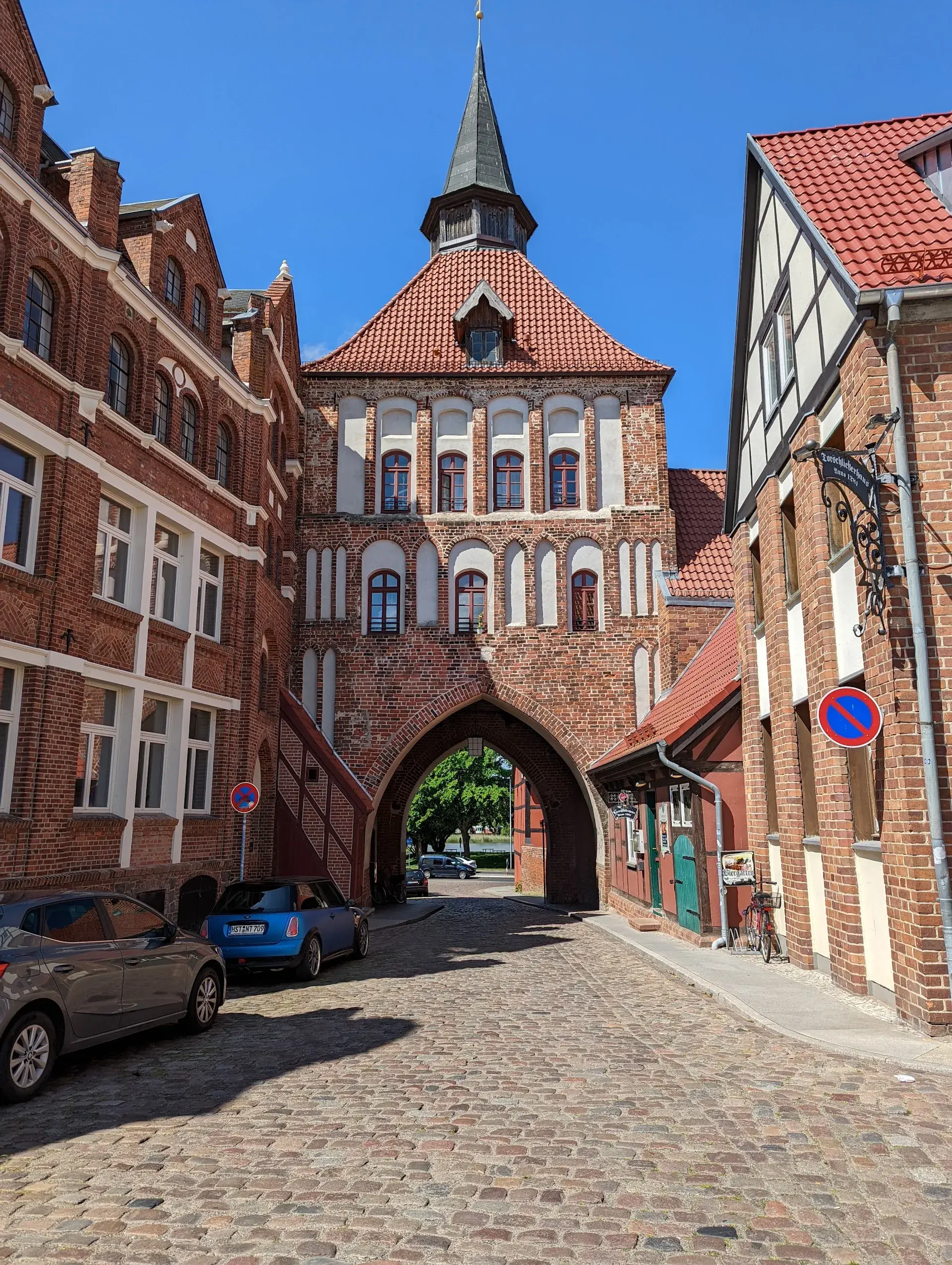
The Kütertor is a 15-meter-high Late Brick Gothic city gate tower located in Stralsund. First documented in 1281 as a simple defensive structure in the town wall, it was rebuilt into its current architectural form in 1446, incorporating the existing masonry.
The structure features a prominent arched gateway, decorative brick blind niches known as Blenden, and a steep hip roof capped by a slender spire. Positioned on the western edge of the Old Town island at the junction of Heilgeiststraße, Bielkenhagen, and Am Kütertor, it is one of only two surviving historic city gates in Stralsund out of an original ten. Today, the tower is a protected monument and forms part of the Historic Centres of Stralsund and Wismar UNESCO World Heritage site.
The Guild of the Offal Butchers
Unlike many medieval structures named for wealthy merchants or prominent families, the Kütertor derives its name from a specialized, working-class guild. The Küter were butchers who processed animal entrails and offal, referred to as Küt in Low German.
The messy nature of this trade, its heavy water requirements, and the resulting foul odors meant these butchers were intentionally concentrated at the city's edge near the inner pond defenses. To control access to the Hanseatic city, a designated gatekeeper resided in the adjacent lodge, the Torschließerhaus, to inspect incoming wagons and secure the town entrance.
Centuries of Reinvention
Over the centuries, the Kütertor underwent an extreme variety of municipal uses. Beyond its initial role as a defensive checkpoint along the landward defense circuit, the gatehouse served as a municipal prison for over 400 years, functioning in this capacity until 1862.
In later years, the tower was integrated into the city’s waterworks system as part of a water tower ensemble. From 1963 to 2003, the gate complex saw an entirely new life when it was repurposed into a youth hostel.
Modern Redevelopment
Following extensive redevelopment between 2012 and 2015, the gate tower and its surrounding historic utility buildings were transformed into a residential complex known as Areal am Kütertor.
The adjacent gatekeeper's house now operates as a rustic restaurant. Meanwhile, the main gateway remains open, serving as an active road and pedestrian passage that connects the medieval Old Town grid with the waterfront promenade and the green ramparts of the Knieperwall.
FAQ
Why is the gate called the Kütertor?
The gate is named after the Küter, a specialized medieval guild of butchers who processed animal entrails and offal (Küt). They were concentrated near the gate due to their trade's heavy water requirements and the foul odors it produced.
How many historic city gates are left in Stralsund?
Out of an original ten medieval city gates that protected the city—five landward and five seaward—only two survive today. The Kütertor is one, and the Kniepertor is the other.
What has the Kütertor been used for throughout history?
Originally built as a defensive checkpoint, the structure later served as a municipal prison for over 400 years until 1862. It was subsequently used as a waterworks facility, operated as a youth hostel from 1963 to 2003, and was redeveloped into a private residential complex between 2012 and 2015.
Discover Stralsund like never before
Dive into Stralsund hidden stories and secret spots with Ciceru interactive tours.
Explore tour
Audioguide
Quizzes
Maps
Solo
Couples
Groups & families

© Photo by Thorsten W. via Google Maps · Google Places