Wulflam House Stralsund: History & Architecture
A Brick Gothic Masterpiece
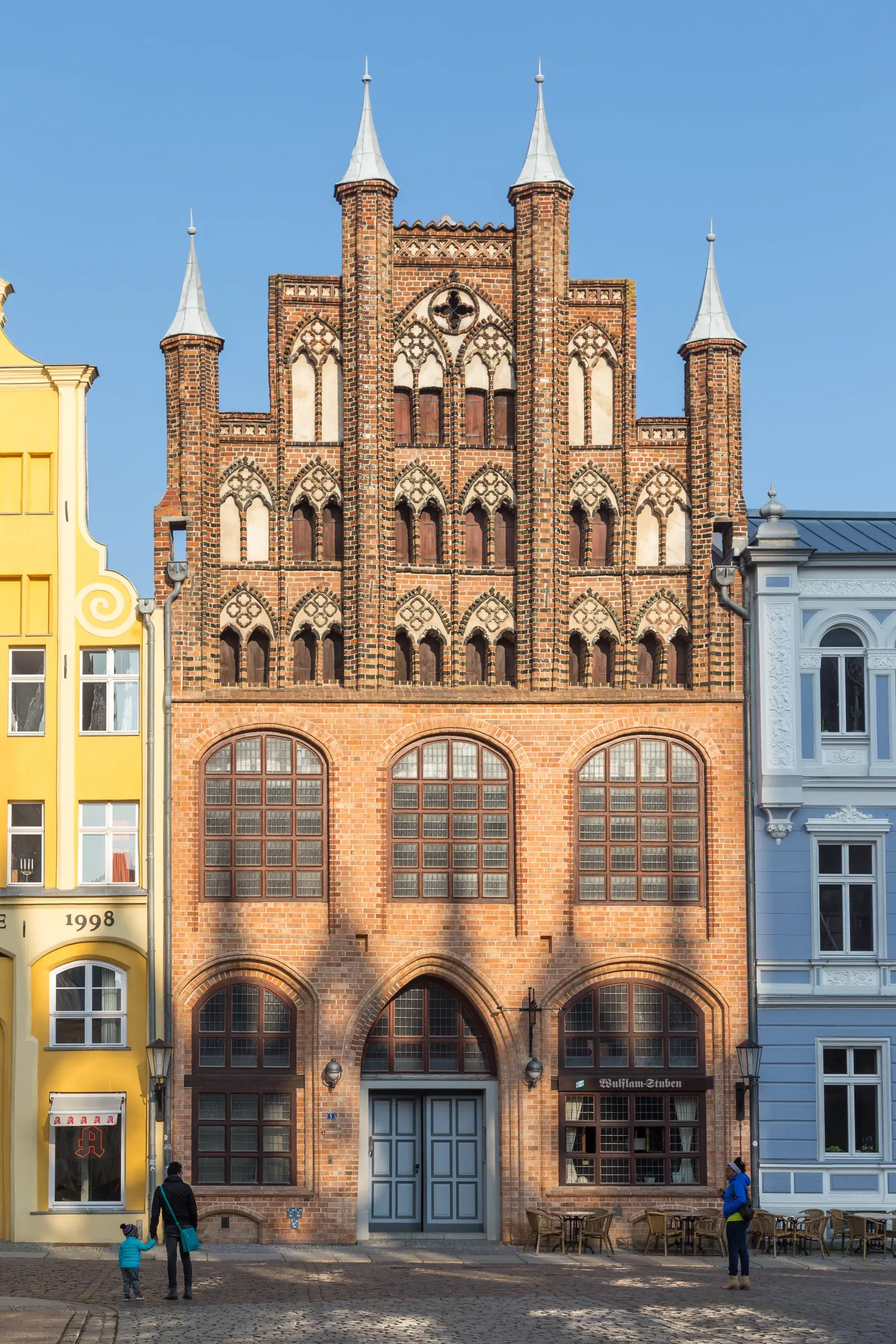
Located at Alter Markt 5 within the UNESCO World Heritage site of Stralsund, the Wulflam House (Wulflamhaus) stands as a monumental example of North German Brick Gothic architecture. Commissioned around 1350 by influential Baltic merchant Bertram Wulflam, this late medieval patrician townhouse was designed to make a political statement. The building features an elaborate screen gable that deliberately mirrors the show-facade of the Stralsund Town Hall directly across the square. This striking design served as a provocative display of private wealth and supremacy long before Wulflam became the city's mayor in 1364.
The exterior of the Wulflam House displays a complex rhythm of alternating warm red clay bricks and dark-glazed decorative bricks. Slender, polygonal brick pillars rise the full height of the gable, framing open pointed arches. The brickwork functions much like a screen, featuring circular rosettes and cutouts near the top that allow daylight and the sky to show directly through the wall. Inside, the historic atmosphere is maintained by massive wooden support pillars known as a Hausbaum, alongside preserved 15th-century fresco fragments located in the upper hall.
The Uncrowned King of the Hanseatic League
Bertram Wulflam grew to become one of the wealthiest merchants in the Baltic, frequently referred to as the "uncrowned king of the Hanseatic League." He successfully brokered the landmark Peace of Stralsund in 1370. However, his governance was highly controversial. For 28 years, Wulflam kept the official municipal money chest stored inside his private residence rather than in the public town council chambers. Accused of autocratic rule and hoarding city funds, he was ousted in a 1391 revolt led by reform councillor Karsten Sarnow and forced into exile in Lübeck.
Exile, Rebellion, and a Macabre Return
The political tide eventually turned when allied Hanseatic cities threatened an economic blockade against Stralsund. The patrician faction reclaimed power, leading to Sarnow's public beheading on the Alter Markt in 1393. Bertram Wulflam died in exile that same year, but his story did not end there. His sons brought his corpse back to Stralsund and propped the lifeless body on the official mayoral seat in the Town Hall opposite the family home. This act was orchestrated to legally and symbolically restore the late mayor's honor prior to his burial.
The Wulflamhaus Today
Today, the Wulflam House continues to serve the city of Stralsund in multiple capacities. The ground floor and courtyard terrace are home to the Wulflamstuben, a traditional restaurant. In the rear courtyard, a 16th-century brewery wing operates as a stage for Theater Vorpommern. Additionally, upper spaces within the building have been utilized for municipal administration offices, maintaining the structure's long-standing connection to civic life.
FAQ
Who built the Wulflam House in Stralsund?
The house was commissioned around 1350 by Bertram Wulflam, a wealthy Baltic merchant and eventual Mayor of Stralsund, as a private residence.
Why does the Wulflam House look like the Stralsund Town Hall?
Bertram Wulflam deliberately designed the building's elaborate screen gable to mirror the Town Hall directly across the square as a provocative statement of his immense private wealth and political power.
What is the Wulflamhaus used for today?
The building houses a traditional restaurant called Wulflamstuben, municipal administration offices, and a performance stage for Theater Vorpommern in its rear 16th-century brewery wing.