Wernigerode Castle: History and the Agnesberg Ascent
Perched above the half-timbered valley town of Wernigerode, Wernigerode Castle (Schloss Wernigerode) forms an imposing landmark on the edge of the Harz mountain range. The complex physically and historically anchors the town, bridging the civic merchant world around the historic Town Hall on the Marktplatz with the aristocratic seat of the Stolberg-Wernigerode dynasty that governed the territory for centuries.
From Medieval Stronghold to Romantic Residence
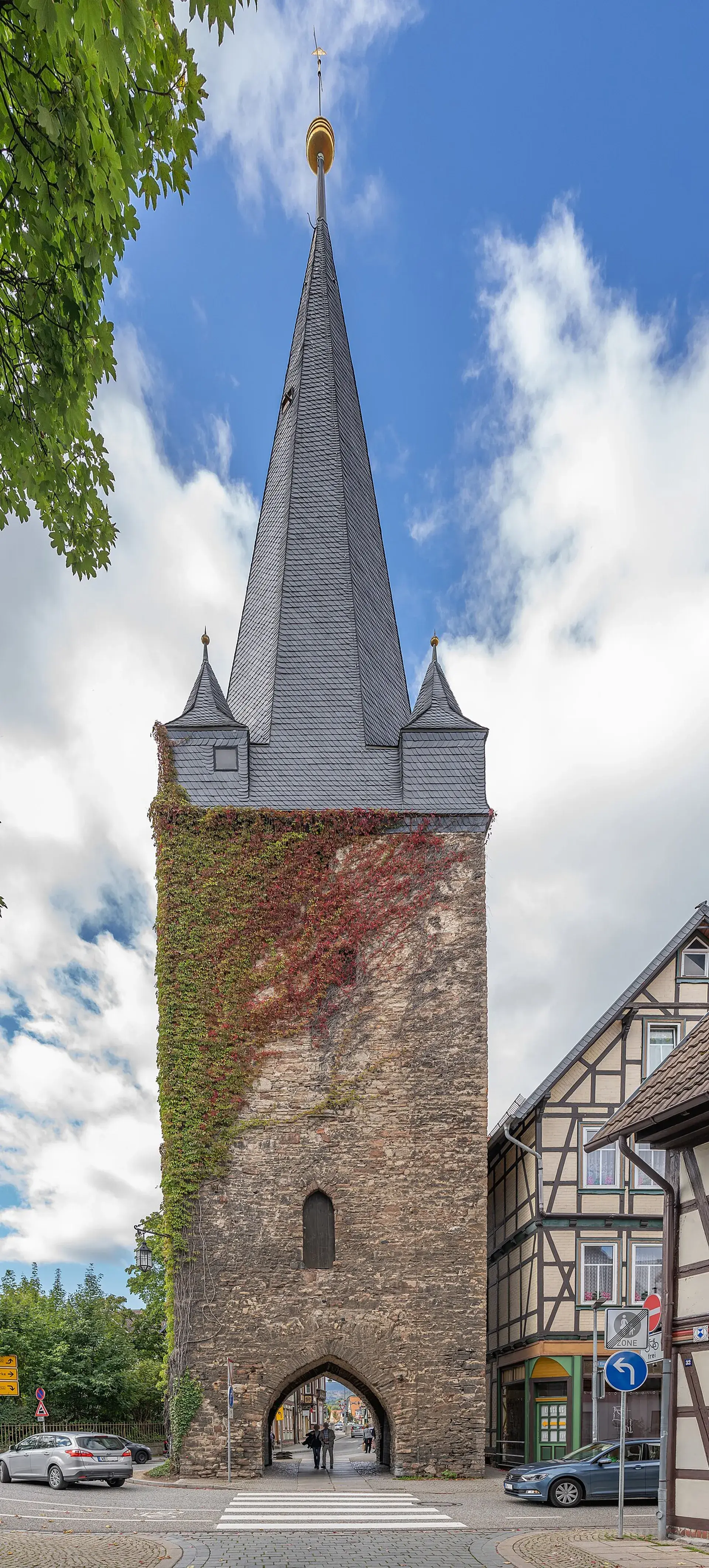
The castle follows the footprint of Castrum Wernigerode, founded during the 12th century by Count Adalbert of Haimar to secure regional mountain and trade routes into the Harz. First documented in 1213, the stronghold was engineered as an impregnable fortress. Its approaches were reinforced by moats, defensive gate structures, and outer kennel walls (Zwinger). Sections of the lower approach incorporated the 13th-century town fortifications, dating from around 1279, which still feature a preserved open-backed half-shell tower (Halbschalenturm).
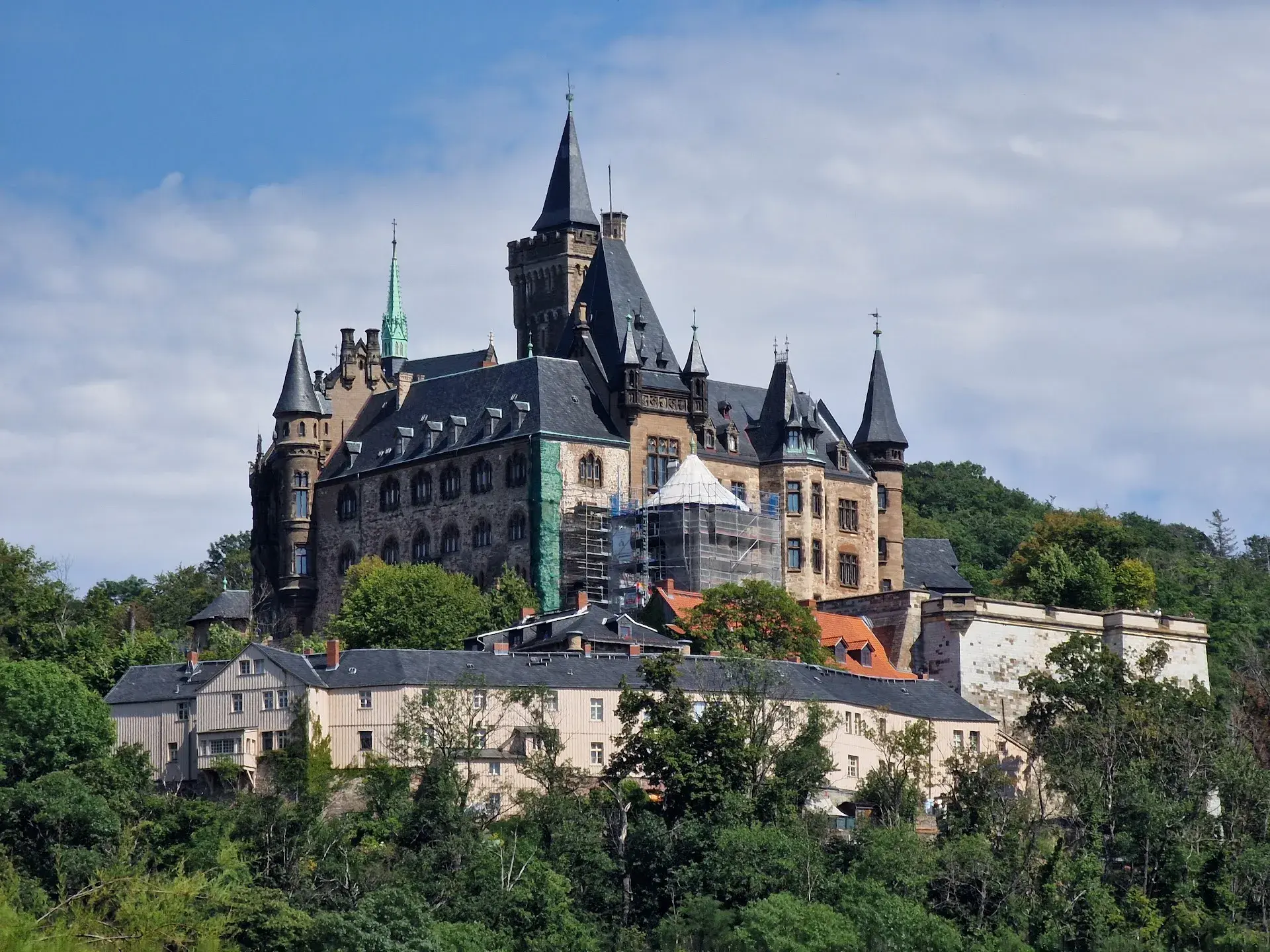
Over subsequent centuries, the fortress changed according to the aesthetic and political desires of its rulers. In the early 18th century, Count Christian Ernst transformed the medieval fortification into a Baroque residential castle. Later, between 1862 and 1893, Count Otto zu Stolberg-Wernigerode commissioned a major reconstruction that reworked the site into a Romantic Historicist complex. This late 19th-century remodel yielded a multi-turreted silhouette of spires and battlements, earning the castle the lasting moniker "Neuschwanstein of the Harz" (Neuschwanstein des Harzes).
Topography and the Ascent to the Agnesberg Spur
Despite visually commanding the valley skyline, Schloss Wernigerode is not built on the absolute summit of the mountain. Instead, it occupies a rocky spur of the Agnesberg at an elevation between 380 and 390 meters above sea level. Directly behind the castle walls, the peak of the Agnesberg rises another 20 meters higher.
The route connecting Wernigerode’s historic center to the castle covers a distance of 1.2 to 2 kilometers, depending on the chosen route, with an elevation gain of 140 to 170 meters. This ascent is notable for its physical intensity, with sections reaching steep gradients of up to 23 percent. The route shifts from civic cobblestone streets to packed gravel paths framed by mature beech and oak trees. As the path climbs, framed views open across the red-tiled roofs and spires of the town below, stretching toward the broader Harz foothills and the Brocken. These forest slopes are frequently punctuated by the distant sounds of steam whistles from the Harz Narrow Gauge Railway in the valley below. For travelers seeking an alternative to the 20- to 35-minute uphill trek, two motorized tourist road-train services—the Wernigeröder Schlossbahn and the Wernigeröder Bimmelbahn—operate regular shuttles between the town and the castle terraces.
Gardens, Trails, and Surrounding Viewpoints
The castle grounds form a central part of the Gartenträume Sachsen-Anhalt ("Garden Dreams") heritage network. This system integrates the Schlossberg terrace gardens with the English- and Baroque-style Lustgarten in the valley and the former princely animal park (Tiergarten).
The historic approach serves as a trail nexus into broader Harz trail systems. Uphill pathways include the Annaweg, which ascends to the Agnesberg crest (stamping point HWN 31 of the Harzer Wandernadel) and provides routes onward to the Christianental wildlife park. Other traditional marked paths on the hillside retain historic local names, such as the Grüner-Käse-Weg (Green Cheese Path). Beyond the castle gates on the Agnesberg lies the Malerblick, a celebrated viewpoint that served as a favored vantage point for 19th-century landscape painter Georg Heinrich Crola and 20th-century artist Bert Heller.
FAQ
Why is Wernigerode Castle nicknamed the 'Neuschwanstein of the Harz'?
The nickname stems from the castle's romantic, multi-turreted silhouette of spires and battlements, which was created during a major Historicist remodeling project led by Count Otto zu Stolberg-Wernigerode between 1862 and 1893.
Is Wernigerode Castle built on the highest peak of the mountain?
No. The castle stands on a rocky spur of the Agnesberg at roughly 380 to 390 meters above sea level, while the true crest of the Agnesberg rises approximately 20 meters higher directly behind the complex.
What motorized transit options are available to reach the castle?
Visitors can take two motorized tourist road-trains: the Wernigeröder Schlossbahn, which departs from the Anger parking area and the Old Chapel, or the Wernigeröder Bimmelbahn, which departs from behind the Town Hall at the Blumenuhr.
What is the Malerblick viewpoint?
The Malerblick ('Painter's View') is a scenic overlook situated on the Agnesberg just past the castle. It was historically favored by landscape artists, including 19th-century painter Georg Heinrich Crola and 20th-century painter Bert Heller.
Discover Wernigerode like never before
Dive into Wernigerode hidden stories and secret spots with Ciceru interactive tours.
Explore tour
Audioguide
Quizzes
Maps
Solo
Couples
Groups & families

© Photo by Sebastian Gropp via Google Maps · Google Places