Westerntorturm: Wernigerode’s Medieval Gate
The Last Gate of Medieval Wernigerode
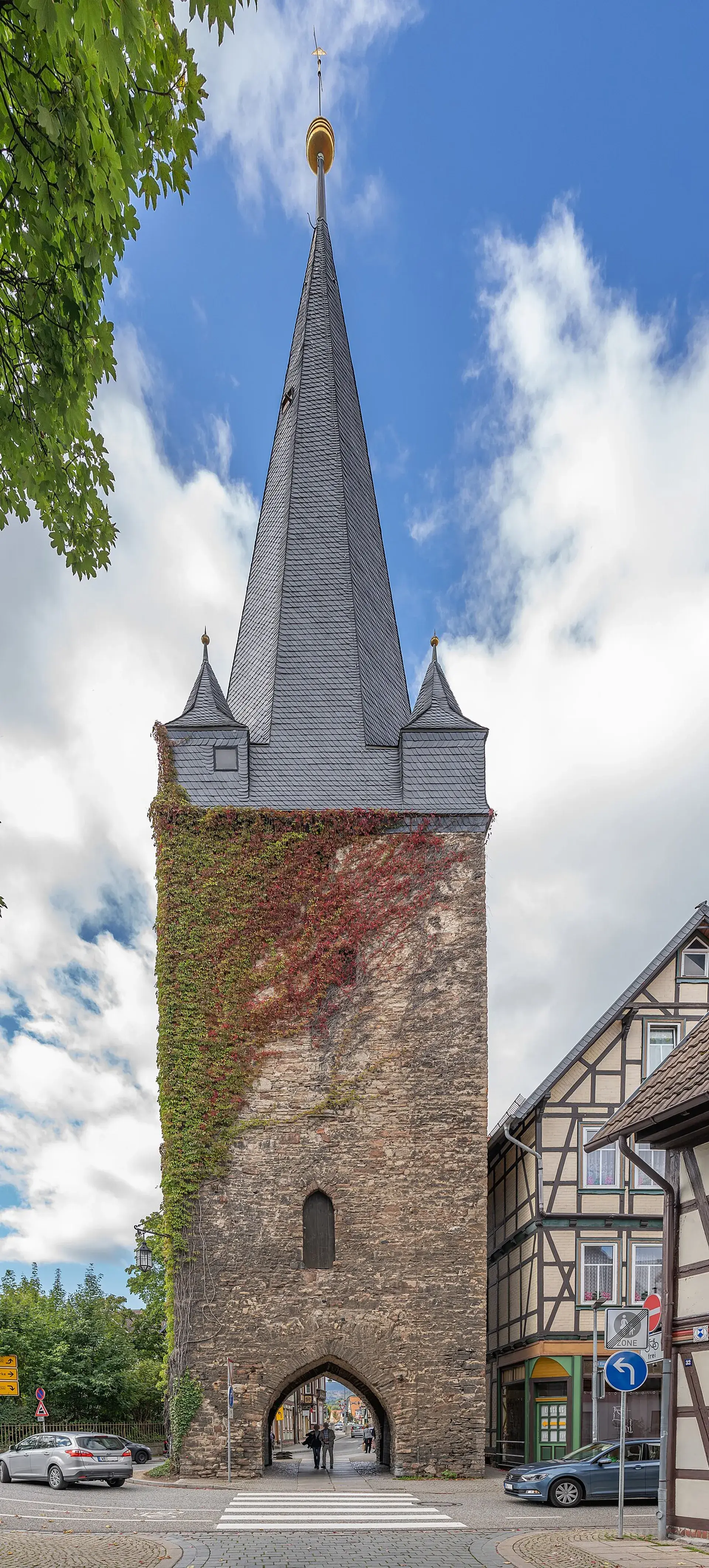
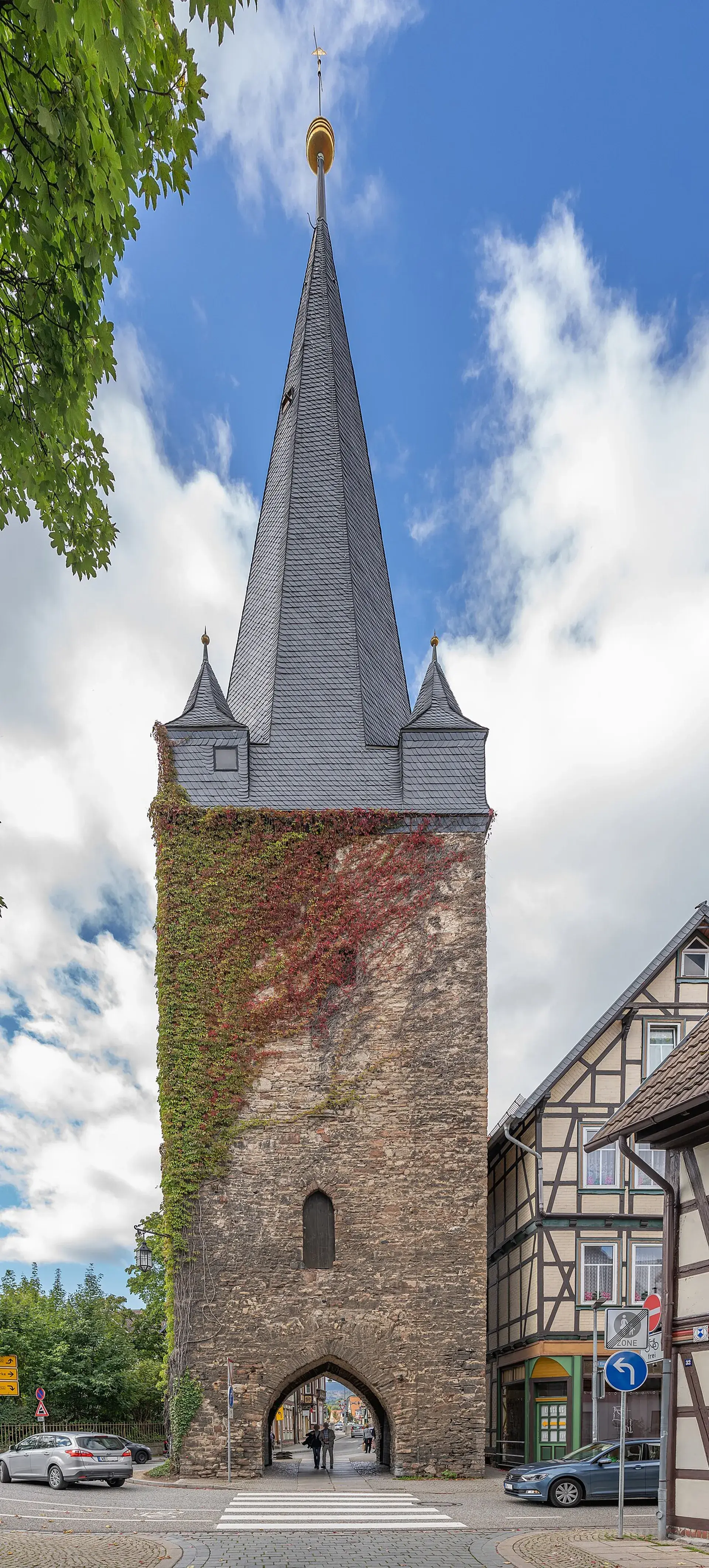
Standing at the western threshold of Wernigerode's historic old town, the Westerntorturm is the sole surviving gate tower of the town's medieval ring wall. Positioned at the western end of Westernstraße, approximately 150 meters from the central Marktplatz, the tower marks the historical entry to the pedestrianized center.
Erected in an early Gothic style, the structure was built from massive stone masonry. It features a pointed-arch passage on the ground level, narrow window embrasures, a clock face, and a steep roof crowned with corner oriels. While historical accounts cite the tower's height as either 38 or 41 meters, an exact survey measures it at 41.18 meters.
Civic Autonomy and Defensive History
The site was first recorded in civic transfer deeds in 1279, when the burghers of Wernigerode purchased fortification rights from the Counts of Wernigerode. This milestone granted the town greater autonomy, allowing municipal authorities to regulate access and levy trade tariffs. In 1356, the structure was specifically documented as a gate tower facility (Toranlage).
At the height of its defensive network, Wernigerode was protected by an enclosed circuit comprising approximately 30 towers and four double-gate installations. The Westerntor originally consisted of an elaborate fortified complex complete with a moat, an outer gate, and a smaller foretower (Vorturm). After town walls lost their military purpose in the 19th century, the city dismantled the surrounding fortifications. The outer gate fell to demolition in 1853, and the foretower was removed after 1865, leaving the primary stone tower standing alone.
The Watchman, the Debtor's Jail, and Local Lore
Beyond housing the municipal watchman (Türmer), the tower once held the town's debtor's jail, known as the Bürgergehorsam. Inside, a designated room with two windows held locals serving short sentences for unpaid personal debts or minor civic offenses.
The tower also accumulated local Harz folklore over the centuries. According to one enduring legend, the town of Wernigerode was founded by two sisters who, terrified of foreign invaders, immured themselves inside the Westerntorturm. They are said to have survived entirely on food hauled up by a rope winch until they eventually died within its walls.
Present-Day Role and Historic Setting
Today, the Westerntorturm is preserved as a protected cultural monument and serves as an open pedestrian passage into the shopping corridor of Westernstraße. The interior is not open as a daily walk-in museum, but its exterior connects the town's medieval core with later industrial milestones.
Passing through the thick stone archway muffles the noise of surrounding streets into an enclosed echo. Just steps outside the medieval masonry, the Harzer Schmalspurbahnen narrow-gauge railway crossing operates regularly, sending steam, train whistles, and coal smoke drifting against the historic stone walls.
FAQ
Can visitors tour the interior of the Westerntorturm?
No, the interior of the tower is not operated as a standard walk-in museum. It serves primarily as a protected landmark and an open pedestrian archway.
How tall is the Westerntorturm?
Historical accounts often list the tower at 38 or 41 meters, while exact architectural surveys record its height at 41.18 meters.
What functions did the tower have besides defending the city?
In addition to housing the city watchman, the tower accommodated a municipal debtor's jail (Bürgergehorsam) where residents served short terms for unpaid debts or minor civic offenses.
Gallery