Grafeneckart: Würzburg's Historic City Hall
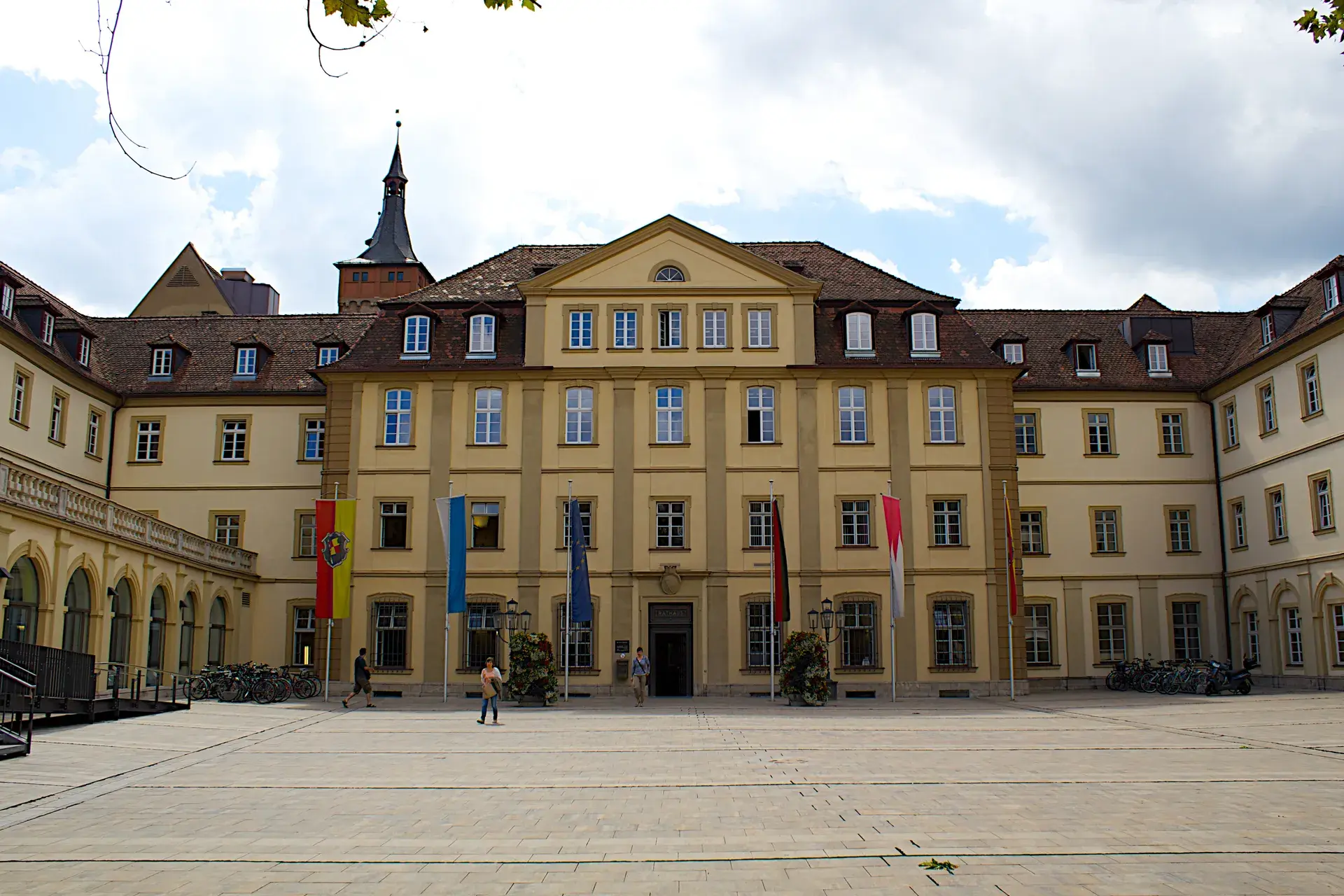
This seemingly unassuming Romanesque tower, the Grafeneckart, stands not as a monument to Würzburg's lavish Prince-Bishops, but as a stubborn symbol of the citizens' long struggle for independence against them. While the Prince-Bishops shaped the city as a theocratic state, the Grafeneckart represents the enduring civic counterbalance to their ecclesiastical and temporal power.
A Symbol of Civic Independence
The Grafeneckart is the oldest part of Würzburg's City Hall complex. It was first documented in 1180 as a residential building known as the curia Billungi. The structure originally served as the seat of an episcopal official, Graf Eckhart de Foro, who was murdered around 1200 and remains the building's namesake.
In a significant act of rebellion against the powerful Prince-Bishops, Würzburg's bourgeoisie purchased the Grafeneckart in 1316. Mayors Arnold vom Sandhof and Ecko von Steren secured the building to establish a town hall and assert the city's autonomy. From 1453 to 1456, the city council expanded the building by raising a 55-meter Romanesque tower. This tower was equipped with fire and storm bells, as well as the city's first public clock. Today, the bells continue to strike quarter-hourly from 7 am to 10 pm. A smaller bell chimes the quarter hours, while a massive 1300-kilogram (26 Zentner) bell marks the hourly strike.
Architectural Evolution and Curiosities
Over the centuries, the complex grew into a distinct blend of architectural styles. The original Grafeneckart retains its medieval and Romanesque elements. Notably, its Wenzelsaal (Wenceslas Hall) survives as one of the few preserved pure Romanesque secular halls in Germany.
To the west, the 'Roter Bau' (Red Building) was added in 1659/60 in the Late Renaissance style, featuring a Renaissance-Volutengiebel designed by architect Wolf Behringer in 1593-94. In the 19th century, a former Baroque Carmelite monastery was integrated into the complex. The side wing known as 'Grünbaum' (Green Tree) draws its name from a lime tree that once stood in the adjacent square. Medieval court proceedings were held beneath this tree, after which the condemned were imprisoned directly in the Grafeneckart's dungeon.
Outside the complex stands the Vierröhrenbrunnen (four-tube fountain), created around 1765 by sculptors L. v. d. Auvera and Peter Wagner.
Resilience Through World War II
The building complex witnessed one of the darkest days in the city's history during World War II. On March 16, 1945, an Allied bombing raid destroyed approximately 90% of Würzburg. Remarkably, the Grafeneckart and the gable front of the Roter Bau endured the devastation.
The survival of the town hall allowed the city council to return to the Roter Bau in 1949, marking a resilient step toward rebuilding civic life. Today, a memorial room on the ground floor of the Grafeneckart is dedicated to the 1945 bombing, featuring a detailed scale model of the destroyed city. Outside, historical flood markers on the entrance of the Roter Bau document past water levels, recording the natural challenges the building has also faced.
The Grafeneckart Today
Today, the Grafeneckart functions as a primary administrative building, housing various civic offices and council chambers. The historic Wenzelsaal remains a popular venue for civil weddings.
The interior features significant artwork, including monumental frescoes in the new council hall by Wolfgang Lenz. Historical frescoes depicting Charles IV granting city rights to Würzburg, as well as a scene from the Peasant's War, adorn the Rathaus complex. Some of these works are attributed to Giovanni Battista Tiepolo and his son Domenico, who stayed in the city between 1750 and 1753.
The main building's Grünbaum wing hosts the Ratskeller restaurant, which serves local Franconian cuisine. Free public tours of the Rathaus operate from May to October, taking place every Saturday at 11 am and lasting 1.5 hours. Additionally, access to the top of the tower provides panoramic views of Würzburg for a fee.
FAQ
What is the Grafeneckart used for today?
The Grafeneckart serves as a primary administrative building for the city of Würzburg. It houses civic offices, a memorial room for the 1945 bombings, the historic Wenzelsaal used for civil weddings, and the Ratskeller restaurant.
Why is the building called the Grafeneckart?
The building is named after Graf Eckhart de Foro, an episcopal official who was the original resident of the building before he was murdered around the year 1200.
Did the Grafeneckart survive the bombing of Würzburg?
Yes. While the Allied bombing on March 16, 1945, destroyed approximately 90% of Würzburg, the Grafeneckart and the gable front of the adjacent Roter Bau remarkably survived the destruction.
What architectural styles can be found in the City Hall complex?
The complex is a blend of several styles. The Grafeneckart features medieval and pure Romanesque elements, the adjacent Roter Bau is Late Renaissance, and an integrated former Carmelite monastery adds Baroque characteristics.