Suleymaniye Mosque & Clock Tower: Rhodes' Ottoman Legacy
Located within the UNESCO World Heritage-listed Old Town of Rhodes, the Suleymaniye Mosque and the Roloi Clock Tower stand as prominent testaments to the island's layered history. These landmarks embody the transition from Byzantine and Knights Hospitaller rule to the Ottoman era. A surprising detail lies at the mosque's entrance: an ornate marble archway that was once part of a Christian funerary monument, repurposed by the new rulers.
History of the Suleymaniye Mosque
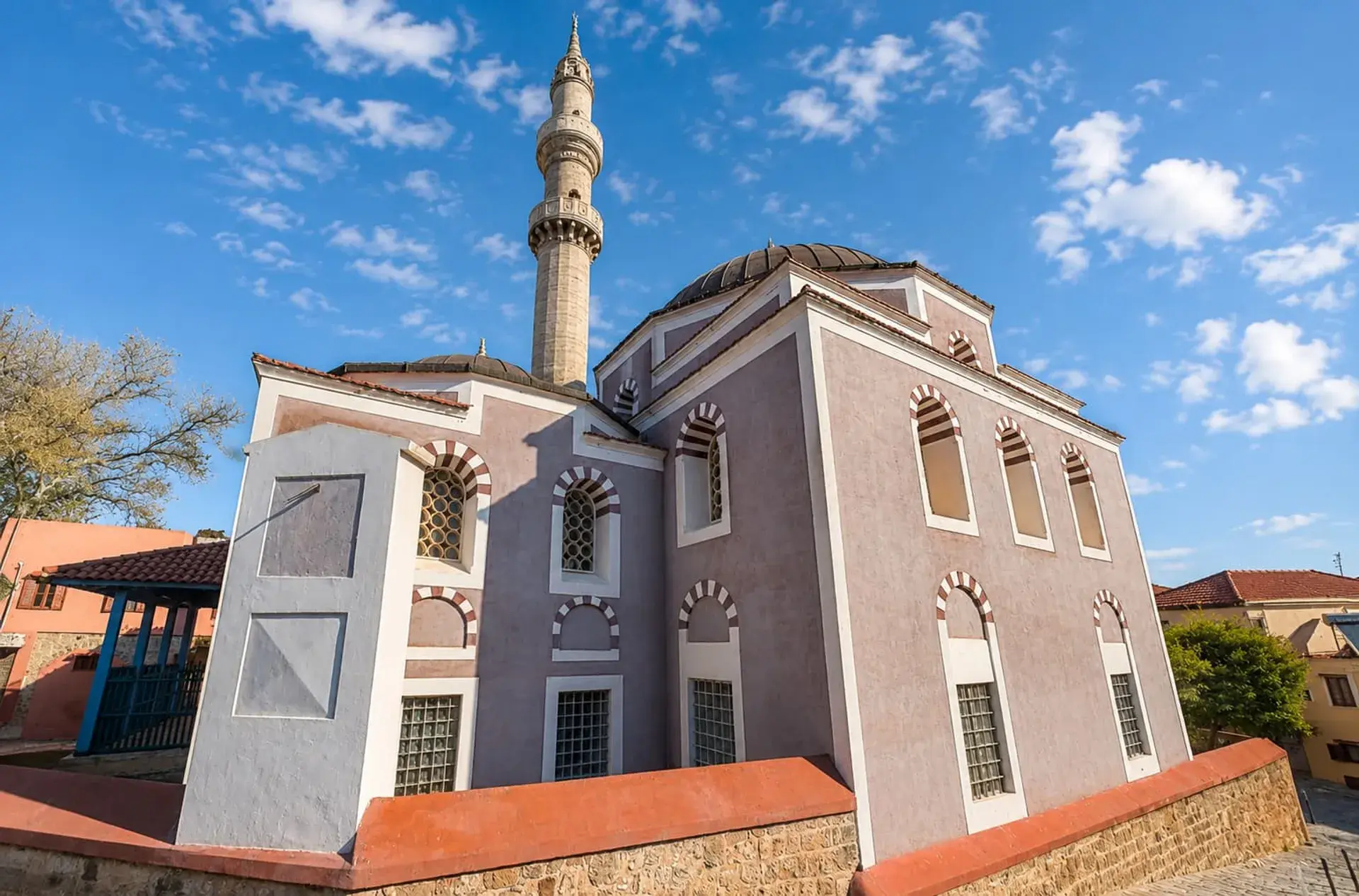
The Suleymaniye Mosque was the first mosque built in Rhodes, constructed in 1522-1523 immediately following the Ottoman conquest of the island. Commissioned by Sultan Suleiman the Magnificent, it served as a powerful symbol of the new Ottoman authority. The building was substantially reconstructed in 1808, maintaining its original Ottoman architectural style, which is notable for its distinctive rose-pink plaster exterior.
In 1856, the mosque sustained significant damage when a gunpowder magazine stored beneath the nearby Church of Saint John was struck by lightning and exploded. A fascinating feature of the mosque is its main entrance. This marble archway was not originally part of the mosque; it was a relic from a Knights Hospitaller funerary monument dating to 1510-1520. This piece of a pre-Ottoman Christian structure was incorporated into the mosque in 1863.
The mosque's minaret also has a complex history. After being rebuilt with two balconies around 1863, it suffered from severe structural issues and was completely demolished in 1987.
The Roloi Clock Tower
The Clock Tower, also known as Roloi, has ancient origins as a 7th-century Byzantine defensive structure. Its modern appearance, however, is the result of a mid-19th century reconstruction. The tower was damaged in the same 1856 gunpowder explosion that affected the mosque.
Ottoman governor Fethi Pasha oversaw the rebuilding of the tower around 1857, giving it its current Baroque-influenced design. As part of a wider civic modernization effort, Fethi Pasha also funded an adjacent junior high school in 1853. The tower's clock mechanism was imported from the London-based company Edward Prior and Co.
The Landmarks Today
Since 2014, the Suleymaniye Mosque has been closed for regular worship pending further restoration. It now functions primarily as a historical landmark and is occasionally opened for special events.
The Clock Tower remains operational and is open to the public. Visitors can climb its 53 steps to enjoy panoramic 360-degree views of the Old Town. The clock still audibly chimes, marking time across the historic city. The original 19th-century clock mechanism is displayed on the tower's terrace level for viewing, and the entrance fee includes a complimentary drink at a terrace cafe.
FAQ
Can I go inside the Suleymaniye Mosque?
The Suleymaniye Mosque has been closed for regular worship since 2014 and is awaiting restoration. It is primarily a historical monument, though it is occasionally opened for special events.
Is the Clock Tower in Rhodes open to the public?
Yes, the Clock Tower is open to the public. Visitors can pay an entrance fee to climb its 53 steps for panoramic views of the Old Town. The fee typically includes a complimentary drink.
What is the origin of the Suleymaniye Mosque's main entrance?
The main entrance is an ornate marble archway that was originally part of a Knights Hospitaller funerary monument from 1510-1520. It was incorporated into the mosque's structure in 1863 after the destruction of the nearby Church of Saint John.
Why was the mosque's minaret demolished?
The minaret of the Suleymaniye Mosque was demolished in 1987 due to severe structural problems.