Holy Church of Saint Demetrius: Thessaloniki UNESCO Site
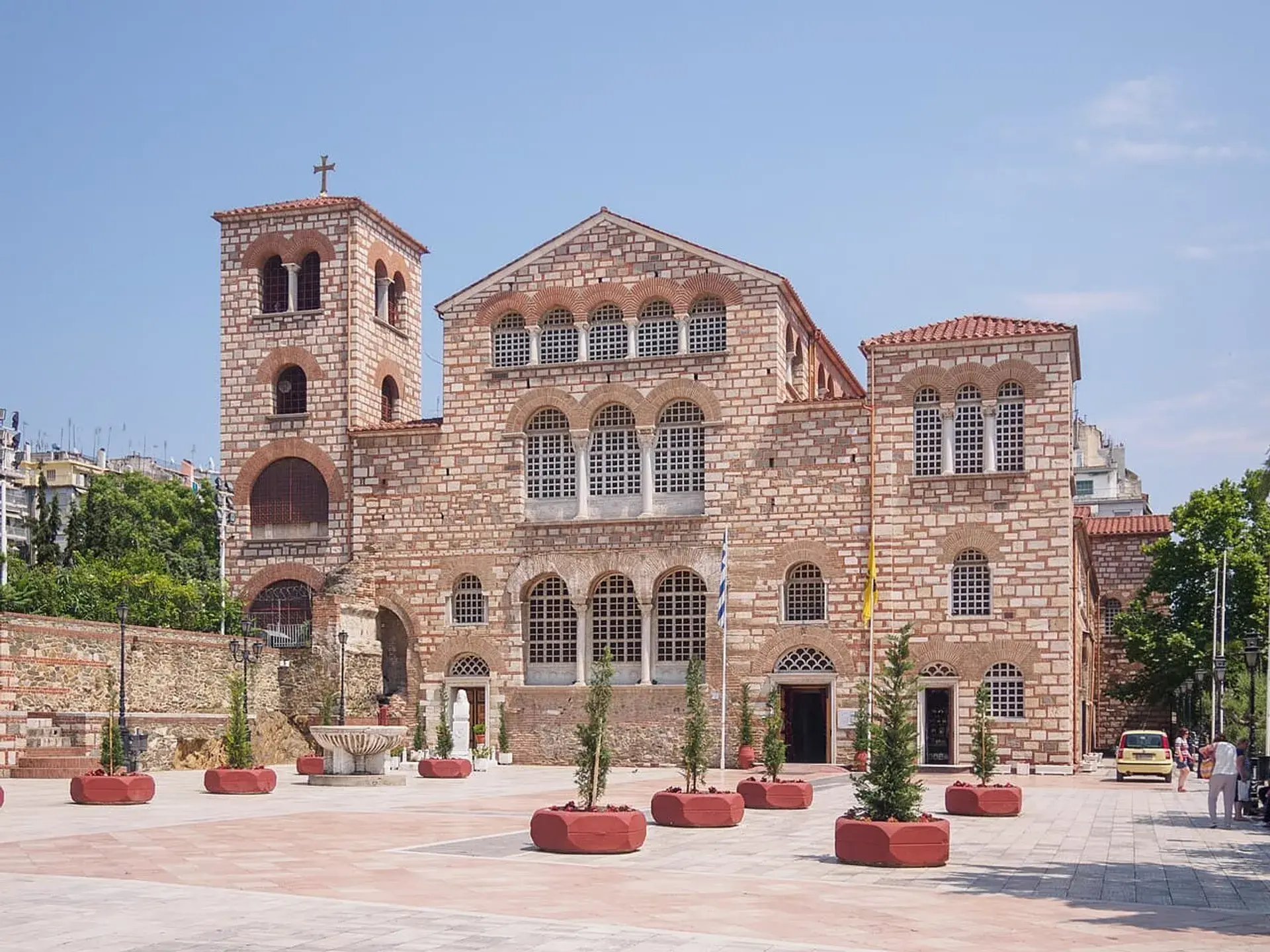
The imposing brick facade of the Holy Church of Saint Demetrius stands upon the ancient Roman bathhouse where the city's patron saint was martyred. Located on Agiou Dimitriou Street, just north of the ancient Roman Agora, this large five-aisled Early Christian basilica is a defining landmark in central Thessaloniki. Inscribed as a UNESCO World Heritage Site in 1988, the building stands as a testament to the city's transition from a Roman imperial center to a major Byzantine pilgrimage hub.
Origins and the Roman Bath Crypt
The site's history begins in 303 AD within a Roman public bath complex, where Demetrius—a Roman military officer turned Christian—was held prisoner and executed with spears for preaching his faith. Following the legalization of Christianity, a small private oratory was constructed over the ruins. By the mid-5th century, Leontios, the prefect of Illyricum, erected a grand three-aisled basilica on the site.
After suffering destruction in the 620s AD, the church was rebuilt into the expansive five-aisled structure seen today. Throughout the Byzantine era, the basilica became an imperial pilgrimage center drawing believers from across the Balkans. Medieval traditions held that a miraculous, sweet-smelling oil known as myrrh flowed from the saint's relics into subterranean stone basins fed by a holy water well, earning Saint Demetrius the title of Myrovlytis, or Myrrh-streamer.
The Ottoman Era and the Great Fire
In 1493, during Ottoman rule, the basilica was converted into a mosque named Kasimiye Camii. Christian worship was restricted to a small northwestern corner housing a cenotaph, and the underground crypt was deliberately filled with earth and forgotten.
The building returned to Christian ownership in 1912, but tragedy struck soon after. The catastrophic Great Fire of Thessaloniki in 1917 caused heavy damage, collapsing parts of the floor. However, this disaster accidentally triggered the rediscovery of the forgotten Roman bath crypt, which had been buried for centuries. Following systematic archaeological restoration, the church was officially reconsecrated in 1949.
Architecture and Byzantine Treasures
The Holy Church of Saint Demetrius is characterized by its transept, double galleries, and subterranean crypt complex. The interior is notable for housing rare 6th- and 7th-century votive mosaics that miraculously survived both Ottoman plastering and the 1917 fire. One prominent mosaic panel depicts Saint Demetrius flanked by city officials, accompanied by an inscription thanking heaven for saving Thessaloniki from a 615 AD siege.
Another surprising historical artifact within the nave is the 1481 marble tomb of Loukas Spantounis. This monument belongs to a wealthy merchant and represents a rare example of Italian Renaissance sculptural art placed inside an Orthodox church.
Modern Significance and the Crypt Museum
Today, the building functions as an active Greek Orthodox basilica and remains the principal sanctuary housing the relics of Saint Demetrius. It serves as the spiritual centerpiece for the city's official civic holiday on October 26, celebrating both the patron saint and Thessaloniki itself.
Beneath the active church, the restored underground crypt now operates as an archaeological museum. The subterranean space displays 5th-century sculptures, architectural capitals, ceramics, coins, and liturgical vessels, highlighting how Early Christian Thessaloniki was built directly over Roman imperial infrastructure.
FAQ
Why is the Holy Church of Saint Demetrius culturally significant?
It is a UNESCO World Heritage Site and the primary sanctuary for Saint Demetrius, the patron saint of Thessaloniki. The basilica is built directly over the ancient Roman baths where the saint was imprisoned and martyred in 303 AD.
What was discovered in the basilica after the 1917 Great Fire of Thessaloniki?
The 1917 fire caused significant floor collapses that accidentally revealed the ancient Roman bath crypt. The subterranean space had been deliberately filled with earth and forgotten during Ottoman rule in 1493.
What is inside the underground crypt today?
The restored underground crypt now functions as an archaeological museum. It displays early historical artifacts, including 5th-century sculptures, architectural capitals, ceramics, coins, and liturgical vessels.