White Tower of Thessaloniki: History & Museum Guide
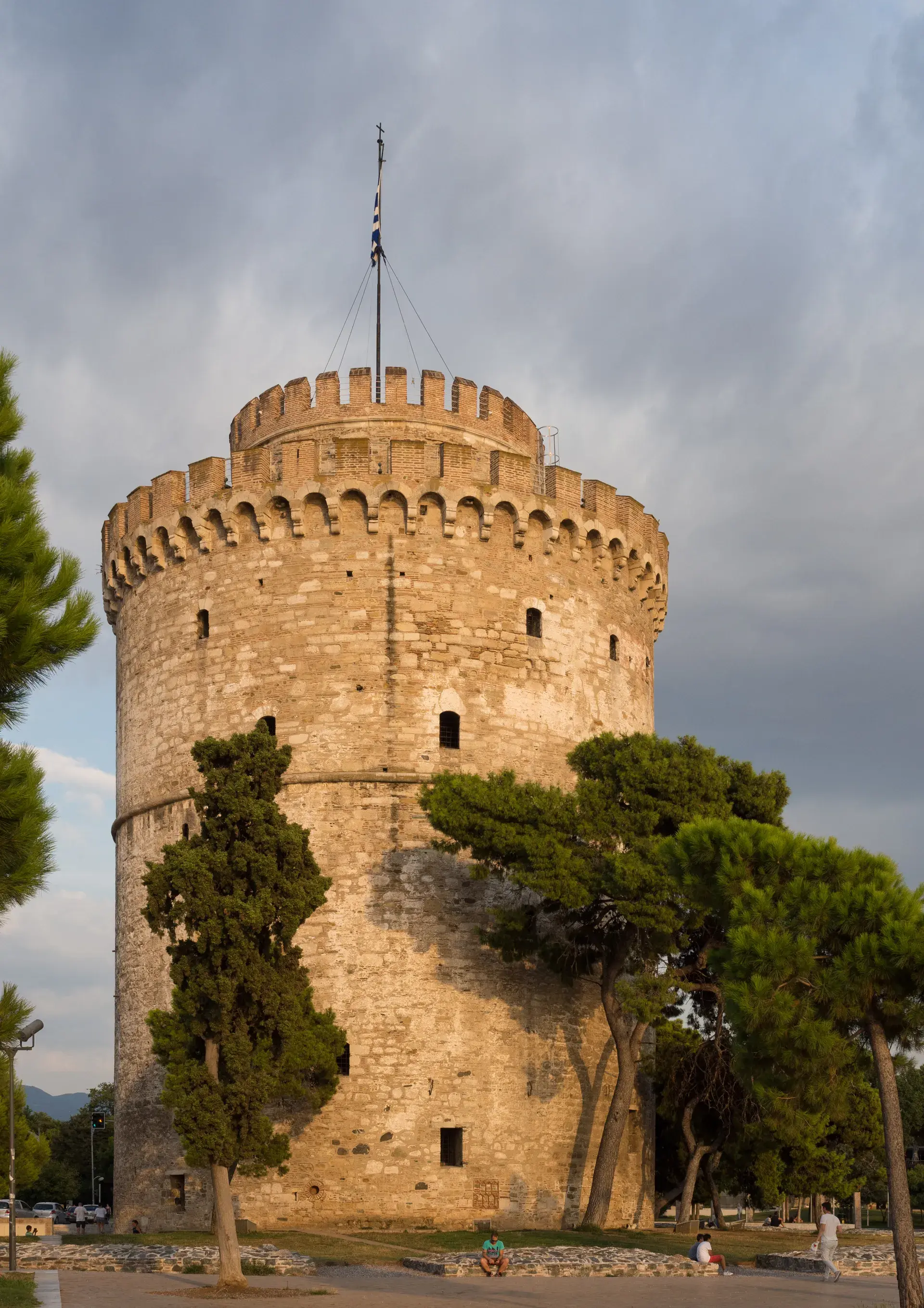
Standing alone on the waterfront edge of Nikis Avenue, the iconic White Tower of Thessaloniki hides a dark past as a notorious Ottoman prison. Today, the cylindrical stone fortress serves as the definitive anchor of the city's coastal promenade.
Origins and the Tower of Blood
Constructed in the 15th century following the 1430 Ottoman capture of Thessaloniki by Sultan Murad II, the structure was erected over the site of a former 12th-century Byzantine tower. Architectural tradition attributes its design to renowned Ottoman master architect Mimar Sinan, based on similarities to a 1530s tower in Valona, Albania. Initially designed to guard the harbor and eastern defensive wall, it was known in earlier centuries as the Lion's Tower and the Fortress of Kalamaria.
During the 19th century, the site operated as an Ottoman garrison and prison. It earned the grim moniker "Tower of Blood" (Kanli Kule) due to its use as a site for severe torture and mass executions, most notably the slaughter of revolting Janissaries under Sultan Mahmud II.
Transformation to the White Tower
In an effort to reform the monument's reputation in the late 19th century, the exterior was painted white, prompting the name change to the "White Tower" (Beyaz Kule). Local tradition claims a Jewish convict named Nathan Guiledi completed this whitewashing single-handedly in 1890 in exchange for his freedom. Conversely, an alternative legend suggests Greek soldiers whitewashed the tower immediately upon entering the city in 1912 to symbolically cleanse its dark prison history.
Although the monument appears as a standalone structure today, it was originally surrounded by sea walls and octagonal outer defensive ramparts. These were demolished between 1866 and 1890, leaving the 33.9-meter-tall building entirely isolated on the modern waterfront edge.
Exploring the Museum and Observation Deck
After passing into Greek control in 1912, the tower served variously as an air defense post, meteorology lab, and antiquities storehouse before transferring to the Ministry of Culture in 1983. Now administered by the Museum of Byzantine Culture, the White Tower operates as a historical monument and museum.
The interior features six floors housing a permanent multimedia exhibition that details the history of Thessaloniki from antiquity through the 20th century. Ascending the enclosed stone spiral ramps through the tower's 22.7-meter-diameter thick walls abruptly gives way to open sea breezes upon reaching the rooftop. The top-floor open terrace serves as a 360-degree public observation deck, offering panoramic views across the Thermaic Gulf that stretch to Mount Olympus on clear days.
FAQ
Why is it called the White Tower of Thessaloniki?
In the late 19th century, the former Ottoman prison known as the "Tower of Blood" was painted white to reform its grim reputation, leading to the name "White Tower" (Beyaz Kule). Local legends claim it was either painted by a Jewish convict in exchange for freedom or by Greek soldiers in 1912 to cleanse its history.
What is inside the White Tower of Thessaloniki?
The six interior floors of the tower house a permanent multimedia exhibition administered by the Museum of Byzantine Culture. The exhibits detail the history of Thessaloniki from its founding in antiquity through the 20th century.
Can visitors go to the top of the White Tower?
Yes, ascending the enclosed spiral stone ramps leads to a top-floor open terrace. This rooftop serves as a 360-degree observation deck with panoramic views of the Thermaic Gulf and the city skyline.