Ponte di Cecco: Ascoli Piceno's Ancient Roman Bridge
Roman Origins and Strategic Engineering
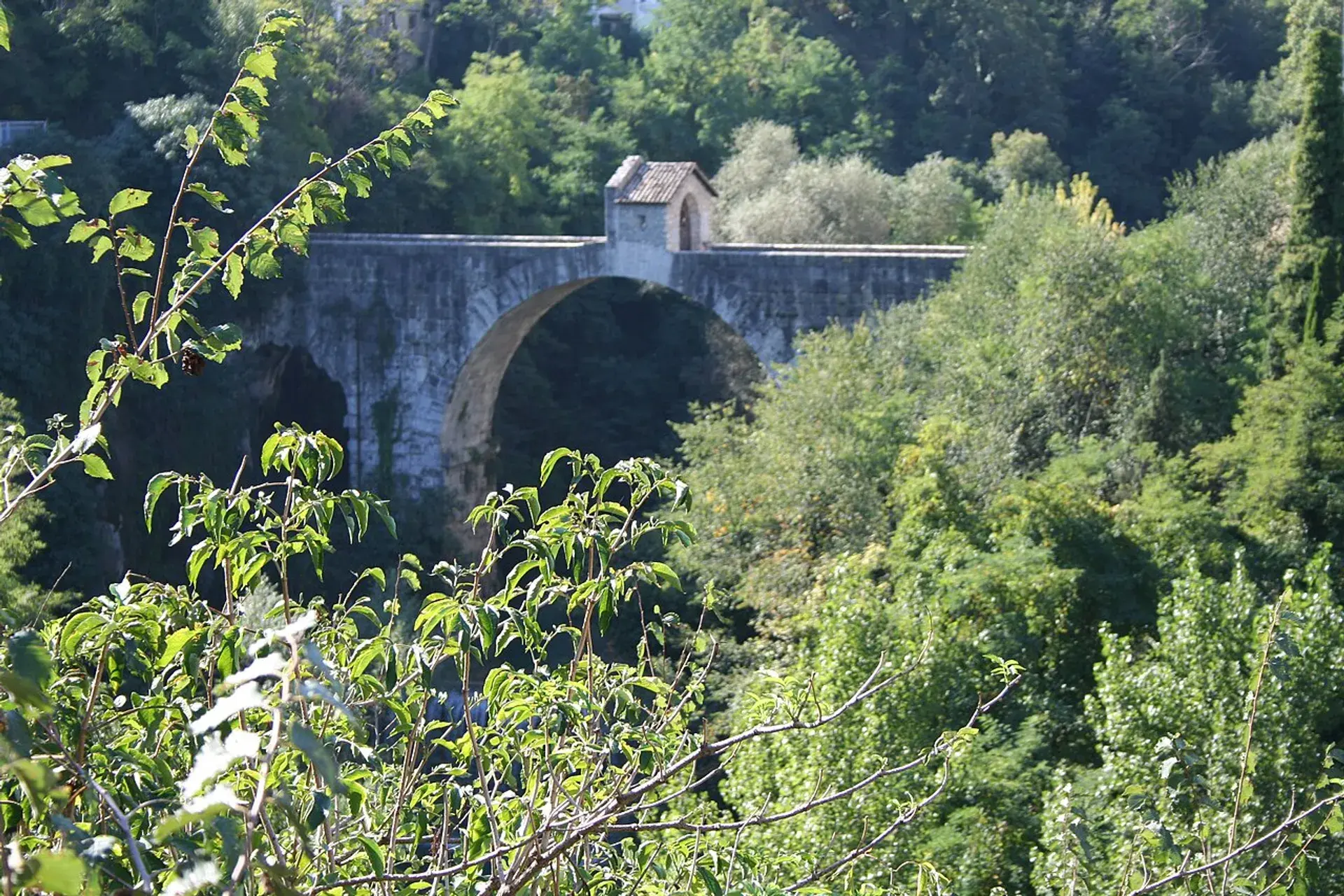
Ponte di Cecco is the oldest surviving bridge in Ascoli Piceno, dating back to the late Republican era of the 1st century BCE. Spanning the rugged gorge of the Castellano torrent, the bridge stands approximately 25 meters above the riverbed. It was built using local travertine stone, an enduring material that characterizes much of the city's ancient architecture.
The bridge features an asymmetrical design formed by two unequal arches: a primary arch spanning roughly 14.5 meters and a smaller secondary arch of about 7.5 meters. Ascoli Piceno’s urban layout was strategically protected by the natural confluence of the Tronto and Castellano rivers, and Ponte di Cecco served as the fortified eastern gateway for the consular Via Salaria. Roman traffic crossed this high span as the road headed east from ancient Asculum toward the Adriatic port of Castrum Truentinum. Midway along the bridge, a small stone toll house (casetta del dazio) once housed the gate-hinging mechanism used to control and defend entry into the city.
The Builder, the Necromancer, and the 19th-Century Rediscovery
For generations, the true age of the bridge was obscured by later modifications and local naming conventions, leading many to assume it was a medieval work. A enduring piece of local folklore claimed that the 13th- to 14th-century poet, astronomer, and alleged necromancer Cecco d’Ascoli (Francesco Stabili) summoned the devil to build the entire crossing in a single night.
Historical records reveal a more terrestrial origin for the moniker. In 1349, the condottiero Galeotto I Malatesta commissioned master builder Mastro Cecco Aprutino to repair the failing bridge and tie it directly into the defensive network of the adjacent Forte Malatesta. The bridge's true antiquity was finally clarified in the 19th century by the Ascoli architect and archaeologist Giambattista Carducci, who recognized late Republican Roman masonry techniques by comparing the ashlar work to other contemporary spans along the Via Salaria.
Wartime Destruction and Anastylosis Reconstruction
The bridge faced catastrophic damage during World War II. On June 16, 1944, retreating German forces dynamited the crossing, causing the centuries-old travertine structure to collapse into the canyon below.
Rather than constructing a modern replacement, preservationists embarked on an ambitious recovery operation. Workers retrieved the original travertine ashlar blocks directly from the Castellano riverbed. Utilizing the archaeological process of anastylosis, experts reassembled the bridge piece by piece using its original components. This reconstruction effort began in the 1960s and concluded in 1971, successfully returning the Roman monument to its historic profile.
Modern Pedestrian Crossing
Today, Ponte di Cecco functions as a public pedestrian crossing linking the Porta Maggiore neighborhood with the grounds of Forte Malatesta. Overlooking the deep river gorge, the bridge serves as an integral scenic section of the walking network around the perimeter of Ascoli Piceno's historic center.
FAQ
How old is Ponte di Cecco?
Ponte di Cecco was constructed during the 1st century BCE in the late Roman Republic, making it the oldest standing bridge structure in Ascoli Piceno.
How did Ponte di Cecco get its name?
While local myth claims the bridge was built in one night by the alleged necromancer Cecco d'Ascoli, historical records show it was named after Mastro Cecco Aprutino, a master builder hired in 1349 to reconstruct the span.
How was the bridge rebuilt after World War II?
After retreating German troops blew up the bridge on June 16, 1944, the original travertine stone blocks were retrieved from the Castellano riverbed and reassembled via anastylosis between the 1960s and 1971.
Discover Ascoli-piceno like never before
Dive into Ascoli-piceno hidden stories and secret spots with Ciceru interactive tours.
Explore tour
Audioguide
Quizzes
Maps
Solo
Couples
Groups & families

© Infinitispazi at Italian Wikipedia | CC BY-SA 3.0