Palazzo del Podestà, Bologna: A Historic Civic Center
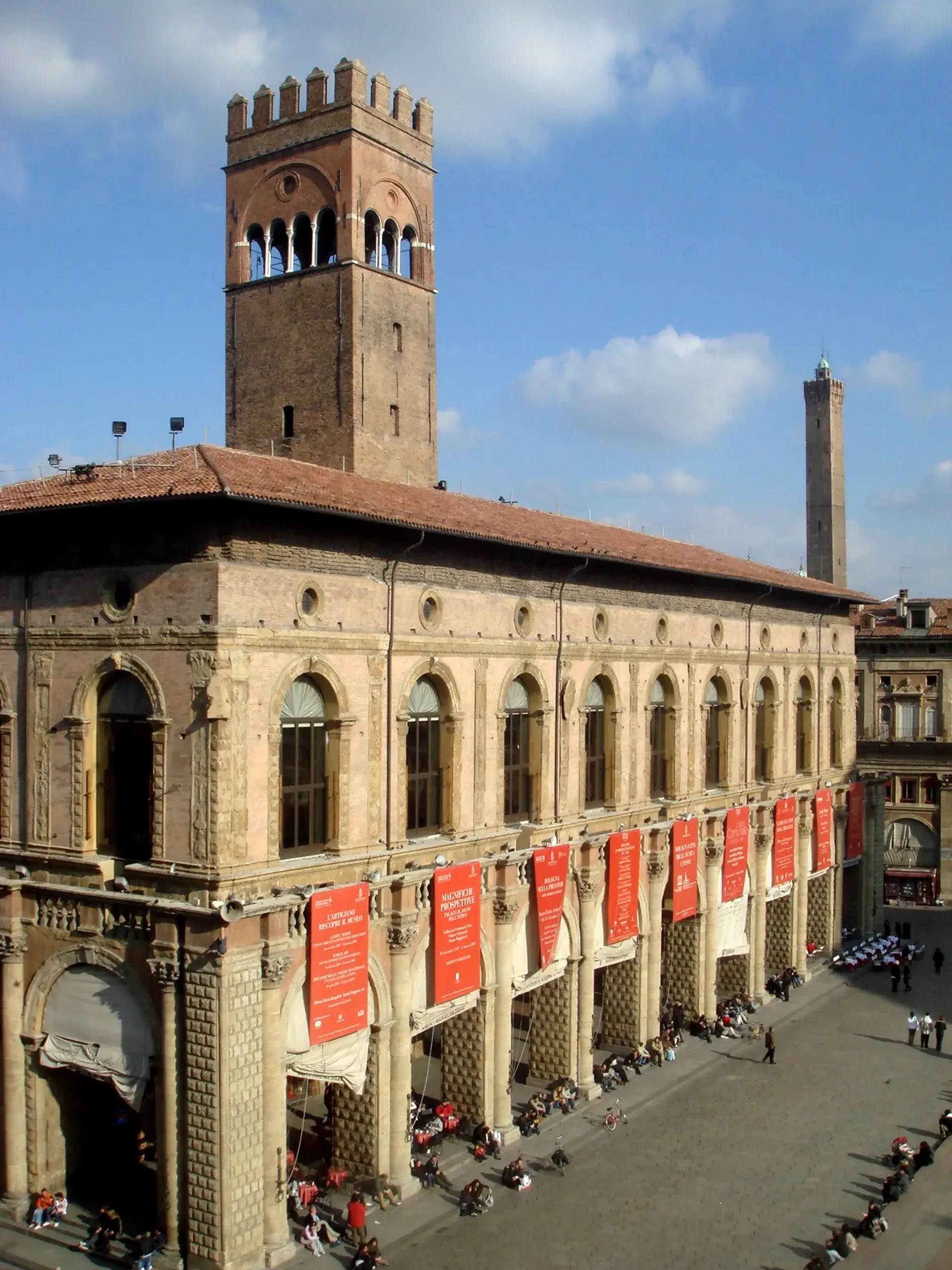
Dominating a central position on Bologna's Piazza Maggiore, the Palazzo del Podestà stands as a monumental testament to the city's medieval civic origins. Constructed around 1200 as the first seat of government, this historic building has witnessed centuries of political, social, and architectural transformation, cementing its place as the heart of Bolognese public life.
A Foundation of Civic Life
The Palazzo del Podestà was erected to house the Podestà, the city's chief magistrate, and his council. Its construction on the newly established Piazza Maggiore required the demolition of several existing structures, signifying a major urban reorganization. From its earliest days, the building was integrated into the city's commercial fabric. The vaulted arcades on the ground floor sheltered shops for artisans, greengrocers, and textile sellers, while notaries conducted their business under the stairs.
Architectural Transformations
Originally built in a Romanesque-Gothic style, the palazzo has undergone significant changes over its long history. The original bell tower, the Torre dell'Arengo, was built in 1212. In 1259, architect Alberto di San Pietro replaced it with the current brick version. The tower's bell, known as the "Campanazzo," was installed in 1453 by Aristotile Fioravanti, who also oversaw a major Renaissance facelift of the facade at the behest of ruler Giovanni II Bentivoglio.
Further embellishments came in 1525 when Alfonso Lombardi added terracotta statues of Bologna's patron saints—San Petronio, San Procolo, San Domenico, and San Francesco—to the niches of the grand archway below, the Voltone del Podestà. Much later, in the early 20th century, the large Sala del Podestà on the upper floor was adorned with frescoes by Adolfo De Carolis.
The Voltone del Podestà: Whispers and Shadows
The large vaulted archway supporting the main building is famous for its unique acoustic properties. This "whispering gallery" allows a person speaking softly in one corner to be heard clearly in the diagonally opposite corner, a phenomenon caused by sound waves reflecting off the curved surfaces. Rumor suggests this feature was used in the Middle Ages to allow priests to hear the confessions of plague and leprosy patients without direct contact.
This playful feature contrasts with a grimmer past. The Voltone was also a site for public humiliation and executions, and beams reportedly used for hanging condemned criminals are still visible. The pillars of the portico are also noteworthy, featuring approximately 3,000 carved rosettes, each said to be unique.
The Palazzo Today
From the 16th to the 18th centuries, the main hall served as a public theater and later a venue for ball games. Today, the Palazzo del Podestà continues its role as a public space, hosting prominent exhibitions and cultural events. While the upper floors are typically open only for these events, the ground-level arcades are freely accessible to the public. The building also houses Bologna's main tourism office, welcoming visitors to the city it has served for over 800 years.
FAQ
What is the whispering gallery at Palazzo del Podestà?
The whispering gallery is an acoustic phenomenon under the Voltone del Podestà. Due to the vaulted ceilings, a whisper from one corner can be clearly heard in the diagonally opposite corner.
When was the Palazzo del Podestà built?
The Palazzo del Podestà was constructed around the year 1200. It was built to serve as Bologna's first seat of government, housing the chief magistrate, or Podestà.
Can you go inside the Palazzo del Podestà?
The ground-level arcades, including the Voltone del Podestà, are freely accessible to the public. The upper floors, which host exhibitions and events, are generally open only during these special occasions. The building also contains Bologna's main tourism office.