Piazza Maggiore: Bologna's Historic & Vibrant Heart
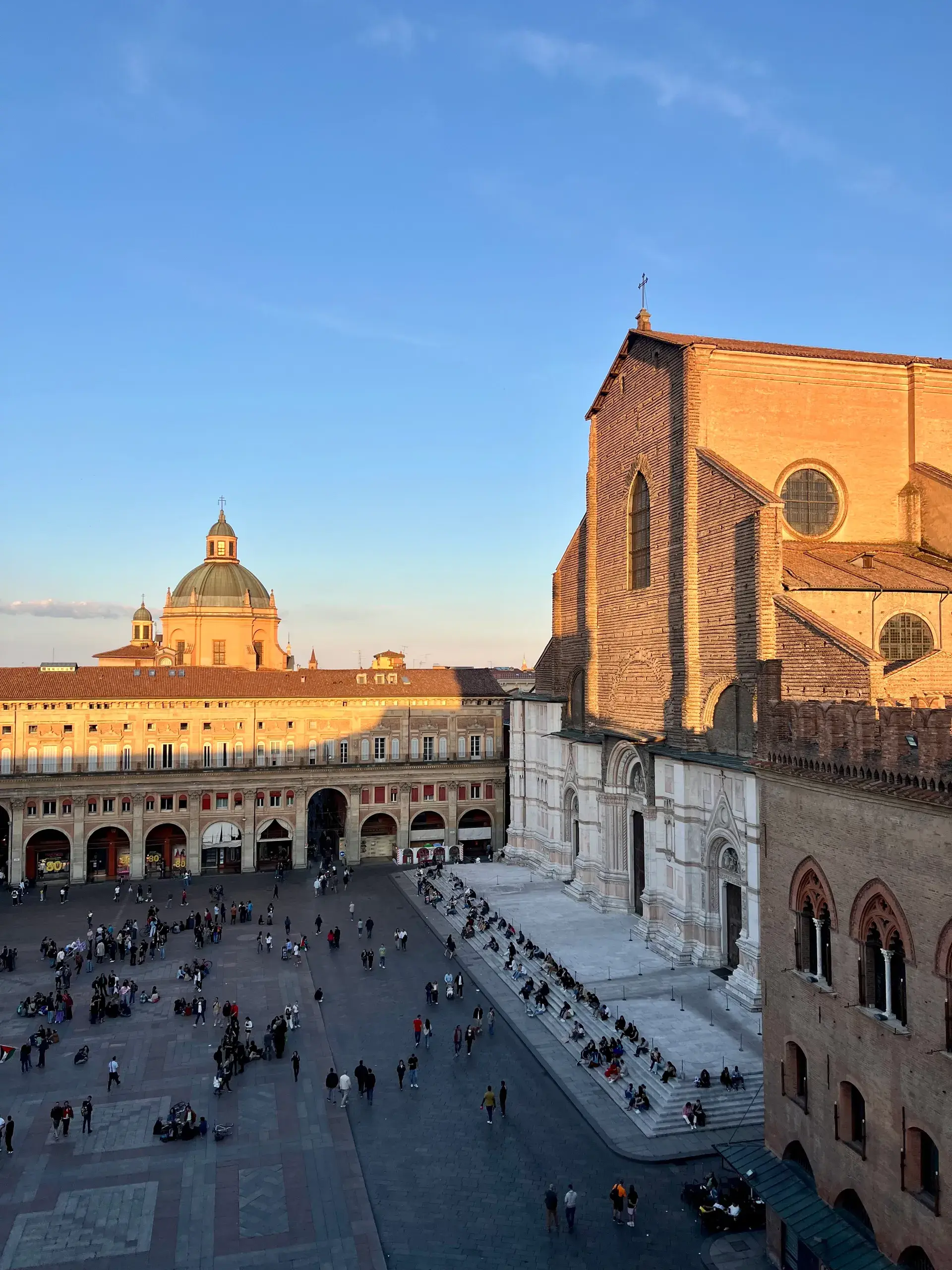
Piazza Maggiore is the historical and cultural nucleus of Bologna, a grand public space framed by magnificent Medieval and Renaissance buildings. Since its creation, it has served as the primary center for the city's civic, religious, and commercial life, bustling with cafes, street musicians, and a lively social scene.
A Medieval Beginning
Piazza Maggiore originated around the year 1200 as the "platea communis," or common plaza. It was one of the first true public squares built in Italy after the fall of the Roman Empire, created when the municipality acquired and demolished existing structures to establish a central area for government and market activities. Throughout the Middle Ages, the square was not only a bustling market but also the site for public executions.
Architectural Grandeur
The square is an architectural showcase, blending Medieval and Renaissance styles. Dominating the piazza is the Basilica di San Petronio, a prominent example of Italian Gothic architecture. Its construction began in 1390, but its facade remains famously unfinished, with a lower section of marble and an upper section of bare brick.
Other significant structures include the Palazzo d'Accursio, which houses the city hall, and the Palazzo del Podestà, which was remodeled in 1453 by Ridolfo Aristotele Fioravanti. The Palazzo dei Banchi, designed by Vignola in the late 16th century, features an elegant facade that conceals the more humble streets behind it. Adjacent to the main square is the Piazza del Nettuno, home to the iconic Fountain of Neptune, sculpted by Giambologna in 1563.
Centuries of History
Piazza Maggiore has been the stage for pivotal historical events. In 1530, Holy Roman Emperor Charles V was crowned within the Basilica of San Petronio. During Napoleon's invasion in 1796, the bronze statue of Bologna-native Pope Gregory XIII, creator of the Gregorian calendar, was disguised as Saint Petronius to save it from being melted down for cannons.
A raised platform in the center of the square, known as the "Crescentone," became the site for celebrating Bologna's liberation from Nazi occupation on April 21, 1945. It still bears the marks from an American tank as a memorial to this event.
Hidden Secrets and Curiosities
The piazza holds several fascinating secrets. Under the vaulted archway of the Voltone del Podestà, a unique acoustic phenomenon allows a person in one corner to clearly hear a whisper from the diagonally opposite corner. This feature is sometimes called Bologna's "wireless phone."
On the walls of the Palazzo d'Accursio, one can find standard units of measurement carved into the stone. These served as a public reference during the Middle Ages to prevent merchants from defrauding customers in the market.
The Square Today
Today, the pedestrianized Piazza Maggiore is a vibrant meeting point for locals and visitors alike. It regularly hosts city festivals, concerts, and cultural events, including the popular "Sotto le Stelle del Cinema" open-air film festival in the summer. The surrounding historic buildings now contain shops, cafes, and museums like the Civic Art Collection and the Museo Morandi, while the square itself remains a central hub for city life.
FAQ
Why is the Basilica of San Petronio in Piazza Maggiore unfinished?
The construction of the Basilica di San Petronio, which began in 1390, was halted in 1759. Its facade remains incomplete partly because the Pope at the time opposed plans that would have made the basilica larger than St. Peter's Basilica in Rome.
What is the 'whispering gallery' in Piazza Maggiore?
The 'whispering gallery' refers to an acoustic effect under the Voltone del Podestà, an archway beneath the Palazzo del Podestà. Due to the curved architecture, a whisper spoken into one corner of the vault can be heard clearly by someone standing in the diagonally opposite corner.
When was Piazza Maggiore built?
The creation of Piazza Maggiore began around the year 1200 as a central space for the market and government. It took on its present form by the 15th century, and the name 'Piazza Maggiore' was officially adopted in 1945.
What is the 'Crescentone'?
The 'Crescentone' is a raised granite platform in the center of Piazza Maggiore. It is used for public gatherings and events, and it serves as a historical memorial, still showing damage marks from an American tank during the celebration of Bologna's liberation in 1945.