Capitolium of Brescia: A Preserved Roman Temple
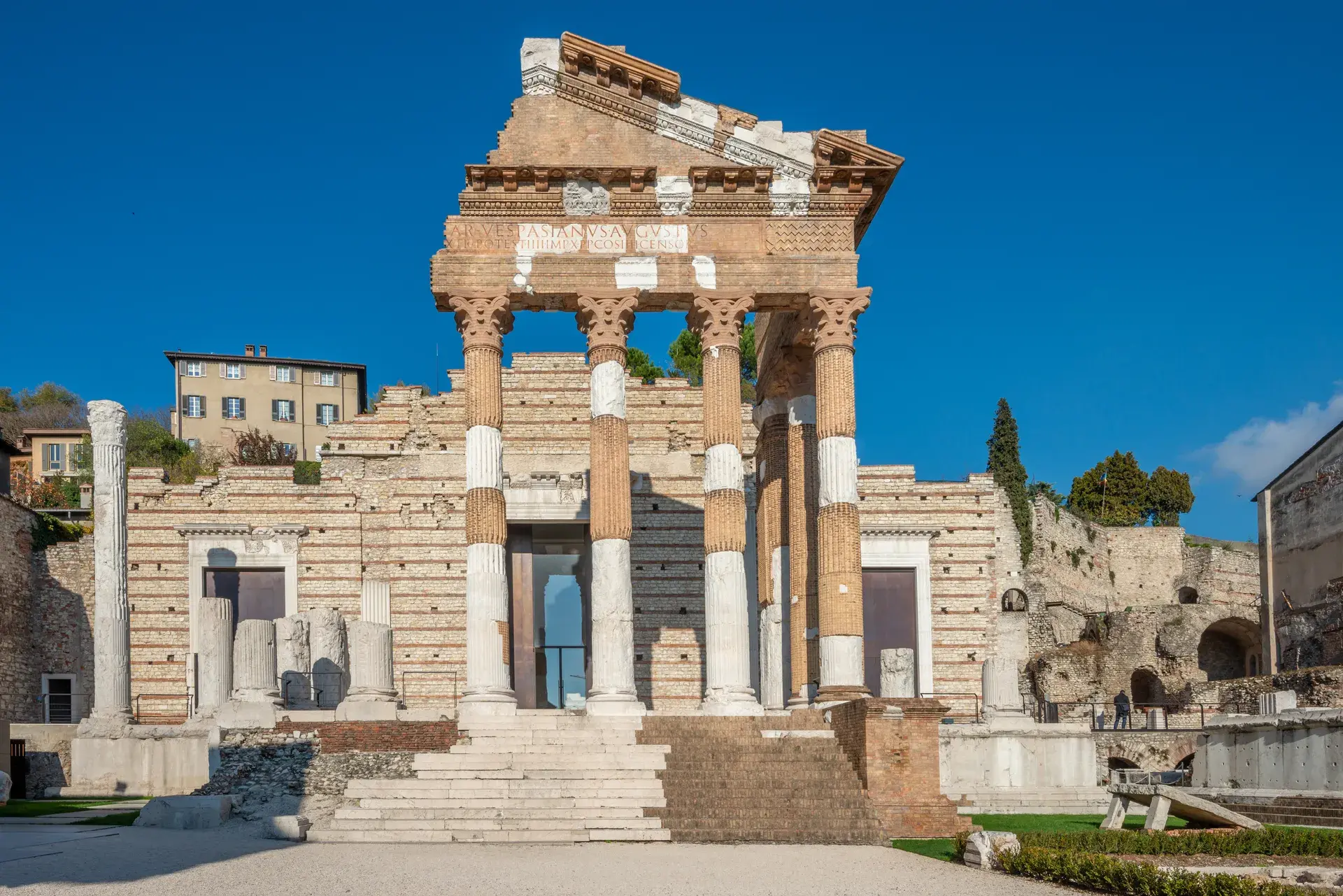
The Capitolium, or Tempio Capitolino, stands as ancient Brixia's main religious sanctuary and the civic heart of Roman Brescia. Commissioned in 73 AD by Emperor Vespasian, the structure was dedicated to the Capitoline Triad of Jupiter, Juno, and Minerva. Today, it anchors the Archaeological Park of Roman Brescia along Via dei Musei. The site represents the largest and best-preserved Roman public monumental area in Northern Italy and holds a UNESCO World Heritage designation.
A Vanished Monument
Erected atop an older Republican sanctuary, the Capitolium featured a monumental portico leading into three sacred chambers lined with marble. Following the suppression of pagan cults and damage during late antiquity incursions, the temple fell into ruin. Over the centuries, landslides from the steep slopes of the Cidneo Hill completely buried the structure under earth and urban build-up.
The temple remained hidden until 1823, when a single Corinthian column capital was spotted protruding from a private garden. Systematic excavations promoted by the Ateneo of Brescia quickly followed. Between 1823 and 1830, architect Rodolfo Vantini led an early reconstruction of the ruins. The project created a stark visual contrast that remains visible today, pairing the original gleaming white Botticino marble with brownish-red terracotta bricks used to fill in missing portions.
The Hidden Bronze Hoard
During the excavations on July 20, 1826, workers uncovered a secret cavity located between the western temple wall and the hillside. This chamber held a massive cache of Roman bronzes that had been deliberately walled up during late antiquity to protect the valuable metal from looters. The hoard contained gilded imperial portrait busts and a nearly two-meter-tall bronze statue known as the Winged Victory.
Ancient Chambers and Modern Displays
Currently operating as an archaeological museum managed by Fondazione Brescia Musei, the Capitolium offers access to its original sacred chambers, or cellae. The interiors feature cool, cavernous spaces preserving their original first-century AD geometric polychrome marble floors. The eastern cella now serves as a dedicated exhibition hall for the restored Winged Victory statue, featuring a modern architectural installation by Juan Navarro Baldeweg. The central and western cellae house original imperial altars and a collection of Roman stone inscriptions.
Directly beneath the imperial foundations lie four interconnected chambers belonging to the older first-century BC Republican sanctuary. This subterranean area contains preserved Roman wall frescoes that predate Emperor Vespasian's temple by over a century.
FAQ
When was the Capitolium of Brescia built?
The Capitolium was commissioned in 73 AD by Emperor Vespasian to honor the Capitoline Triad: Jupiter, Juno, and Minerva.
What is the Winged Victory?
The Winged Victory is a nearly two-meter-tall Roman bronze statue discovered hidden in a secret cavity at the Capitolium in 1826, alongside other gilded bronzes.
Why are there terracotta bricks in the Capitolium?
Between 1823 and 1830, architect Rodolfo Vantini reconstructed the ruins. He used brownish-red terracotta bricks to fill in the missing portions alongside the original white Botticino marble.