Piazza della Vittoria: Brescia's Modernist Square
Discover a monumental 20th-century stage built over a medieval neighborhood, featuring Italy's very first skyscraper. Located just 100 meters from the Renaissance Piazza della Loggia and the medieval Piazza del Duomo, Piazza della Vittoria serves as a striking modernist counterpoint to Brescia's older historical eras.
A Drastic Urban Transformation
Between 1927 and 1932, the central layout of Brescia underwent a massive alteration to make way for Piazza della Vittoria. The project required the demolition of the Quartiere delle Pescherie, a dense medieval district of narrow alleyways, craftsmen markets, the remains of the Lombard curia ducis, and the Romanesque Church of Sant'Ambrogio.
Promoted locally by Fascist Party secretary Augusto Turati and approved directly by Benito Mussolini, the initiative aimed to replace the old housing with a grand civic forum designed for mass political rallies. The Roman architect Marcello Piacentini designed the L-shaped square in a simplified neoclassicist and rationalist style. Mussolini officially inaugurated the space on November 1, 1932.
Landmarks and Architectural Contrasts
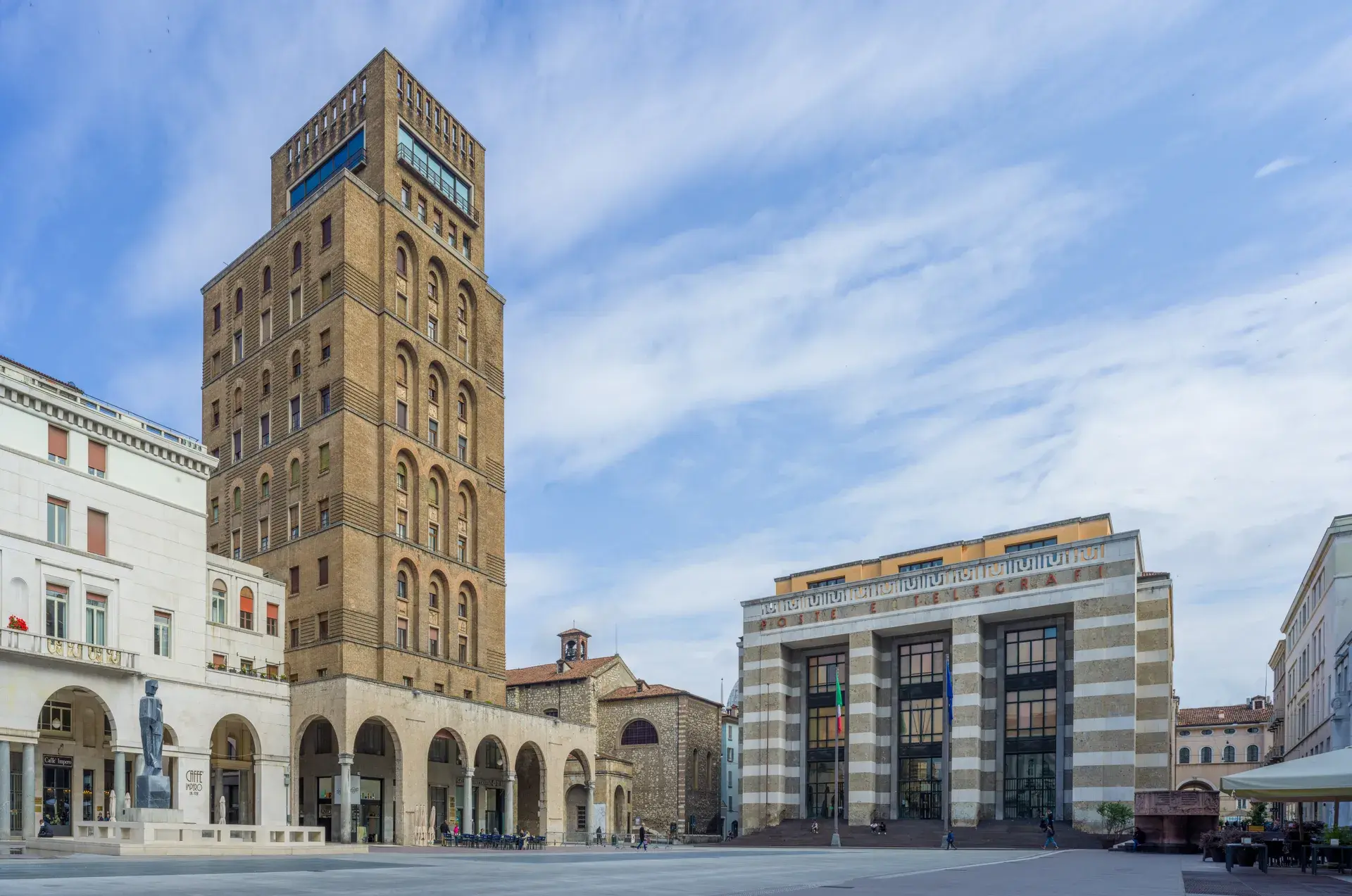
The square presents a stark geometric contrast of textures and materials. Expansive, light-colored stone pavement sets the stage for the surrounding monumental structures. Dominating the north side is the Palazzo delle Poste, clad in striking two-tone travertine.
Nearby stands the Torre della Rivoluzione, a clock tower featuring the Arengario. This orator’s pulpit is crafted from deep red Tolmezzo stone and showcases nine bas-relief panels carved by sculptor Antonio Maraini, illustrating the history of Brescia.
The most prominent feature of the square is the Torrione INA. Standing 57.25 meters tall with 15 stories, it is recognized as Italy's first skyscraper and one of the earliest high-rises in Europe. Architect Marcello Piacentini based its exposed brickwork design directly on his submission to the famous 1922 Chicago Tribune Tower architectural competition.
De-Fascistization and Hidden Relics
Following the fall of the regime and World War II, the square underwent significant de-fascistization. Prominent iconography was stripped from the public space, including a bas-relief of Mussolini on horseback that originally adorned the clock tower.
The most notable removal was Arturo Dazzi's colossal 7.5-meter nude marble statue, L’Era Fascista. Popularly known as the Bigio, the statue was placed in municipal storage to defuse political tensions and remains hidden from public display today.
A Modern Civic Hub
Today, Piazza della Vittoria operates as a fully pedestrianized civic space and a major downtown transit node, situated directly above the underground Vittoria metro station and a central parking facility. The open expanse regularly hosts cultural gatherings and sporting events. Additionally, an antiques market sets up in the square on the second Sunday of every month, bringing community life to this 20th-century forum.
FAQ
When was Piazza della Vittoria built?
The square was constructed between 1927 and 1932 and was officially inaugurated by Benito Mussolini on November 1, 1932.
What is the tallest building in Piazza della Vittoria?
The Torrione INA is the tallest structure in the square. Standing at 57.25 meters with 15 stories, it is recognized as Italy's first skyscraper.
What happened to the statues in Piazza della Vittoria after World War II?
Following World War II, prominent fascist iconography was removed. This included a bas-relief of Mussolini and a colossal 7.5-meter marble statue known as the Bigio, which remains in municipal storage.
What events take place in Piazza della Vittoria today?
The pedestrianized square hosts cultural gatherings, sporting events, and a regular antiques market held on the second Sunday of every month.