Castello di Brescia: Guide to the Falcon of Italy
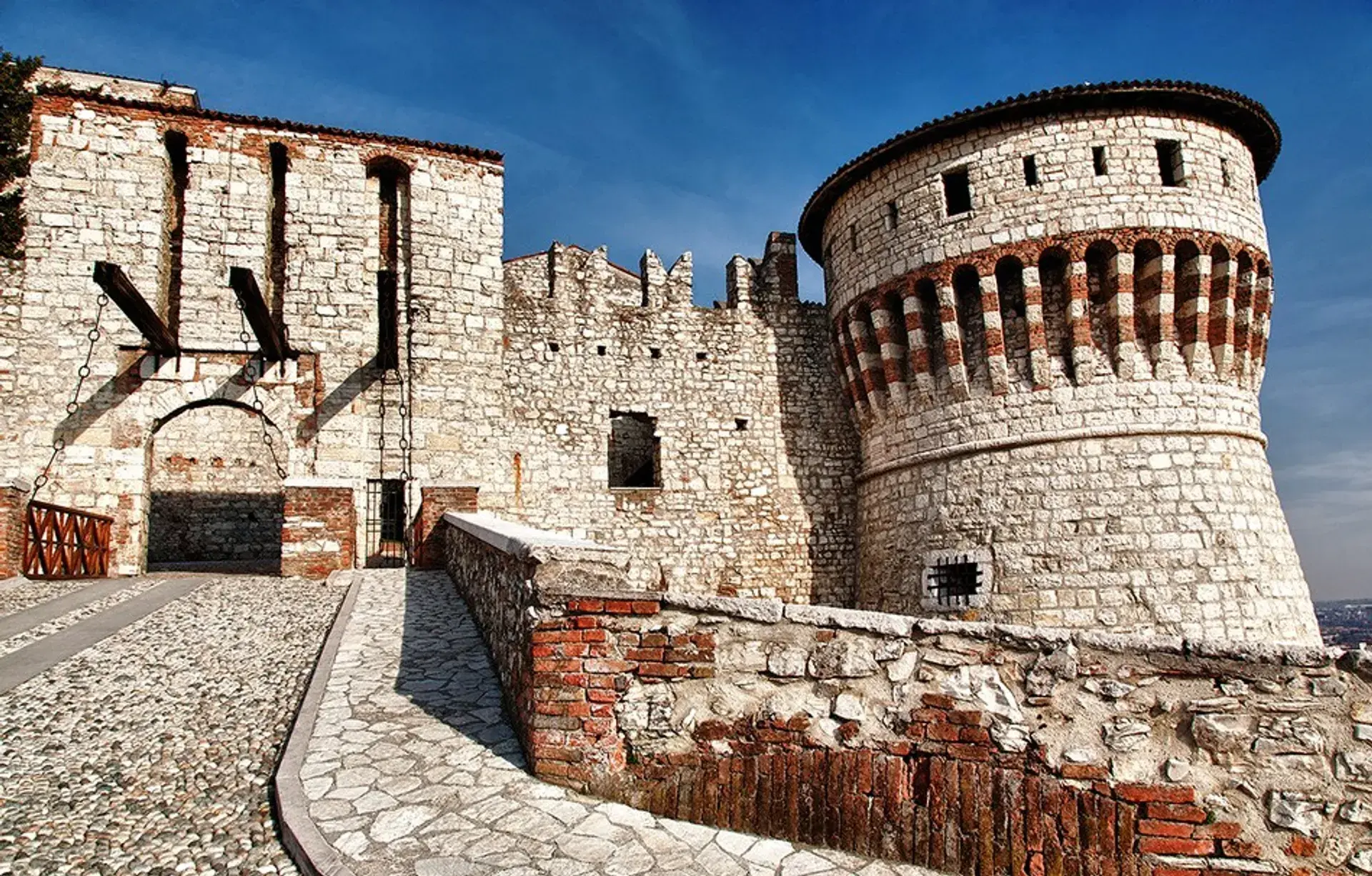
Gaze up from the sloping paths to behold the imposing medieval battlements, stone tower, and historic drawbridge of Castello di Brescia. Spanning approximately 75,000 square meters atop Colle Cidneo, this massive fortified complex is historically known as "Il Falcone d’Italia" (The Falcon of Italy). For centuries, it served as a towering citadel used by occupying forces to control the city, creating a striking historical contrast with the democratic civic squares below.
A Legacy of Military Might
Settlements on Colle Cidneo date back to the Bronze Age, eventually giving way to a 1st-century AD Roman temple and fortified outpost. In the 14th century, Milan's Visconti rulers established military control over the city by erecting the inner fortress and the Visconti keep, known as the Mastio Visconteo. Additional structures from this era include the circular Torre Mirabella and the Torre dei Prigionieri.
During the rule of the Venetian Republic from the 15th to the 18th centuries, the site was transformed into a modern artillery fortress. The Venetians added wide outer bastions, subterranean tunnels, and ramparts designed for gunpowder warfare. A monumental gate topped with the Lion of Saint Mark still guards the entrance to these fortifications.
The castle played a devastating role during the 1849 anti-Austrian uprising known as the Ten Days of Brescia. Austrian troops, commanded by Field Marshal Julius Jacob von Haynau, used the elevated fortress to bombard the rebelling city. The fierce local resistance during this conflict earned Brescia the enduring title "Leonessa d'Italia" (Lioness of Italy).
Museums and Subterranean Exploration
Today, the complex functions as a freely accessible public park offering 360-degree sightlines over Brescia's terracotta rooftops, the Prealps, and the Lombard plains. A stark physical transition occurs when moving from the wind-swept, sunlit stone bastions into the cool, vaulted silence of the Mastio Visconteo.
Inside the Visconti keep sits the Luigi Marzoli Arms Museum. Featuring exhibition spaces designed by architect Carlo Scarpa, it displays a major collection of historic European weaponry. Remarkably, the preserved stone foundations and a staircase of the original 1st-century AD Roman temple are embedded directly in the museum's floor.
The castle's former grain stores house the Museo del Risorgimento, an institution dedicated to the Italian unification movement. Beneath the surface, local speleological organizations operate guided tours through the castle's network of hidden oil depots, stone passages, and the historic escape route known as the Strada del Soccorso.
Unexpected Monuments and Urban Vineyards
Despite its origins as a medieval military installation, the fortress grounds hold several surprising monuments. The Piazzale del Bastione di San Faustino features "Locomotiva Numero 1." Built in the late 19th century, this retired steam engine is considered Italy’s first public railway monument.
Scientific and agricultural curiosities also thrive on the historic grounds. The Bastione San Marco hosts the Specola Astronomica Cidnea, recognized as Italy's first public astronomical observatory. Just beneath the castle walls on the northern slope of the hill lies the Vigneto Pusterla, holding the distinction of being one of the oldest continuously productive urban vineyards in Europe.
FAQ
Why is Castello di Brescia called the Falcon of Italy?
It earned the nickname "Il Falcone d’Italia" due to its commanding, predatory vantage point atop Colle Cidneo, overlooking the plains and the city below.
What museums are located inside Castello di Brescia?
The complex houses the Luigi Marzoli Arms Museum, featuring historic weaponry within the Visconti keep, and the Museo del Risorgimento, which details the Italian unification movement.
Are there Roman ruins at Castello di Brescia?
Yes, the foundations and a staircase of a 1st-century AD Roman temple are preserved directly beneath the floor of the Weapons Museum inside the castle.
Is Castello di Brescia free to enter?
The castle grounds serve as a freely accessible public park, though entry to specific museums and the guided subterranean tours require admission.
Discover Brescia like never before
Dive into Brescia hidden stories and secret spots with Ciceru interactive tours.
Explore tour
Audioguide
Quizzes
Maps
Solo
Couples
Groups & families

© Photo by Castello di Brescia via Google Maps · Google Places