Duomo Vecchio: Brescia's Ancient Round Cathedral
A Tale of Two Cathedrals
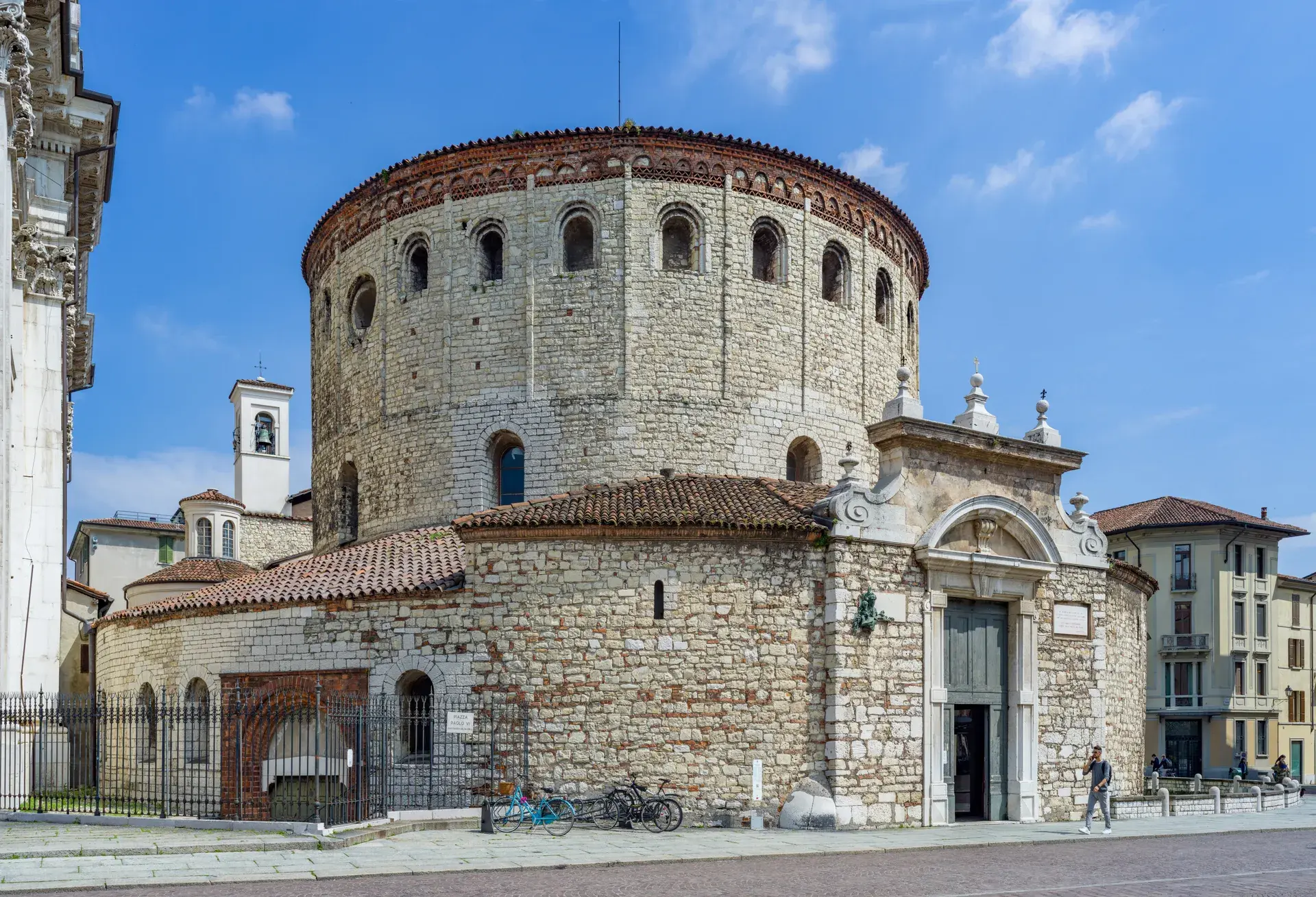
Brescia’s Piazza Paolo VI is one of the rare European squares where two functional cathedrals stand side by side. The Duomo Vecchio, an ancient stone cylinder sinking into the earth, sits in stark contrast to the towering Baroque and Neoclassical architecture of the adjacent Duomo Nuovo. Officially known as the Winter Co-Cathedral of the Assumption, this 11th-to-12th-century structure is one of the largest and best-preserved Romanesque round churches in Italy.
Architecture and Ancient Foundations
Constructed from local medolo limestone around 1100, the building’s circular design was inspired by the Church of the Holy Sepulchre in Jerusalem. Over the centuries, rising ground levels have left the cathedral floor noticeably below the modern street, requiring a descent upon entry. Inside, thick cylindrical walls and small clerestory windows create a cool, hushed atmosphere characterized by echoing acoustics in the circular stone ambulatory.
The Duomo Vecchio was built over significant historical layers. Ruins of 1st-century BC Roman thermal baths are visible through floor openings in the transept. Beneath the presbytery lies the subterranean Crypt of San Filastrio, containing remnants from an earlier 6th-to-8th-century paleo-Christian basilica. A 19th-century restoration campaign stripped away later Gothic and Renaissance additions, revealing the cathedral's raw medieval masonry, though the current Baroque entrance remains—a replacement added after the original bell tower collapsed in 1708.
Renaissance Masterpieces and Historic Relics
The interior houses a wealth of artistic and historical treasures. Near the entrance rests the red marble sarcophagus of Bishop Berardo Maggi, dating to 1308, alongside a 1349 funerary monument by Bonino da Campione. The cathedral also features a mid-16th-century pipe organ crafted by Giangiacomo Antegnati.
Renaissance masterworks adorn the walls, most notably Il Moretto's 1526 Assumption of the Virgin, accompanied by canvases from Romanino and Francesco Maffei. The cathedral is also home to the Chapel of the Holy Crosses. Its treasury includes the Croce di Campo, a 12th-century wooden and silver-gilt processional cross once carried into battle on Brescia's war wagon. This revered collection is kept in a locked strongbox and is only displayed to the public on specific liturgical dates, such as September 14 and the last Friday of Lent.
A Living Monument in the Historic Center
The Duomo Vecchio remains an active place of worship, serving as Brescia's winter co-cathedral and hosting regular religious services, including a Sunday Latin Mass. It is open daily to the public free of charge, with access generally available in the morning and late afternoon blocks, as the building closes during midday hours. Anchoring the eastern flank of Piazza Paolo VI opposite the medieval Palazzo del Broletto, the cathedral forms a key historical milestone on the axis connecting the Roman forum to the Renaissance Piazza della Loggia.
FAQ
Why is the floor of the Duomo Vecchio lower than the street level?
The cathedral sits below the current street level of Piazza Paolo VI due to centuries of rising ground levels around the building, which requires visitors to descend steps upon entering.
Are there Roman ruins inside the Duomo Vecchio?
Yes, the cathedral was built over 1st-century BC Roman thermal bath structures, and the ancient ruins are visible through floor openings in the transept.
What is the Treasure of the Holy Crosses?
It is a collection of revered relics housed in the cathedral, including the 12th-century Croce di Campo processional cross. The treasure is kept in a locked strongbox and only displayed on specific dates like September 14 and the last Friday of Lent.
Does the Duomo Vecchio still hold church services?
Yes, it functions as Brescia's winter co-cathedral and regularly hosts religious services, including a weekly Sunday Latin Mass.