Piazza della Loggia: Brescia's Renaissance Heart
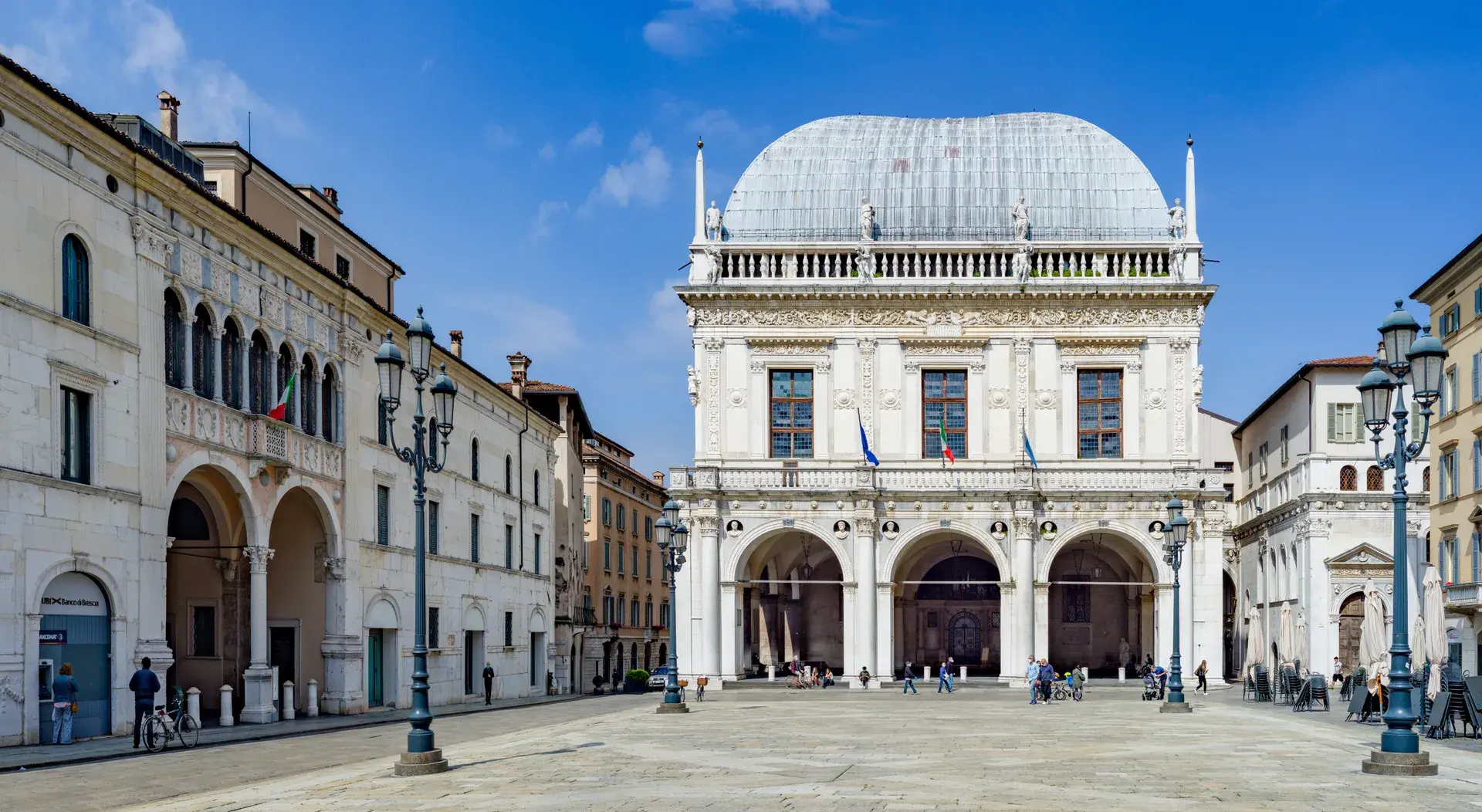
Piazza della Loggia represents Brescia's closest architectural link to the Venetian Republic. Conceived in 1484 as a monumental civic forum distinct from the nearby religious center at Piazza del Duomo, the square is a fully pedestrianized Renaissance gathering space. Today, it hosts major outdoor concerts, cultural festivals, public rallies, and ceremonies.\n\n## Palazzo della Loggia\nThe square's defining monument is the Palazzo della Loggia, constructed in bright white Botticino marble between 1492 and 1574. Work initially began under Filippo Grassi but was interrupted by the 1512 Sack of Brescia. Construction resumed in the mid-16th century with input from renowned masters, including Jacopo Sansovino, Andrea Palladio, and Lodovico Beretta. A notable architectural feature is its lead-sheathed roof, engineered in the silhouette of an overturned boat hull to reflect Venetian maritime construction techniques. Originally, the upper floor contained a grand hall featuring three allegorical ceiling paintings by Titian, which were tragically destroyed in a 1575 fire. Today, the building serves as Brescia's City Hall, housing the municipal council and administrative offices. Under the portico stands a 16th-century statue known as "La Lodoiga." Historically, this served as one of Brescia's "talking statues," where citizens posted anonymous satirical notes protesting the government.\n\n## Torre dell'Orologio\nBuilt opposite the Loggia between 1540 and 1550 by Lodovico Beretta, the Torre dell'Orologio houses a striking 16th-century astronomical clock installed by Paolo Gennari. The regular metallic chimes ringing across the square are produced by two automated mechanical copper figures atop the tower. Known in the local Brescian dialect as "I Macc de le Ure" (The Madmen of the Hours), these figures are traditionally nicknamed Tone and Batista. Passages underneath the Clock Tower seamlessly connect this Venetian hub to the religious center of Piazza Paolo VI.\n\n## Ancient Stones and Monuments\nThe southern side of the square features the 15th-century Monte di Pieta. The facade of the older section, Monte di Pieta Vecchio, integrates salvaged Roman-era inscriptions and architectural fragments, effectively creating Italy's first open-air public lapidary display. Nearby, Giovanni Battista Lombardi's 1864 Monument to Bella Italia commemorates the fallen of the Ten Days of Brescia, erected where a Venetian column with the Lion of Saint Mark once stood. The square also holds a solemn commemorative stele marking the site of a tragic bombing. On May 28, 1974, a neo-fascist bomb hidden near the Clock Tower exploded during an anti-fascist demonstration, killing eight people and injuring over a hundred.
FAQ
What is Piazza della Loggia used for today?
The fully pedestrianized square functions as Brescia's central civic gathering space for concerts, festivals, and rallies, while the Palazzo della Loggia serves as the City Hall.
Who built the Palazzo della Loggia?
Construction began in 1492 under Filippo Grassi and resumed in the mid-16th century with contributions from renowned architects like Jacopo Sansovino, Andrea Palladio, and Lodovico Beretta.
What are the figures on top of the Clock Tower?
The two automated copper figures are locally known as "I Macc de le Ure" (The Madmen of the Hours). Nicknamed Tone and Batista, they mechanically strike the summit bell to ring the chimes.