Portici Minori: Brixen's Historic Arcaded Street
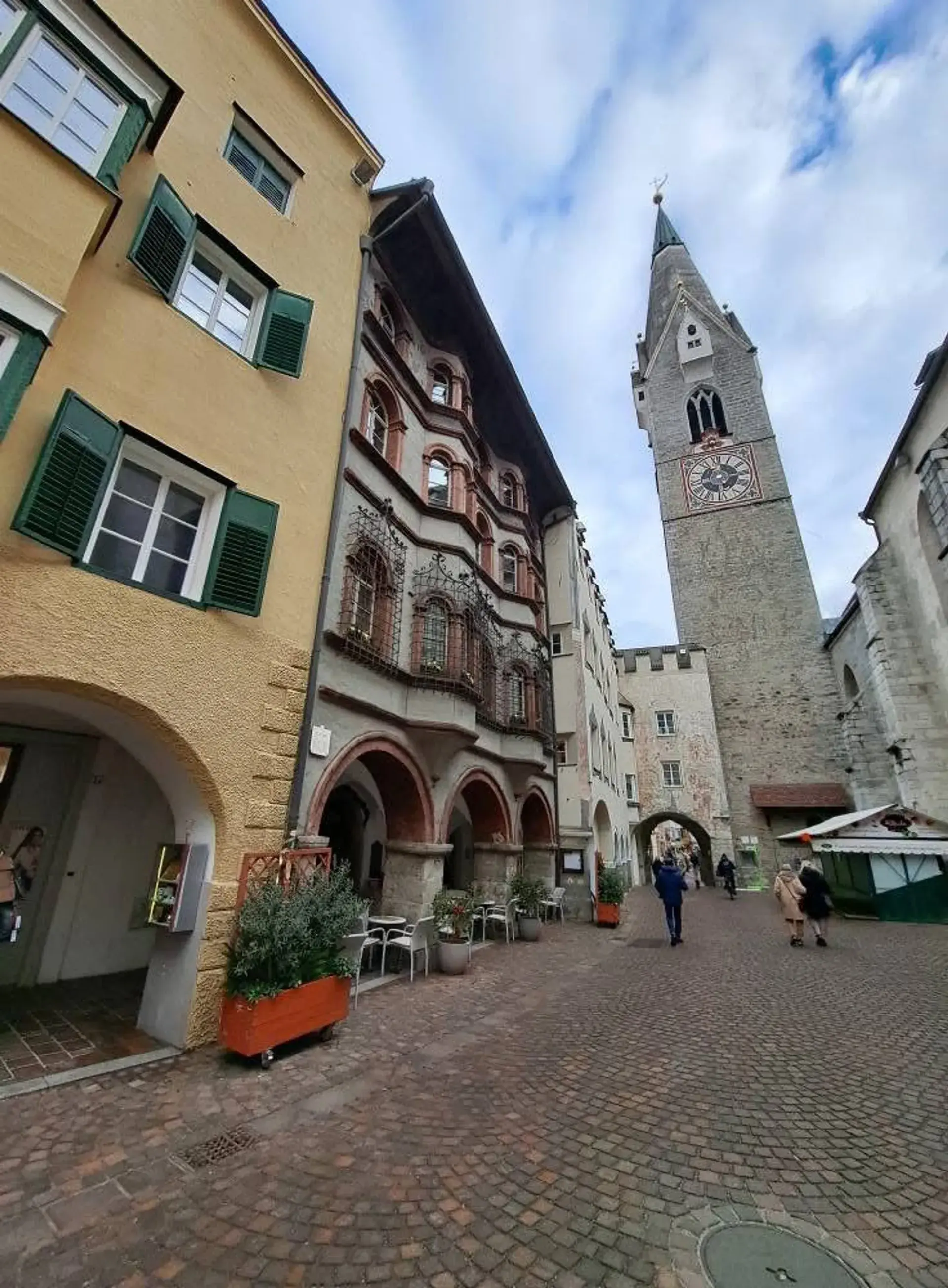
Portici Minori, also known as Kleine Lauben, is a historic arcaded street that forms an integral part of Brixen's commercial heart. This vibrant thoroughfare reflects centuries of history, shaped by both practical necessity and the powerful influence of the Prince-Bishops who once ruled the city.
Medieval Origins and Reconstruction
The buildings lining Portici Minori have late medieval foundations, but the street's character was significantly defined by a major reconstruction effort. A devastating fire swept through Brixen in 1444, necessitating a large-scale rebuilding of the area. In the 15th century, the characteristic arcades were constructed as a pragmatic response to the growing city's need for more residential and commercial space.
Architecture and Historic Function
The structures seen today mostly date from the 15th and 16th centuries. They feature colorful facades and distinctive polygonal bay windows known as 'erker'. Historically, these buildings had a specific functional layout. The ground floors under the arcades housed shops, while the upper floors contained residential spaces. Warehouses were located at the rear, often illuminated by small courtyards.
The Rule of the Prince-Bishops
The development of Portici Minori occurred during the long reign of the Prince-Bishops of Brixen. From 1027 until 1803, these ecclesiastical rulers held both temporal and spiritual authority over the principality, answering directly to the Holy Roman Emperor. This status gave them considerable autonomy and allowed them to shape Brixen into a prosperous capital, with Portici Minori serving as a key commercial artery.
A Curious Landmark: The Wild Man
A notable curiosity on the street is the 'Uomo selvaggio' (Wild Man), a 16th-century statue depicting a three-headed giant. This unusual figure is believed to have originally functioned as an inn sign for the Albergo all'Aquila nera, adding a whimsical detail to the street's historic facade.
Portici Minori Today
True to its origins, Portici Minori remains a bustling commercial center in modern Brixen. The arcades continue to shelter shoppers visiting the numerous shops and businesses that line the street. It endures as a central hub for commerce and social interaction for locals and visitors alike.
FAQ
Why were many buildings on Portici Minori rebuilt?
A significant portion of the street's architecture dates from a reconstruction phase that followed a major and devastating fire in Brixen in 1444.
What is the significance of the arcades on Portici Minori?
The arcades were constructed in the 15th century as a practical solution to a lack of urban space in the growing city. They provided sheltered areas for shops and pedestrians.
What is the 'Uomo selvaggio' statue?
The 'Uomo selvaggio' (Wild Man) is a 16th-century statue of a three-headed giant located on Portici Minori. It is thought to have originally been an inn sign for the Albergo all'Aquila nera.
Discover Brixen like never before
Dive into Brixen hidden stories and secret spots with Ciceru interactive tours.
Explore tour
Audioguide
Quizzes
Maps
Solo
Couples
Groups & families

© Photo by Giovanni via Google Maps · Google Places