Piazza Paolo Diacono in Cividale del Friuli
Ancient Foundations and the Lombard Discovery
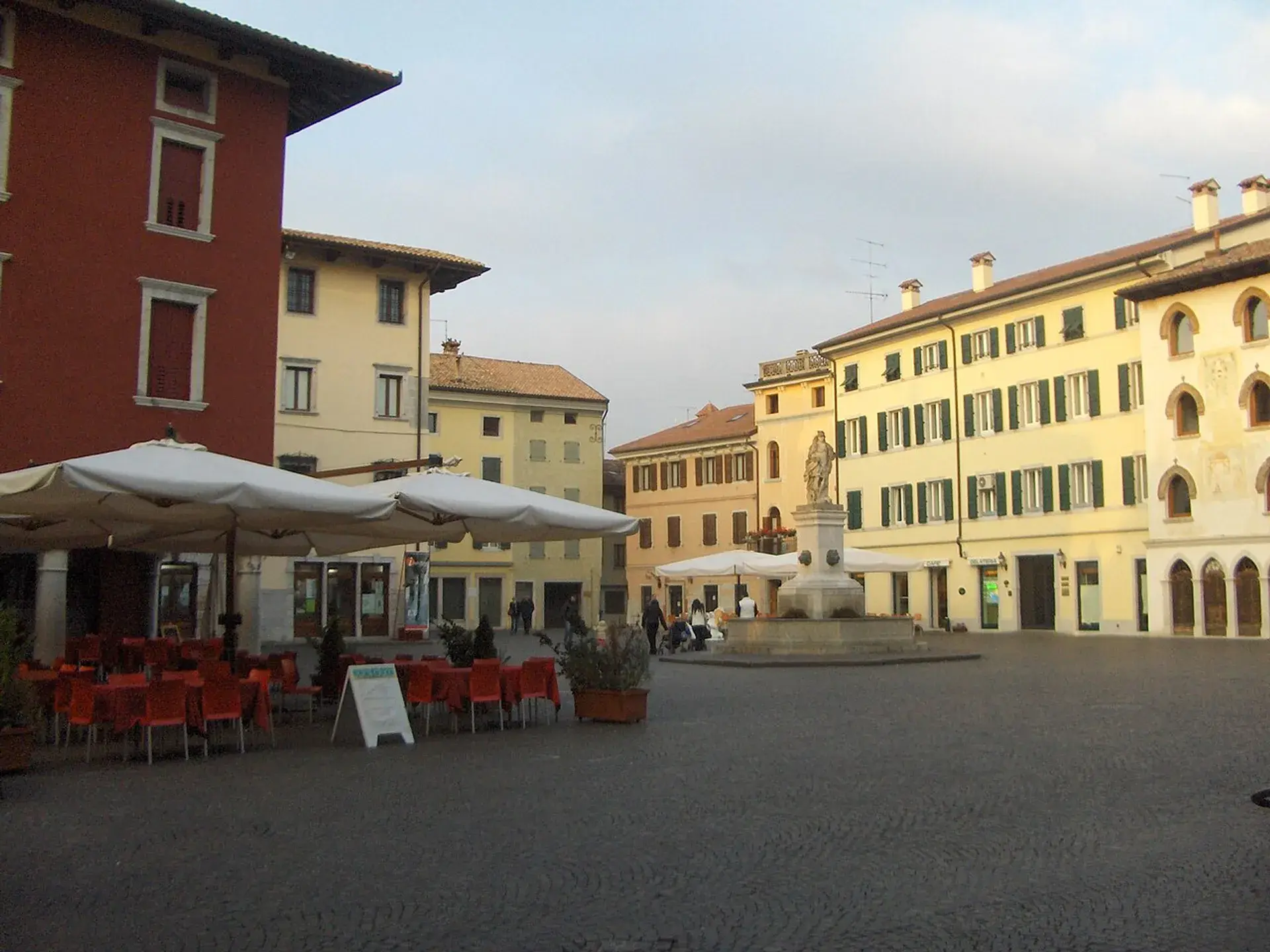
Piazza Paolo Diacono is an irregular quadrilateral square situated southeast of the ancient Roman cardo maximus in the historic center of Cividale del Friuli. Subterranean excavations show that the area encompasses multiple eras of habitation, including the remains of Roman domestic dwellings (domus) and public baths from the ancient city of Forum Julii, followed by early medieval burials.
In 1874, municipal workers digging two meters below the paving stones to repair aqueduct pipes accidentally struck a heavy early medieval stone sarcophagus attributed to Duke Gisulf I. The intact grave goods recovered from the burial included gold-thread textile fragments, a gold sheet cross, a glass votive vessel, and a signet ring set with a coin of Emperor Tiberius. Today, a commemorative paving stone near the former Monte di Pietà marks the spot of the discovery.
Market Traditions and Historic Architecture
Throughout the Middle Ages, the square served as the primary open-air civic assembly point for magistrates and local citizens. Historically known as Piazza del Mercato and Piazza della Fontana, it also earned the moniker Piazza delle Donne (Women's Square). This title referred to the rivindiulis, peasant women from surrounding valleys who gathered weekly in the square to sell produce and fresh herbs.
Before the construction of the square's permanent stone fountain, the center held an elevated wooden chapel dedicated to the Santissima Annunziata. Demolished in 1803, this structure allowed a priest to celebrate morning Mass directly above the marketplace so vendors could attend religious services without abandoning their goods.
Today, the perimeter of the piazza displays a blend of medieval and Renaissance architecture with low covered porticoes, exposed masonry, and painted facades. At No. 29 stands the 14th-century Casa di Paolo Diacono, notable for its terracotta-moulded single-lancet windows and remnants of exterior frescoes. Although local tradition identifies this building as the family home and birthplace of the chronicler, no documentary proof survives to verify the exact domestic plot.
The Central Fountain and Modern Civic Life
A municipal conduit has fed water to the square since 1277. The present fountain basin was installed in 1824 and carved out of local pietra piasentina stone. It features four carved lion-head spouts spilling water into the basin and is surmounted by a classical stone statue depicting Athena (Minerva), which was brought from Villa Manin di Passariano.
In 1898, the square was formally dedicated to the 8th-century Lombard scholar and Benedictine monk Paul the Deacon (Paolo Diacono), who was born in Cividale around 720 AD and authored the foundational chronicle Historia Langobardorum. Positioned just northwest of Piazza del Duomo, Piazza Paolo Diacono serves as the relaxed civic counterpart to Cividale's administrative and religious center. It functions as a pedestrian hub lined with café terraces, gelato shops, and osterias serving regional Friulano wine, while continuing to host seasonal food vendors and open-air cultural performances.
FAQ
Who was Paul the Deacon?
Paul the Deacon (Paolo Diacono) was an 8th-century scholar, tutor, and Benedictine monk born in Cividale del Friuli around 720 AD. He wrote the Historia Langobardorum, which serves as the primary historical written source on the Lombard kingdom in Italy. The square was officially named in his honor in 1898.
What archaeological finds were uncovered beneath the square?
Excavations beneath the square revealed Roman domestic houses and bath structures from ancient Forum Julii, as well as early medieval burials. In 1874, municipal workers accidentally discovered the stone sarcophagus of Duke Gisulf I, which contained intact artifacts including gold-thread fabric, a gold cross, and a signet ring set with an ancient coin of Emperor Tiberius.
Why was the square historically called Piazza delle Donne?
The square was nicknamed Piazza delle Donne because peasant women known as rivindiulis came from the surrounding valleys every week to set up outdoor stalls and sell herbs and agricultural produce.