Ponte del Diavolo in Cividale del Friuli
An Architectural Feat Over the Natisone Gorge
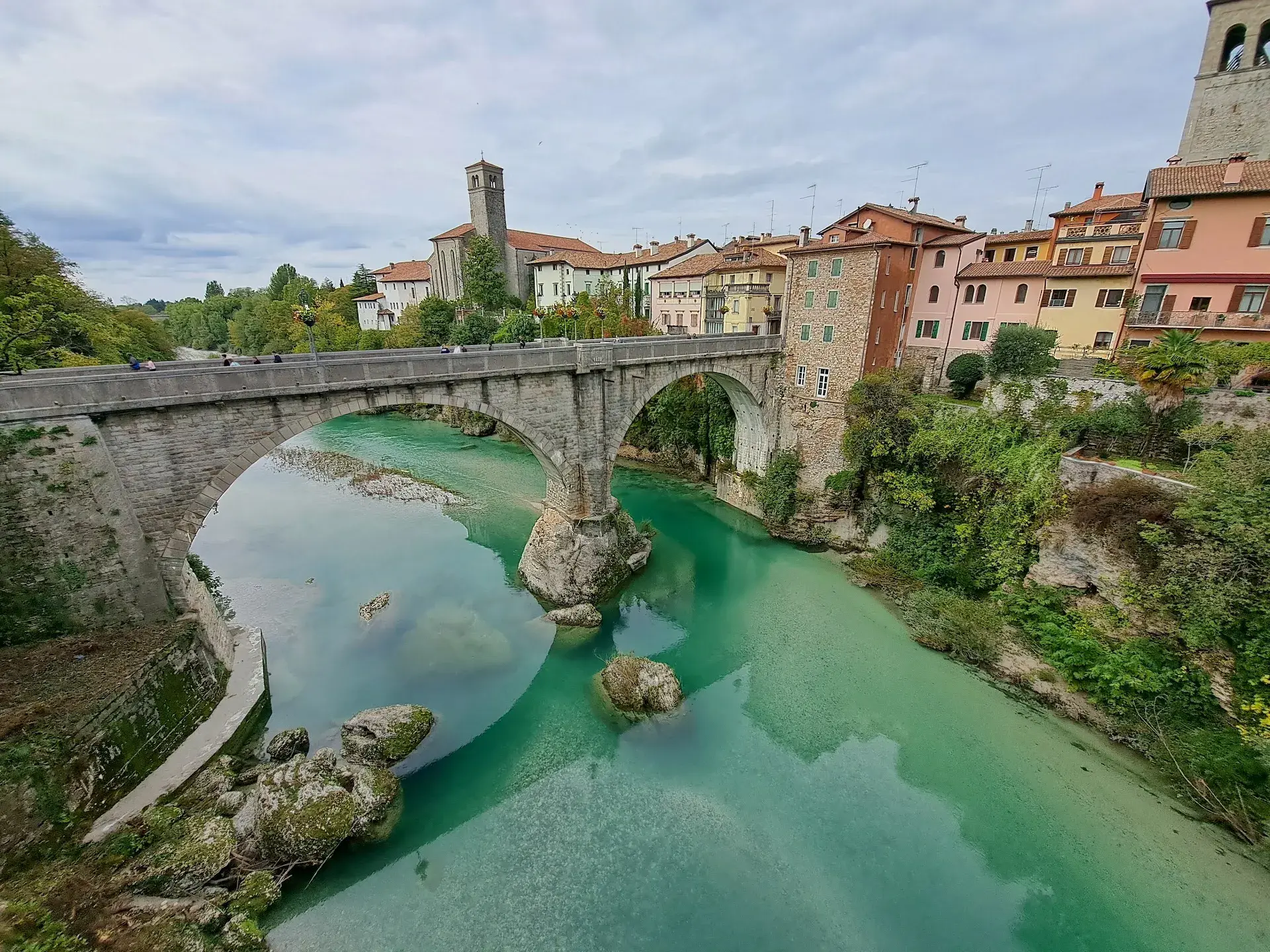
Spanning the deep limestone chasm of the Natisone River in Cividale del Friuli, the Ponte del Diavolo—known in the local Friulian language as Puìnt dal Diàul—stands as the primary civic emblem of the historic town. The stone masonry bridge rises approximately 22.5 meters above the riverbed, measuring 3.6 meters in width and between 48 and 50 meters in length.
Its structural profile is defined by two distinctly asymmetrical arches measuring 22 meters and 19 meters across. This uneven layout was a deliberate engineering solution: it allowed the central masonry pier to rest securely upon a massive, naturally occurring limestone boulder lodged in the riverbed. Beneath these arches, clear turquoise and emerald-green waters course through pale rock walls, sending the deep acoustic echoes of the rushing river up through the gorge.
Centuries of Construction and War
Prior to the stone crossing, documented timber bridges had spanned the gorge since the 13th century, though recurrent flash floods regularly swept them away. The transition to stone began in December 1441, when master builder Iacopo Dugaro da Bissone contracted with the municipality. Construction commenced in 1442, but following Dugaro's death in 1445, master builder Erardo Villach assumed oversight. Engineering hurdles, technical setbacks, and the loss of successive architects extended the project over decades, culminating in the bridge’s final stone paving in 1558.
Centuries later, the landmark was caught in the turmoil of modern warfare. On October 27, 1917, during the retreat from the Battle of Caporetto, Italian troops dynamited the bridge to slow the enemy advance. The occupying Austro-Hungarian military immediately initiated its reconstruction under architect Anselmo Nowak. Utilizing the original plans, the crossing was rebuilt in stone in roughly seven months and reopened on May 18, 1918. Retreating German forces inflicted minor damage in 1945, which was repaired in the mid-20th century.
The Legend of the Demonic Pact
The prolonged and troubled construction period gave rise to local folklore. According to legend, the master builders grew desperate over their inability to tame the torrent and appealed to the Devil. In exchange for the soul of the first living being to cross, the Devil agreed to complete the structure overnight by hurling a giant boulder into the riverbed to anchor the foundation. At dawn, the townsfolk outwitted him by driving an animal across first—recorded in varying oral traditions as a cat, a dog, or a pig. Deprived of a human soul, the enraged Devil had to accept the animal, and local lore claims that faint grunting sounds occasionally heard near the base of the boulder are his phantom cries.
Modern Role and Civic Emblem
Today, the bridge functions as an active route linking Corso Paolino d'Aquileia in the historic city center to the Borgo di Ponte quarter. It also forms a scenic threshold between the residential district and the town's core attractions, including the Lombard Tempietto, the Cathedral, and the National Archaeological Museum.
Regulated by municipal traffic guidelines, the bridge carries light local vehicular traffic on weekdays. It transforms into a pedestrian-only zone on weekends, summer evenings, and during civic celebrations such as the Mittelfest. In addition to serving urban transit, the bridge provides a panoramic vantage point over the Natisone gorge, the historic riverfront facades, and the Julian Prealps.
FAQ
Why is the bridge designed with asymmetric arches?
The asymmetric arches, measuring 22 and 19 meters, were engineered to anchor the central pier directly onto a large natural limestone boulder positioned in the riverbed.
Who rebuilt the bridge after its destruction in World War I?
After retreating Italian troops blew up the bridge in October 1917, occupying Austro-Hungarian forces reconstructed it to its historical form under architect Anselmo Nowak, reopening it in May 1918.
When is the bridge open to pedestrians versus vehicles?
The bridge carries light vehicular traffic on weekdays and converts to a pedestrian zone on weekends, summer evenings, and during festivals like Mittelfest.
Discover Cividale-del-friuli like never before
Dive into Cividale-del-friuli hidden stories and secret spots with Ciceru interactive tours.
Explore tour
Audioguide
Quizzes
Maps
Solo
Couples
Groups & families

© Photo by Volker Schlechta via Google Maps · Google Places