Basilica of Saint Margaret: Cortona's Sacred Summit
The Hilltop Sanctuary of Cortona
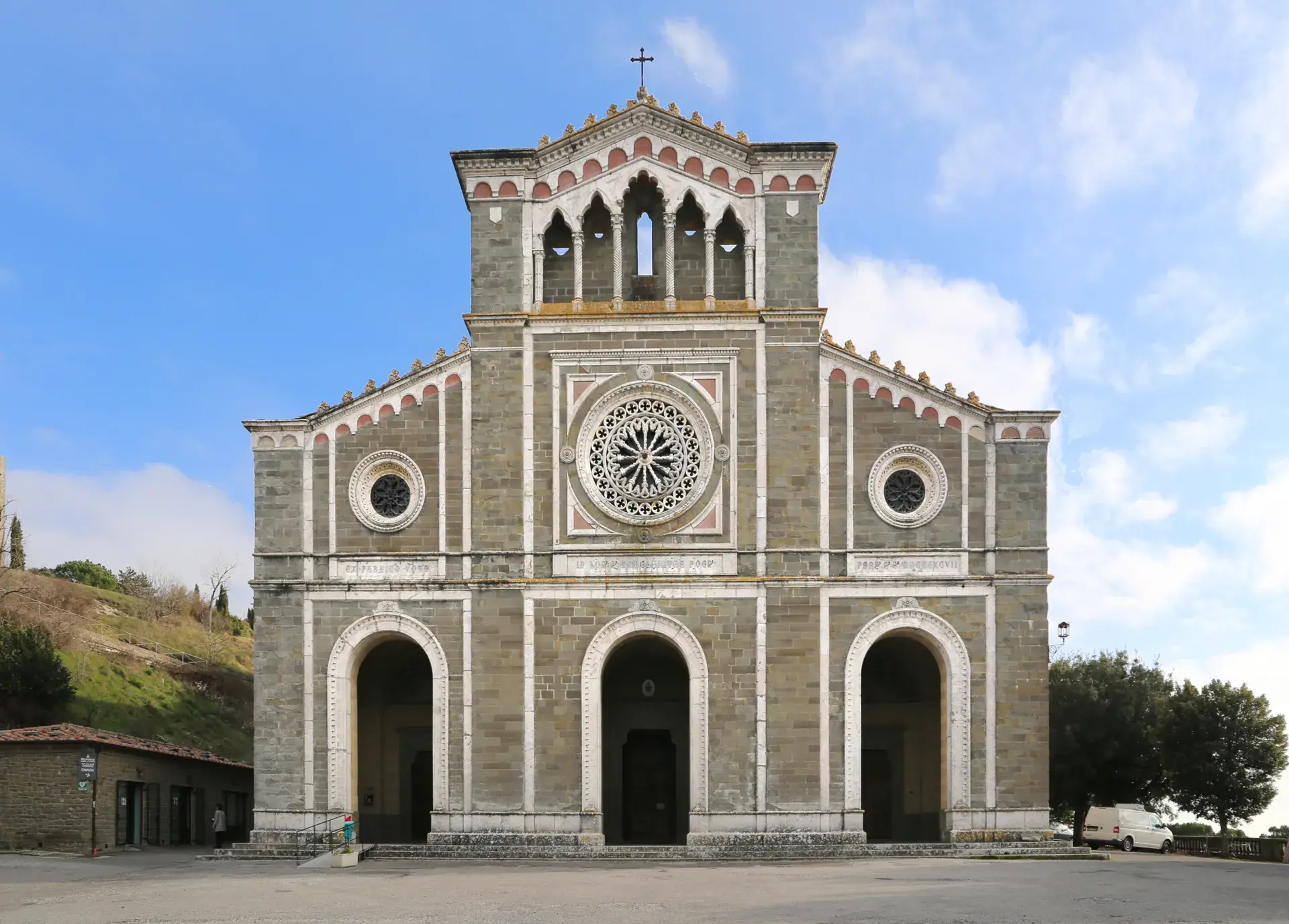
The Basilica of Saint Margaret of Cortona (Basilica di Santa Margherita) crowns the crest of Monte Sant’Egidio, resting directly below the Medici fortress, the Fortezza del Girifalco. Situated on Piazzale Santa Margherita at the upper boundary of Cortona, the site serves as the city’s primary religious summit. Outside, the stone and gravel square provides expansive views spanning terraced olive groves, the Valdichiana plain, and Lake Trasimeno.
The exterior of the basilica presents a late 19th-century Roman Catholic Gothic Revival facade, designed by Enrico Presenti, Mariano Falcini, Domenico Mirri, and Giuseppe Castellucci. Despite the 19th-century reconstruction, the complex incorporates surviving elements from earlier architectural phases, including a 14th-century Gothic rose window, choir walls, and an adjoining bell tower.
Life and Legacy of Saint Margaret
The religious complex originated as an 11th-century Camaldolese oratory dedicated to San Basilio, which was ruined in 1258 during the sacking of Cortona by troops from Arezzo. Between 1288 and 1290, Margaret of Cortona (1247–1297), a Franciscan tertiary who had spent years caring for the sick and impoverished in the town below, gained permission to repair the ruined hilltop chapel. She lived her remaining years in a small cell adjacent to the sanctuary until her death on February 22, 1297.
According to Catholic tradition, Margaret's religious conversion occurred after her pet hound led her to the hidden shallow grave of her murdered lover, Arsenio Del Pecora. Because of this narrative, she is frequently depicted in religious iconography alongside a dog. Today, she is honored as the patron saint of Cortona and the Catholic patroness of single mothers, penitents, reformed sinners, the falsely accused, and homeless individuals.
Following Margaret’s death, the citizens of Cortona commissioned a larger Gothic church between 1297 and 1330 to welcome arriving pilgrims, integrating the original oratory into the nave. In 1728, Pope Benedict XIII formally canonized Margaret. This prompted architectural modifications in 1738, culminating in a major neo-Gothic reconstruction between 1874 and 1897 that established the current three-nave layout.
Interior Art and Sacred Relics
Inside the basilica, bright neo-Gothic pigments and star-patterned ribbed vaults contrast with the austere exterior stone. Over the high altar, an elevated 17th-century silver and glass casket designed by Pietro da Cortona houses the body of Saint Margaret. In the left transept stands a 14th-century marble funerary monument dedicated to the saint, attributed to followers of Giovanni Pisano, traditionally identified as Angiolo and Francesco di Pietro.
A transept chapel preserves a 13th-century wooden crucifix that, according to Franciscan tradition, spoke directly to Margaret to call her to Cortona and assure her of divine mercy. Historically, the basilica also displayed an Ottoman naval banner captured from the flagship of Ali Pasha during the Battle of Lepanto in 1571. In the 20th century, Pope John XXIII returned the banner to Turkish representatives as an ecumenical gesture.
The Severini Way of the Cross and Practical Details
The basilica marks the conclusion of Cortona's classic uphill route, connected to the lower historic center by the steep Via Santa Margherita. Flanked by cypress trees and paved flagstones, this pathway features a 15-station outdoor mosaic Way of the Cross. Created in the 1940s by Cortona-born Futurist artist Gino Severini, the mosaic cycle was installed in gratitude for the town surviving devastation during World War II.
The Basilica di Santa Margherita functions as an active Roman Catholic church and pilgrimage site, welcoming visitors daily with free admission. Each year on February 22, Cortona commemorates Margaret’s feast day with liturgical celebrations, processions, and a civic-religious ceremony during which the silver casing protecting her casket is opened using historic ceremonial keys.
FAQ
What is the architectural style of the Basilica of Saint Margaret?
The basilica features a late 19th-century Roman Catholic Gothic Revival exterior and a three-nave interior with star-patterned ribbed vaults. It also preserves historic elements from a 14th-century Gothic church, including its bell tower, choir walls, and rose window.
Which relics and artworks are preserved inside the basilica?
The church houses an elevated 17th-century silver and glass casket containing the body of Saint Margaret, designed by Pietro da Cortona. Other notable works include a 14th-century marble funerary monument attributed to followers of Giovanni Pisano and a 13th-century wooden crucifix.
What is the mosaic pathway leading to the basilica?
The steep Via Santa Margherita features a 15-station outdoor mosaic Way of the Cross designed in the 1940s by Cortona-born Futurist artist Gino Severini.
What occurs at the basilica during the feast day of Saint Margaret?
Annually on February 22, the church holds patronal festivities including solemn services, processions, and a ceremony in which the silver casing surrounding Margaret's casket is unlocked with historic ceremonial keys.