Chiesa di San Francesco, Cortona: History & Relics
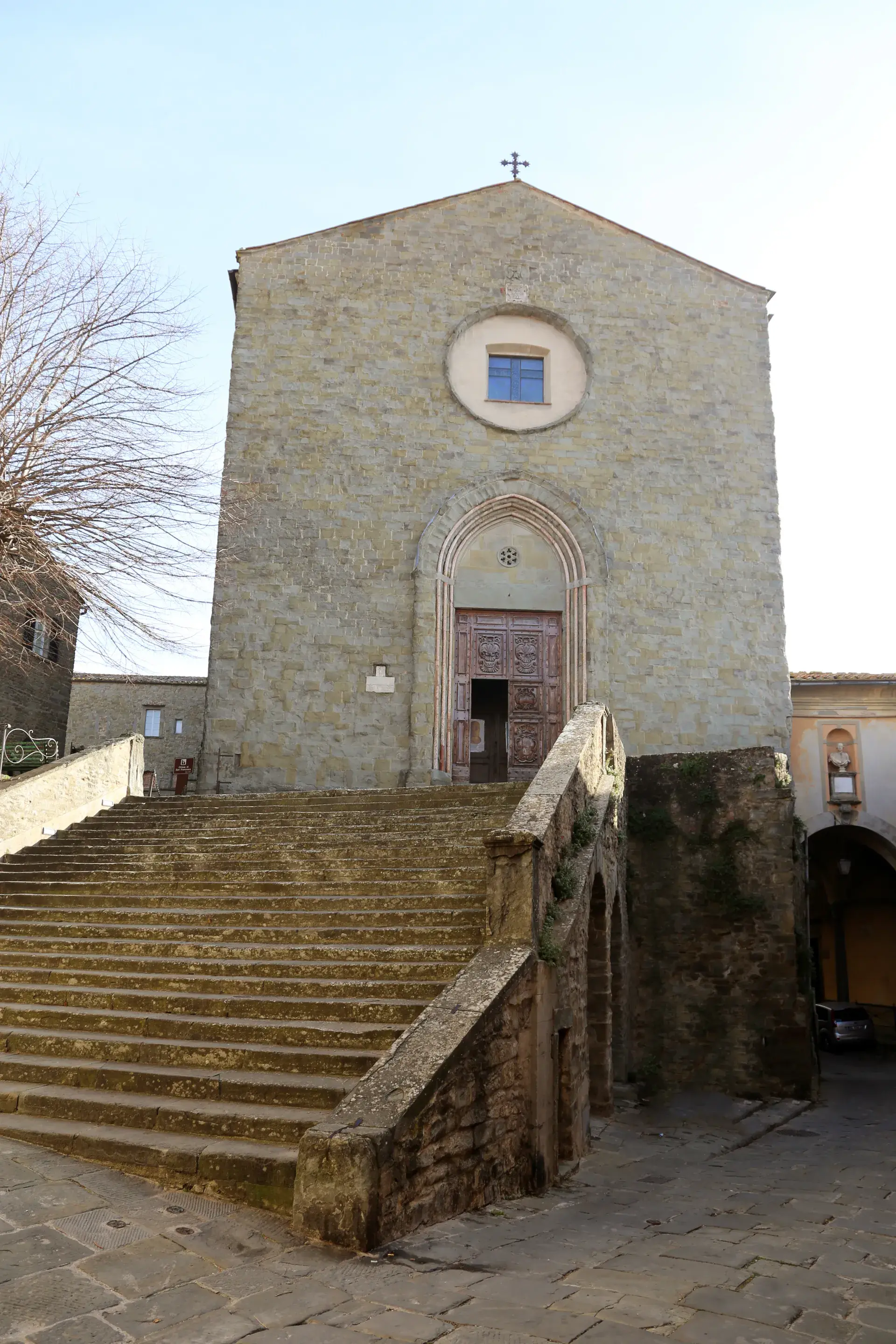
Positioned on an artificial terrace above ancient Roman bath remains known as the Balneum Reginae, the Chiesa di San Francesco stands along Via Berrettini in Cortona. Built between 1245 and 1247, this early Gothic church marks the historical transition between Cortona's civic core and the upper monastic precinct extending toward the Girifalco Fortress. Alongside the hermitage of Le Celle outside the walls, the complex serves as the foundational anchor of the Franciscan order within the medieval city.
The Vision of Brother Elias
The construction of the church was initiated by Brother Elias (Frate Elia), one of Saint Francis of Assisi’s closest early companions and a former Minister General of the Franciscan Order. After overseeing the construction of the monumental Basilica of San Francesco in Assisi, Elias became embroiled in factional conflicts within the order, leading to his excommunication in 1240 due to his close alignment with Holy Roman Emperor Frederick II.
Taking refuge in Ghibelline Cortona, Elias secured a municipal land grant in 1245 to erect a major Franciscan center inside the city walls. Using his personal prestige and diplomatic connections with the Byzantine imperial court and Roman nobility, Elias accumulated major holy items. His intention was to establish Cortona as an alternative devotional center capable of rivaling Assisi.
Authentic Relics of Saint Francis
The church preserves an exceptional collection of early Franciscan relics. Among the items safeguarded here are Saint Francis's rough habit, an embroidered mortuary cushion, and a manuscript Gospel. In 2007, radiocarbon dating conducted by the Nuclear Physics Laboratory in Florence confirmed that the Cortona tunic and cushion originate from the exact period of Francis's lifetime, scientifically authenticating their provenance.
The church also houses a tenth-century Byzantine ivory and silver staurotheke, a reliquary holding a fragment of the True Cross. According to tradition, this reliquary was presented directly to Brother Elias during a diplomatic embassy in Constantinople undertaken on behalf of Frederick II.
Architecture and Counter-Reformation Art
The architecture of the church reflects early Franciscan conventions. It features a single wide nave set beneath exposed timber roof trusses, terminating in three groin-vaulted rectangular apse chapels. The exterior retains its fourteenth-century Gothic splayed portal and a stone-framed rose window.
While the medieval structural shell remains intact, the interior underwent significant remodeling during the Counter-Reformation in the late sixteenth and seventeenth centuries. Tridentine-era side altars were added to the nave, introducing notable Baroque works. Highlights include Pietro da Cortona’s Annunciation, Lodovico Cardi's (Cigoli) Miracle of the Mule, Raffaello Vanni’s Nativity, and paintings by Ciro Ferri.
Historical Burials and Continuing Worship
The church holds the tomb of its founder, Brother Elias, situated within the sanctuary. In the lower church, historical records document the crypt burial site of Renaissance master Luca Signorelli, who died in Cortona in 1523. The lower church also hosted the Confraternity of Santa Maria della Laude, where Cortona’s patron saint, Saint Margaret, was a member and is traditionally said to have received Christ's forgiveness before its crucifix.
Today, the Chiesa di San Francesco remains an active Catholic church and friary maintained by the Order of Friars Minor Conventual. It continues to welcome pilgrims and visitors daily for religious worship, study supported by the Centro Studi Frate Elia da Cortona, and the veneration of its historic relics.
FAQ
Who founded the Chiesa di San Francesco in Cortona?
The church was founded between 1245 and 1247 by Brother Elias (Frate Elia), an early companion of Saint Francis and former Minister General of the Franciscan Order.
What Saint Francis relics are kept at the church?
The church preserves Saint Francis's habit, an embroidered mortuary cushion, and a manuscript Gospel. In 2007, radiocarbon testing verified that the habit and cushion date directly to Francis's lifetime.
What famous artworks are located inside the church?
The church's Baroque altars house significant works, including Pietro da Cortona's Annunciation, Cigoli's Miracle of the Mule, and paintings by Raffaello Vanni and Ciro Ferri.
Who is buried in the Chiesa di San Francesco?
The church contains the tomb of Brother Elias, and the crypt is documented as the burial site of Renaissance painter Luca Signorelli.