Piazza della Repubblica in Cortona: History & Sights
Ancient Origins and Civic Foundations
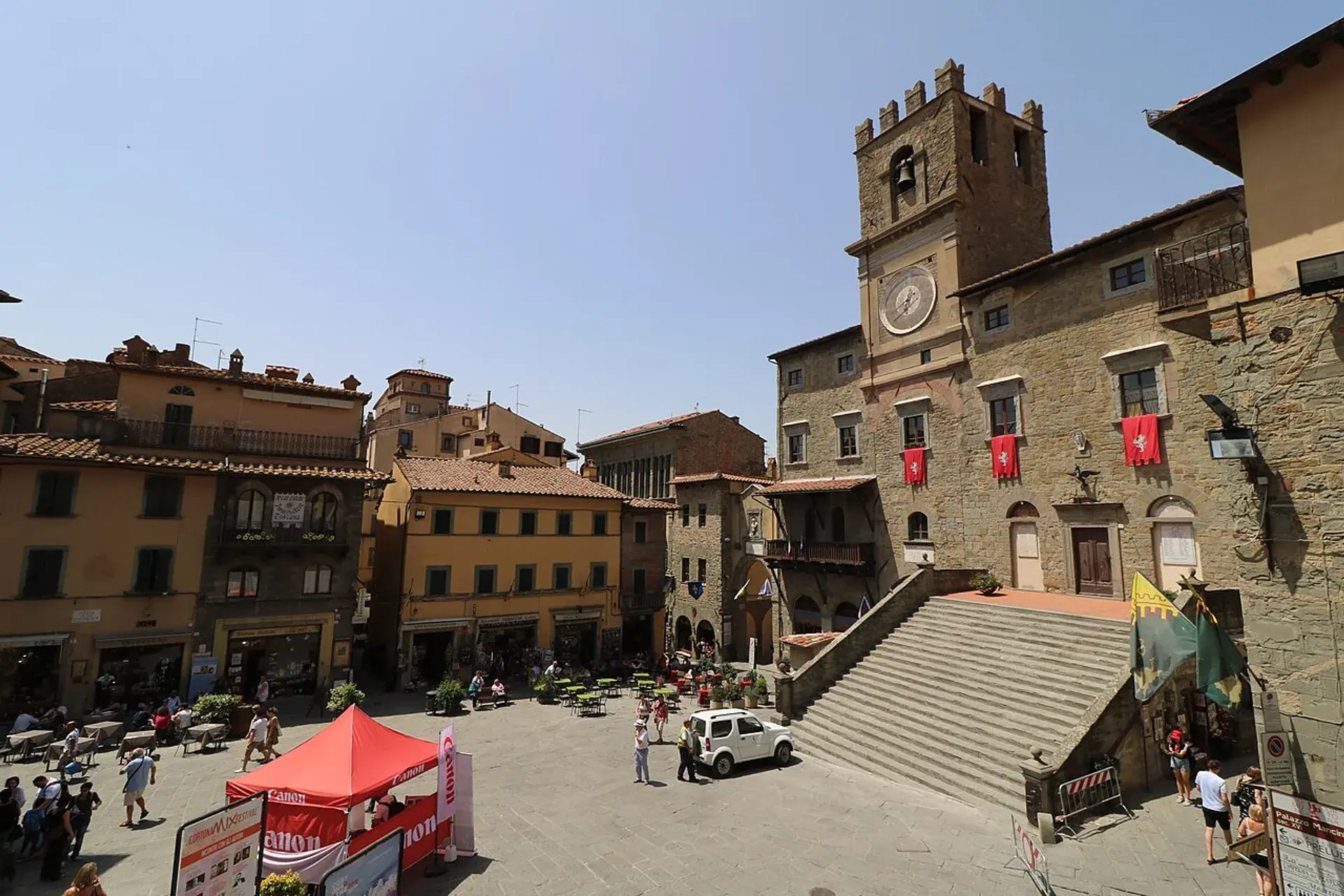
Situated at an elevation of roughly 500 to 600 meters above sea level, Piazza della Repubblica forms the historical core of Cortona. The square occupies the footprint of the ancient Roman forum, positioned at the original intersection of the settlement's primary thoroughfares: the north-south cardo and the east-west decumanus.
During the town's development as an independent medieval commune, the site evolved into the epicenter of civic governance. Opposite the 13th-century Palazzo del Capitano del Popolo, municipal authorities erected the Palazzo Comunale—originally designated as the Palazzo dei Priori—between the late 12th and 13th centuries. Built to house magistrate council meetings, the original municipal structure began as a single expansive assembly chamber.
Architecture of the Palazzo Comunale
Over the centuries, the Palazzo Comunale expanded to reflect shifting political administrations. Under Florentine authority in the 16th century, the building gained its prominent clock tower (Torre dell'Orologio), an arched loggia, and a significantly widened monumental staircase made of grey pietra serena sandstone. Architectural emblems still reflect these alliances: a 16th-century Florentine lion, or Marzocco, stands adjacent to the facade facing neighboring Piazza Signorelli, while the civic coat of arms featuring the Lion of Saint Mark is set directly above the entrance atop the exterior stairs.
Beneath the civic complex lies an unusual urban feature: the medieval vault constructed in the early 14th century allows an active public street, Via Roma, to pass directly under the building. In the late 19th century, architect Giuseppe Castellucci directed extensive structural and stylistic restorations, concluding around 1896 to restore the Romanesque and medieval aesthetic visible today.
Modern Civic Life and Traditions
The Palazzo Comunale continues to operate as Cortona’s working municipal hall. Civic administration operates within its walls, and civil ceremonies frequently take place inside the frescoed 13th-century Sala del Consiglio.
Outside, the monumental pietra serena stairs serve as an open-air gathering space. Centuries of foot traffic have worn the sandstone steps smooth, creating a natural amphitheater where the enclosed square reflects the sounds of civic bells and daily conversation. The square regularly hosts civic ceremonies, such as the Colata dei Ceri (candle-offering ritual) and costumed processions for the Giostra dell'Archidado, an annual pageant commemorating the 1397–1398 wedding of Cortona’s ruler, Francesco Casali, to the Sienese noblewoman Antonia Salimbeni.
Urban Crossroads and Cultural Prominence
Piazza della Repubblica acts as the central junction for Cortona's street network. The square connects directly to Piazza Signorelli, Via Guelfa, Via Ghibellina, and Via Nazionale, which is renowned as the town's only level pedestrian street. Within the town’s layout, it serves as the primary midpoint linking lower approaches, such as Piazza Garibaldi, to the uphill climbs leading toward the Cathedral and the Girifalco Fortress.
The square's architectural backdrop also earned international recognition in contemporary cinema, serving as a prominent filming location in Roberto Benigni’s 1997 Academy Award-winning film Life is Beautiful (La vita è bella).
FAQ
What ancient site lies beneath Piazza della Repubblica?
The square is positioned on the site of Cortona's ancient Roman forum, directly at the intersection of the historical cardo and decumanus.
What street passes underneath the Palazzo Comunale?
Via Roma passes directly beneath the Palazzo Comunale through an arched medieval vault built in the early 14th century.
What historical event does the Giostra dell'Archidado commemorate in the square?
The Giostra dell'Archidado pageantry commemorates the 1397–1398 wedding celebrations uniting Francesco Casali, the Lord of Cortona, and the Sienese noblewoman Antonia Salimbeni.
Which award-winning film was shot in Piazza della Repubblica?
The square served as a filming location for Roberto Benigni's 1997 Oscar-winning film, Life is Beautiful (La vita è bella).