Porta Colonia: Cortona's Ancient Northern Gate
Cortona's Historic Northern Portal
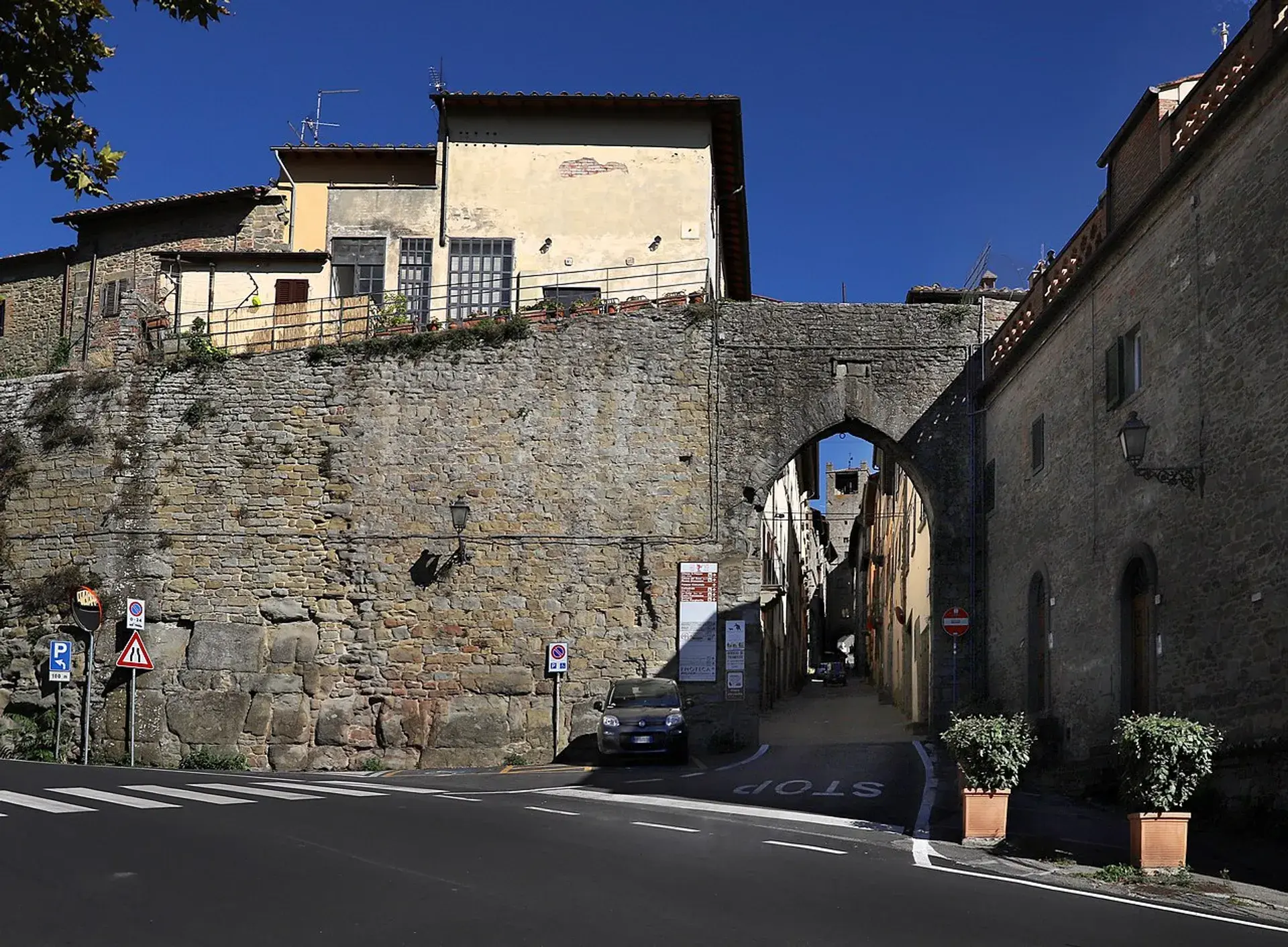
Porta Colonia stands on the northern perimeter of Cortona, forming an integral part of the town's roughly three-kilometer defensive wall circuit. Of the eight gates documented during the Renaissance and the ten that existed in antiquity, it is one of only six historic gateways that survive today. Positioned adjacent to the exterior parking area at Piazza Mazzini, the gate serves as an active northern arrival threshold for pedestrians and authorized local vehicles entering the historic center.
From the exterior, the portal frames an open landscape of terraced olive groves and the Renaissance dome of the Church of Santa Maria Nuova nestled on the slopes below. Inside the gate, the urban fabric opens into the northern terminus of Via Dardano, which winds uphill toward central landmarks such as Piazza Signorelli and Piazza della Repubblica.
Multi-Layered Architecture and Ancient Drainage
The construction of Porta Colonia reveals centuries of architectural layering. At the foundation level, the gate rests on colossal, dry-stacked Etruscan ashlar blocks dating to the 4th-century BCE defensive ring. At eye level, these massive stones transition abruptly into compact, mortared fieldstone added during medieval and Renaissance reconstructions to create the current rounded arch.
Historical surveys of the defensive walls above Porta Colonia revealed a notable engineering detail: a preserved drainage spout embedded directly into the original Etruscan masonry. This drainage element has remained in situ despite centuries of urban rebuilding and military fortification.
Centuries of Conflict and Fortification
Following the Roman conquest of the ancient Etruscan settlement of Curtun, the town's cardinal gates were maintained. The name Porta Colonia directly reflects this era, referencing a Roman colony settled in the Valdichiana plain below the hill.
The gate's position within the town layout was fundamentally altered in the 13th century. After Guelph forces from Arezzo sacked and destroyed Cortona in 1258, the municipal government, supported by Siena, rebuilt the town's defense network and street plan. As part of this reorganization, the gate was linked to Via Dardano, which was intentionally designed as an inflected arc rather than a straight Roman cardo. In the mid-16th century, Duke Cosimo I de' Medici commissioned military architects to overhaul the fortifications once more, updating the approaches to the urban gates to withstand modern artillery warfare.
Connections to Via Dardano and Santa Maria Nuova
Beyond its structural history, Porta Colonia serves as a starting point for exploring Cortona's heritage. The road originating at the gate, Via Dardano, is lined with 14th-century stone dwellings that still feature walled-in porte del morto (doors of the dead), narrow elevated doorways characteristic of medieval residential architecture.
Outside the gate, the downhill path descends toward the Church of Santa Maria Nuova. Erected in the 1550s as an isolated Greek-cross sanctuary, the church was designed by architects Battista di Cristofanello and Giorgio Vasari, maintaining a direct visual and historic link to the Medicean-era defenses above.
FAQ
Why is the gate called Porta Colonia?
The name references a Roman colony settled in the Valdichiana plain below the hill following the Roman conquest of the Etruscan city of Curtun.
What makes the masonry of Porta Colonia unique?
The gateway features a visible blend of periods, starting with colossal, dry-stacked Etruscan ashlar blocks from the 4th century BCE at the base, topped by mortared medieval and Renaissance masonry forming the arch.
What sites are located near Porta Colonia?
Porta Colonia connects internally to Via Dardano, known for medieval houses with walled-in 'porte del morto,' and leads externally down the slope to the 16th-century Church of Santa Maria Nuova.