Palazzo Cittanova: Cremona’s Medieval Broletto
Origins of a Popular Town Hall
Palazzo Cittanova stands along Corso Garibaldi in Cremona, anchoring the northern expansion of the historic center. Positioned directly opposite the Church of Sant'Agata, the building marks the line where medieval Cremona grew beyond the Cremonella canal and the former Roman walls. An inscription embedded in the facade dates its founding to 1256 under the rule of Lord Uberto (Oberto II) Pallavicino, naming Michele Bontempo and Gabriele de Pastore as its builders.
Constructed during the communal era, the palace served as the headquarters for the Società del Popolo and the Consiglio della Città Nova. It was deliberately conceived as a civic and political counterweight to the traditional ecclesiastical and noble power centered around the Duomo and Palazzo Comunale at Piazza del Comune, embodying the rising influence of the city's merchant and artisan classes.
Lombard Broletto Architecture
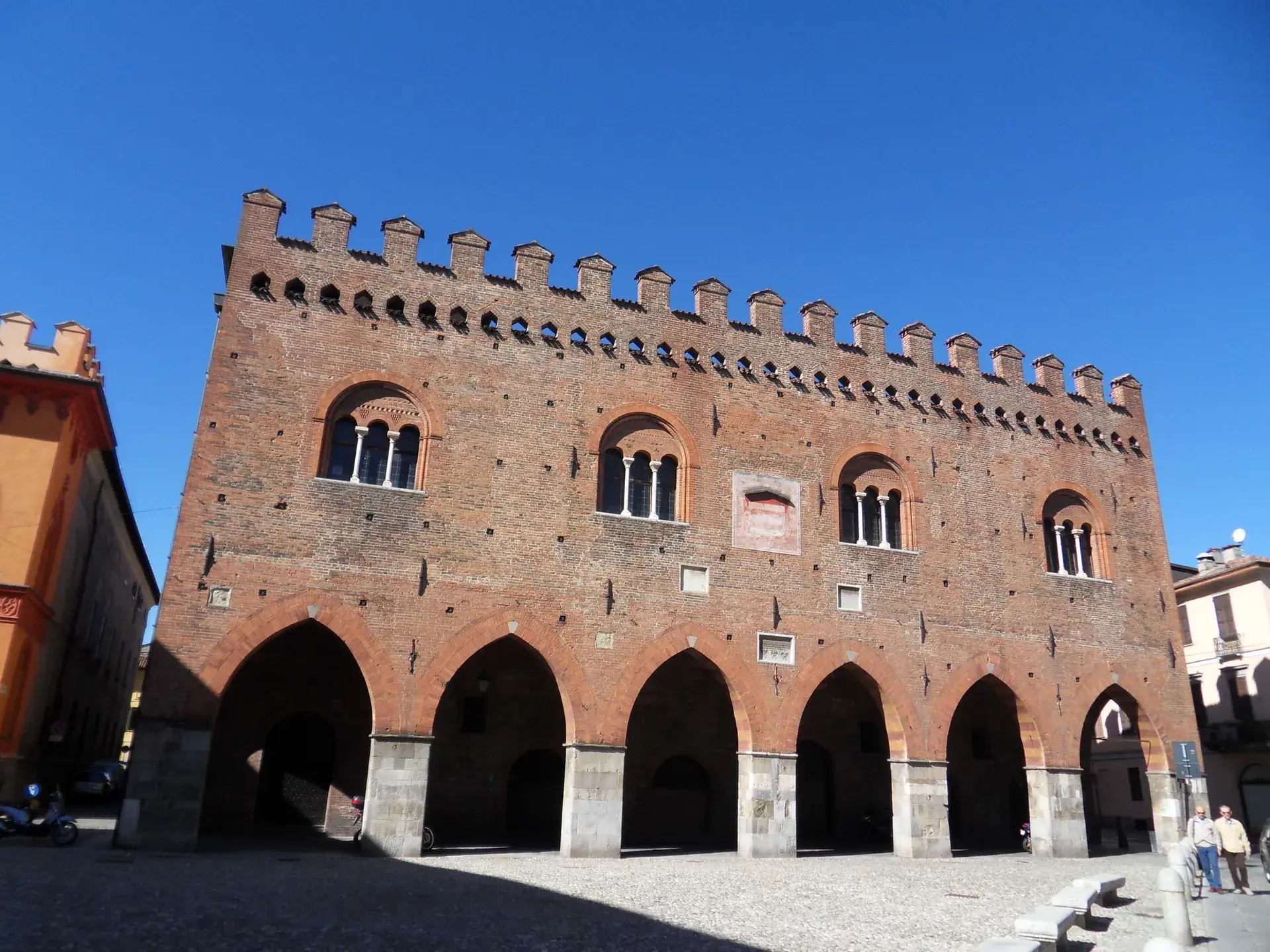
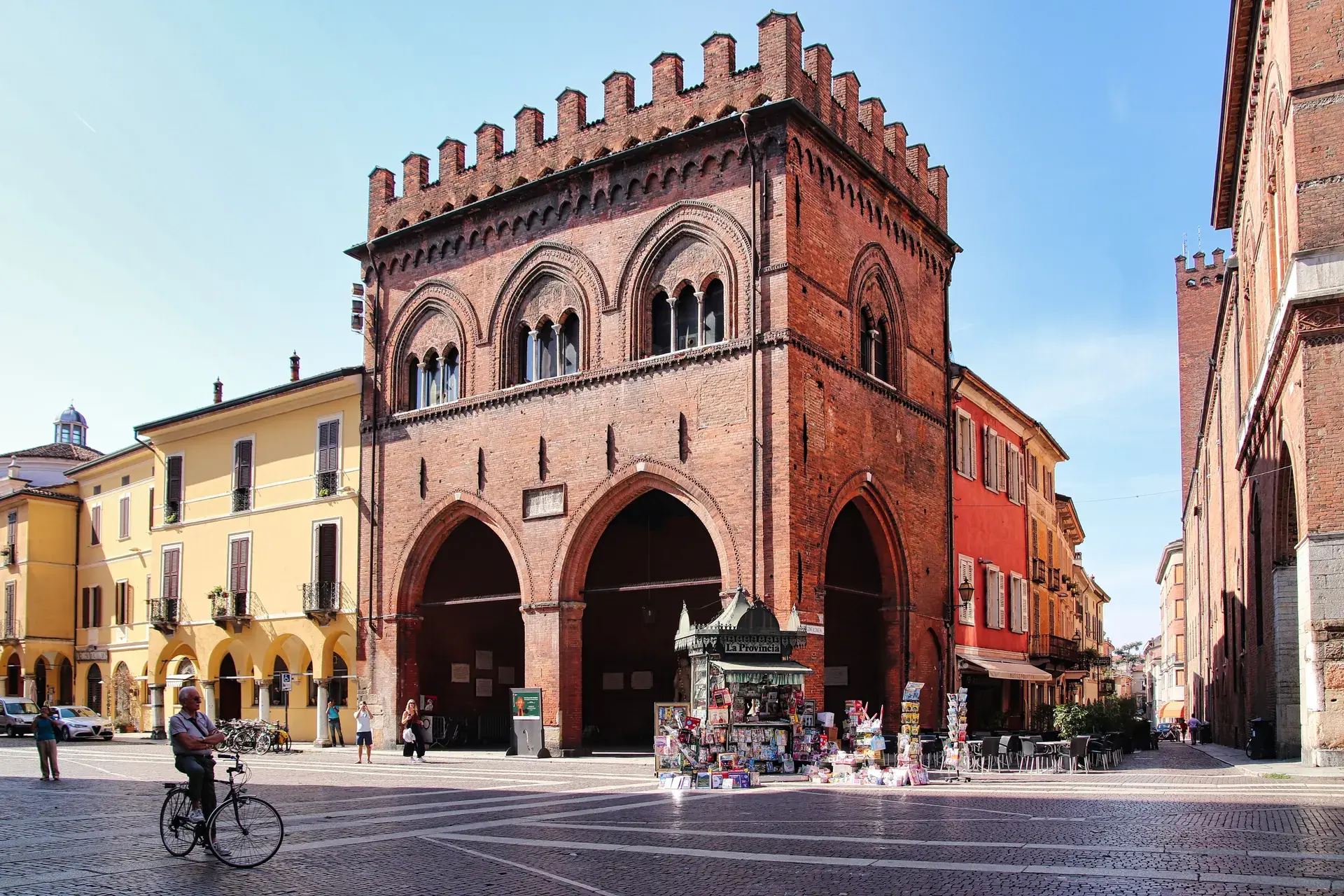
The structure is a classic example of a Lombard broletto, built entirely from red brick. At street level, an open public portico features pointed ogival arches resting on stone pillars beneath a timber coffered ceiling. A squat, square brick staircase tower anchors the southwest corner of the exterior.
Above the portico, the upper level houses a single expansive assembly room illuminated by four three-light mullioned windows, or trifore, flanked by slender colonnettes and capitals carved from pink marble. The roofline is capped by merlons, which were originally swallowtail (coda di rondine)—a classic architectural marker of Ghibelline loyalty—prior to later renovations. The facade also displays conflicting historical inscriptions: one honors the Ghibelline leader Uberto Pallavicino's 1256 foundation, while another asserts that the palace was constructed under the rival Guelph faction.
From Guild Headquarters to Military Barracks
Over the centuries, the palace shifted roles in response to Cremona's changing civic landscape. In 1411–1412, the complex was granted to the guild of fustian, cotton, and linen weavers and merchants (Università e Paratico dell’arte del pignolato, del bombace e del panno del lino), who retained control of the site for generations.
Between 1756 and 1765, the communal palace was converted into military barracks. Its ground floor later housed the civic Gran Guardia until 1860, while the grand hall on the upper level was repurposed from 1805 to 1913 as the municipal notary archive.
Demolition Threat and Modern Restoration
By the late 19th century, centuries of heavy use and neglect left the structure at risk. In 1883, the Cremona city council voted unanimously to demolish Palazzo Cittanova to avoid high maintenance expenses, a measure supported by local socialist politician Leonida Bissolati. In 1886, a subsequent council vote reversed the decision, ensuring the historic landmark survived.
A comprehensive restoration project led by engineer Emilio Gussalli took place between 1913 and 1927. The works removed internal military partition walls to re-establish the medieval single-hall volume and restored the historic coffered ceilings. Owned by the Municipality of Cremona, the upper level features a 300-seat civic auditorium and conference space, with public events periodically restricted to accommodate fire-safety and mechanical infrastructure upgrades.
FAQ
Why was Palazzo Cittanova built?
It was constructed in 1256 to house the Società del Popolo and the Consiglio della Città Nova, establishing a civic and political counterweight to the aristocratic and episcopal authority based at Piazza del Comune.
What architectural style is Palazzo Cittanova?
It is a 13th-century Lombard broletto constructed entirely in red brick, featuring an open ground-floor portico with ogival arches and an upper floor with four three-light mullioned windows detailed with pink marble colonnettes.
Was Palazzo Cittanova ever in danger of being torn down?
Yes. In 1883, the Cremona city council voted unanimously to demolish the palace due to prohibitive upkeep costs, but the council reversed the decision in 1886 to preserve the building.