Antonio Stradivari on Corso Garibaldi in Cremona
Antonio Stradivari on Corso Garibaldi
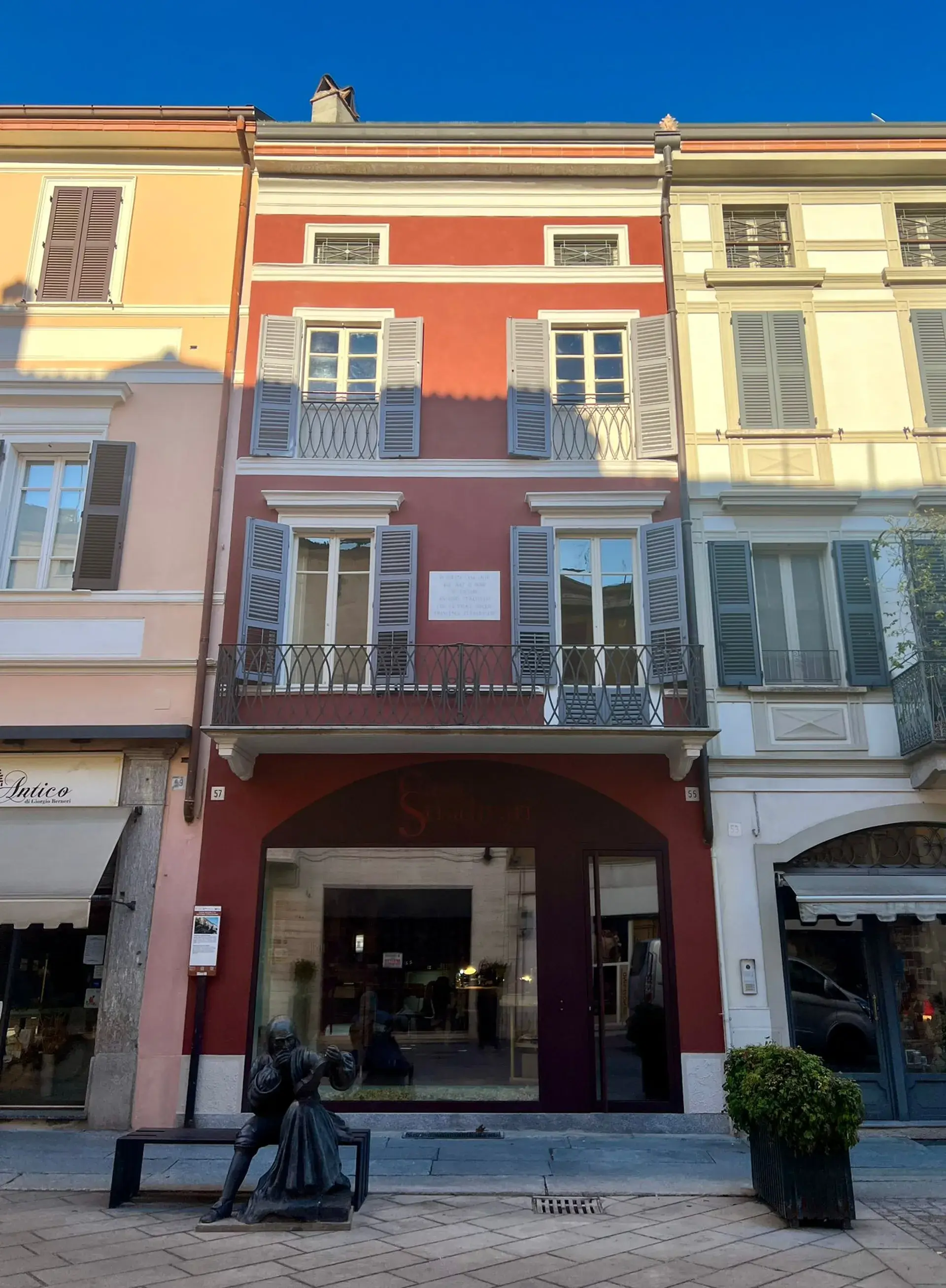
Along Corso Garibaldi, Antonio Stradivari is remembered in the heart of Cremona's civic life, where a bronze sculpture depicts the master luthier seated on a public bench. This urban corridor forms a primary pedestrian route connecting the railway station to the central Piazza del Comune and the Torrazzo, anchoring the city’s deep connection to the art of violin making.
Just along this street at Corso Garibaldi 57 stands the Casa nuziale di Antonio Stradivari, a medieval three-story townhouse that preserves the formative early years of the craftsman's independent career.
The Marital Home and First Independent Workshop
On July 4, 1667, Antonio Stradivari married Francesca Ferraboschi and rented the townhouse at Corso Garibaldi 57 from architect and woodcarver Francesco Pescaroli. The building consists of front and rear residential wings separated by an inner courtyard, linked by a columned portico, and crowned by an open covered roof loggia, or altana.
Stradivari established his first independent workshop on the ground floor while living with his family on the upper levels, where six of his children were born. Between 1667 and 1680, Stradivari transitioned away from the strict style of Nicola Amati to develop his own geometric and acoustic designs, producing early masterworks such as the 1669 Clisbee violin. In 1680, following growing professional acclaim, he moved his household to a larger property on Piazza San Domenico (modern-day Piazza Roma), where he remained until his death in 1737.
The Sole Surviving Stradivari Residence
Corso Garibaldi 57 is the only physical residence of Antonio Stradivari still standing in Cremona. His later residence and main workshop on Piazza San Domenico was lost during late nineteenth- and early twentieth-century urban demolition.
Before undergoing modern restoration, the ground floor of the historic home served commercial uses, operating for approximately 25 years as a housewares and wedding gift shop named Tè per due. A project to revive the site began in 2020 after violinist Fabrizio von Arx brought his 1720 Stradivarius violin, "The Angel," from Geneva to Cremona to play inside the historic structure.
Modern Lutherie and Cultural Revival
On July 4, 2023—the 356th anniversary of Stradivari's arrival—the property reopened following a complete restoration led by the Casa Stradivari Foundation and the Comune di Cremona. The building functions as an active center for craftsmanship and music, supporting Cremona's status as a center of violin making recognized on the UNESCO Intangible Cultural Heritage list.
The ground floor houses a functioning workshop that hosts an 18-month string instrument craftsmanship training course. Workbenches feature the traditional materials of the craft, including spruce and maple shavings, animal glues, and varnish resins such as mastic and propolis. The upper floors provide venues for artistic residencies, musical masterclasses, and an exhibition space accessible through pre-booked small-group guided tours. High above the street, the covered roof loggia remains preserved—a space where Stradivari dried his varnished instruments, giving rise to local lore regarding the Po Valley climate's influence on the varnish.
FAQ
Why is Corso Garibaldi 57 significant to Antonio Stradivari's history?
It is the only surviving physical residence of Antonio Stradivari left standing in Cremona, as his later workshop and residence on Piazza San Domenico was demolished during urban redevelopment.
When did Antonio Stradivari live and work on Corso Garibaldi?
Stradivari lived and operated his workshop at Corso Garibaldi 57 from July 4, 1667, following his marriage to Francesca Ferraboschi, until his move to Piazza San Domenico in 1680.
What is the current function of Casa Stradivari?
Reopened in 2023, the building houses an active luthier workshop hosting an 18-month training course on the ground floor, while the upper floors accommodate artistic residencies, masterclasses, and small-group guided tours.
Discover Cremona like never before
Dive into Cremona hidden stories and secret spots with Ciceru interactive tours.
Explore tour
Audioguide
Quizzes
Maps
Solo
Couples
Groups & families

© Photo by Casa nuziale di Stradivari - Fondazione Casa Stradivari via Google Maps · Google Places