Torrazzo di Cremona: Italy's Tallest Brick Bell Tower
Architectural Marvel and Double-Shell Design
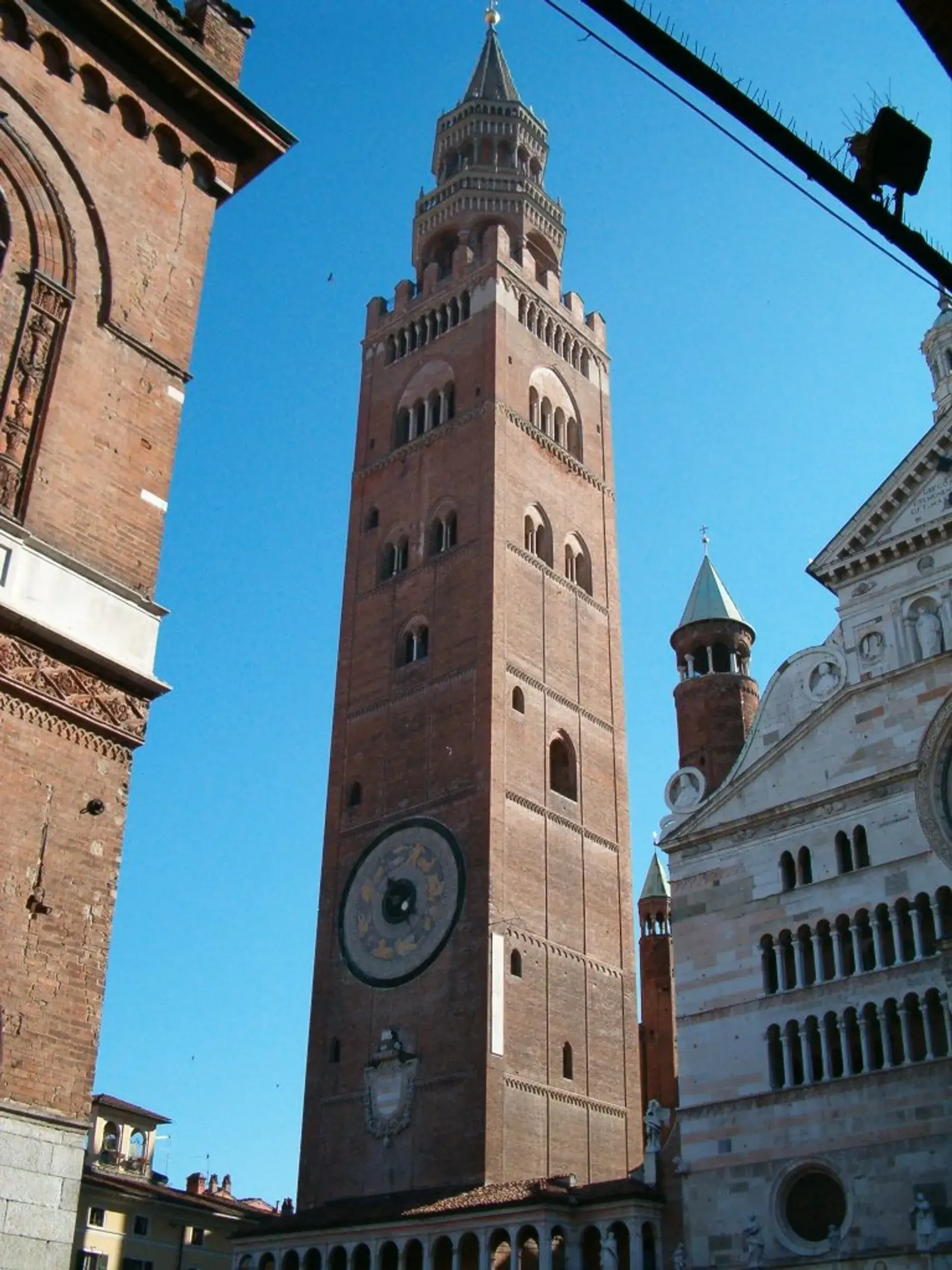
Soaring above the Piazza del Comune in Cremona, the Torrazzo serves as the free-standing bell tower for the Cathedral of Santa Maria Assunta. Officially measured at 112.54 meters in height, it stands as the tallest medieval brick bell tower in Italy and one of the most prominent in Europe. The tower features exposed red clay brickwork constructed using an ingenious double-shell technique. Rather than ascending around a solid central pillar, the interior staircase runs through the structural cavity between two completely independent, nested vertical brick towers.
The tower's exterior profile transitions through distinct architectural eras. A sturdy square Romanesque shaft rises to decorative Guelph battlements before giving way to an octagonal Gothic crown known as la ghirlanda. This crown consists of two receding marble drums and is topped by a 17-meter conical spire. A historical marker at the base of the tower once recorded a height of 122.217 meters; however, this figure resulted from a measurement referencing an arbitrary datum ten meters below ground level rather than an error in surveying the above-ground masonry.
Construction History and Civic Purpose
Archaeological investigations beneath the foundations of the tower in the early 1980s uncovered Roman-era structures and an early Christian burial site. The medieval tower itself took shape across four major building campaigns between the 1230s and 1309. The lower Romanesque tiers were built up to the third cornice between 1230 and 1250, followed by an upward extension beneath the belfry windows from 1250 to 1267. Between 1284 and 1305, workers added the upper tiers and the marble octagonal crown, culminating in the completion of the spire in 1309.
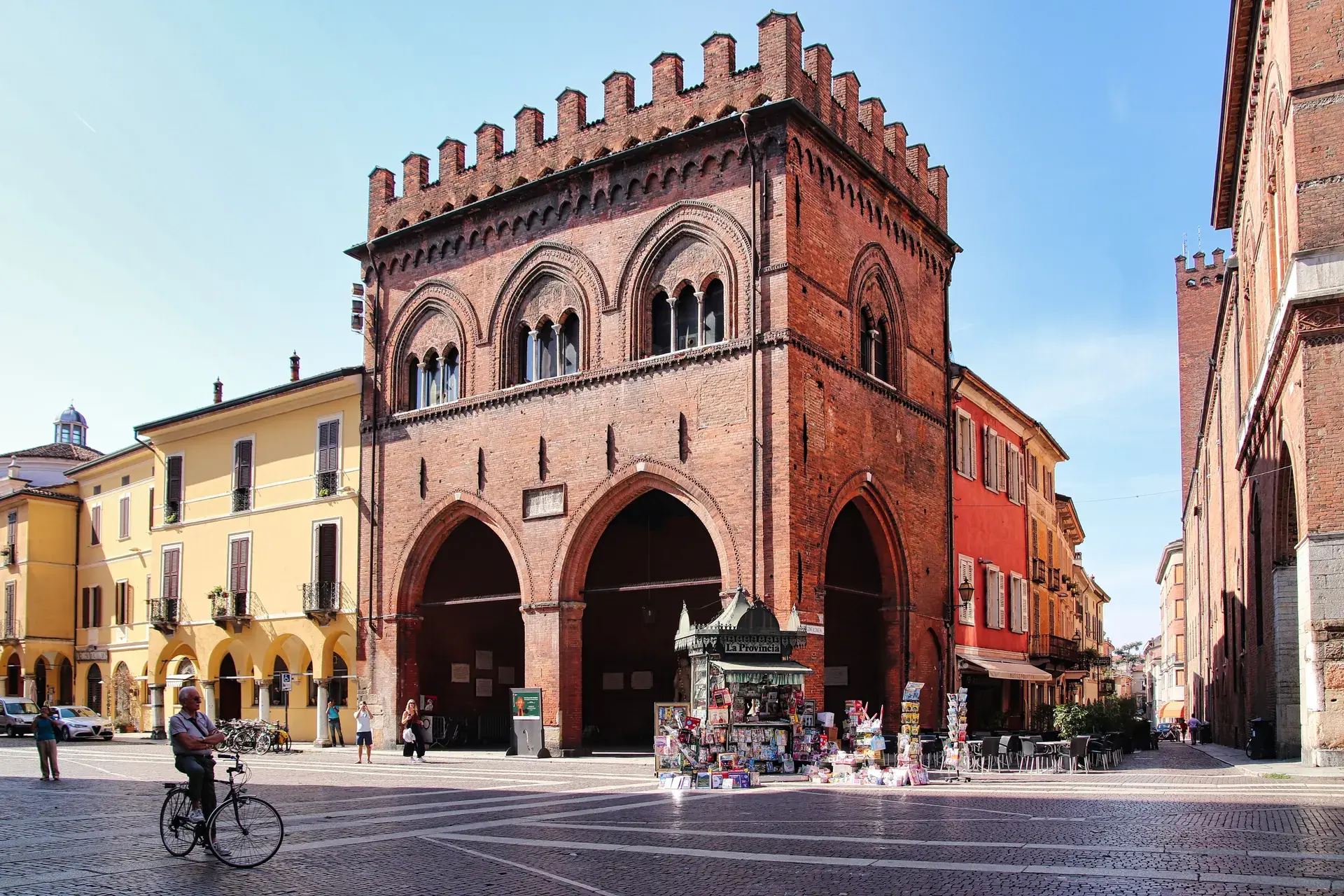
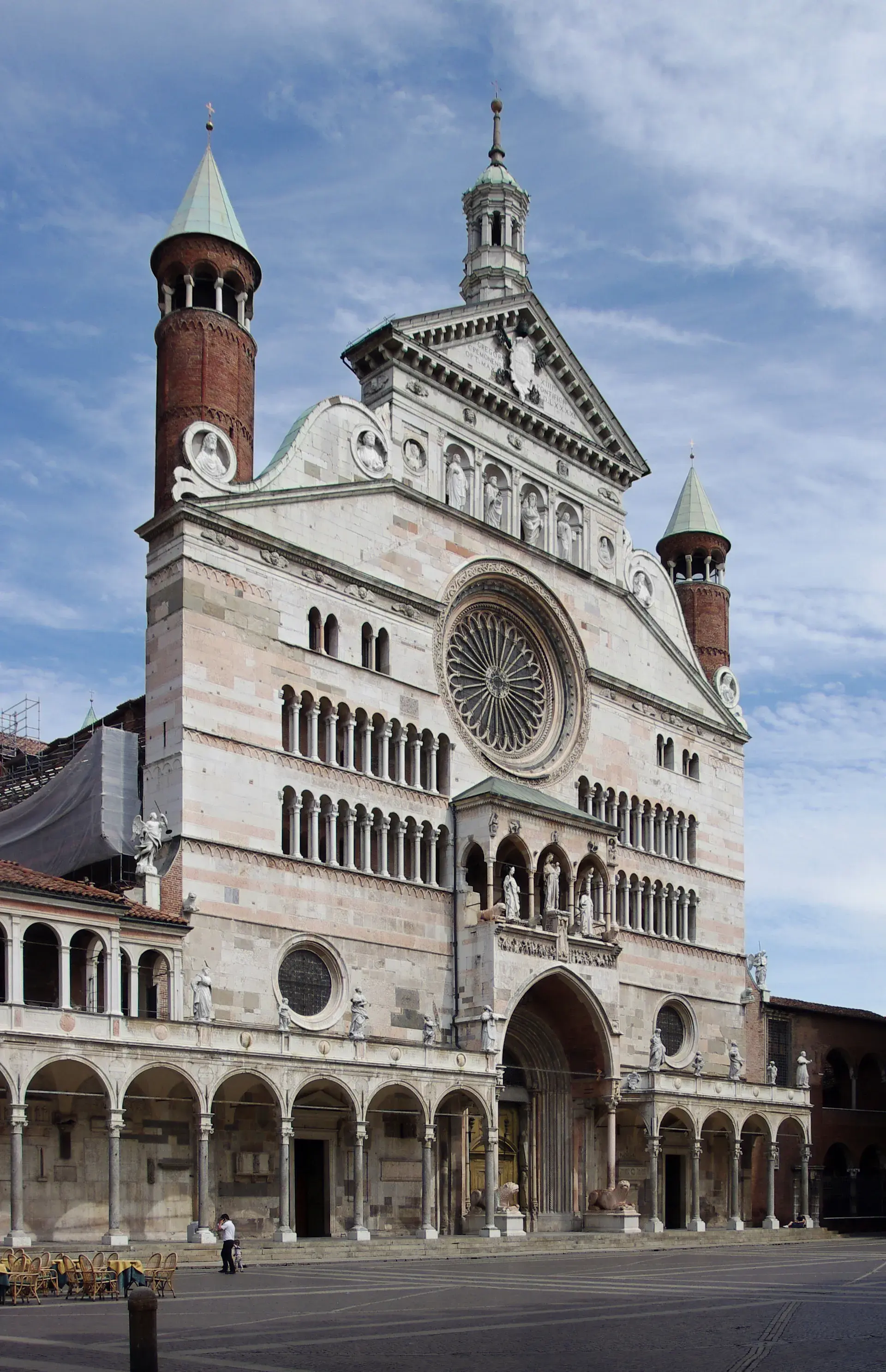
Between 1493 and 1515, architect Lorenzo Trotti built La Bertazzola, an elegant Renaissance portico that physically linked the north flank of the cathedral facade to the base of the tower. Although the Torrazzo functioned as the cathedral's campanile, historical records show that the Cremona municipal government funded a substantial portion of its construction. Positioned directly opposite the 13th-century Palazzo Comunale and the Loggia dei Militi, the tower doubled as a municipal watchtower and a visible symbol of civic autonomy against rival Lombard cities.
The 16th-Century Astronomical Clock
Mounted on the south-facing exterior of the fourth floor is a massive mechanical astronomical clock. Installed between 1583 and 1588 by clockmakers Francesco and Giovan Battista Divizioli, the mechanism was built to align with the Gregorian calendar reform. With a dial spanning 8.2 meters across, the clock face is substantially wider than the dials of London's Elizabeth Tower, which measure roughly 6.9 meters.
The clock's face tracks hours, lunar cycles, zodiac signs, solstices, and equinoxes. Among its pointers is a specialized dragon-shaped hand engineered to identify approaching solar and lunar eclipses when overlapping other celestial indicators. The internal mechanism remains entirely mechanical and is wound by hand every single day. Above the clock, the belfry houses seven liturgical bells cast in 1744 alongside an older hour bell dating to 1581 installed within the octagonal crown.
The Vertical Museum and Panoramic Belvedere
In November 2018, the interior of the tower opened as the Museum of Time (Museo Verticale). The museum features dedicated exhibition spaces covering horology, the history of time measurement, and celestial physics. Among its exhibits is a working Foucault pendulum suspended within the vertical shaft to demonstrate the rotation of the Earth.
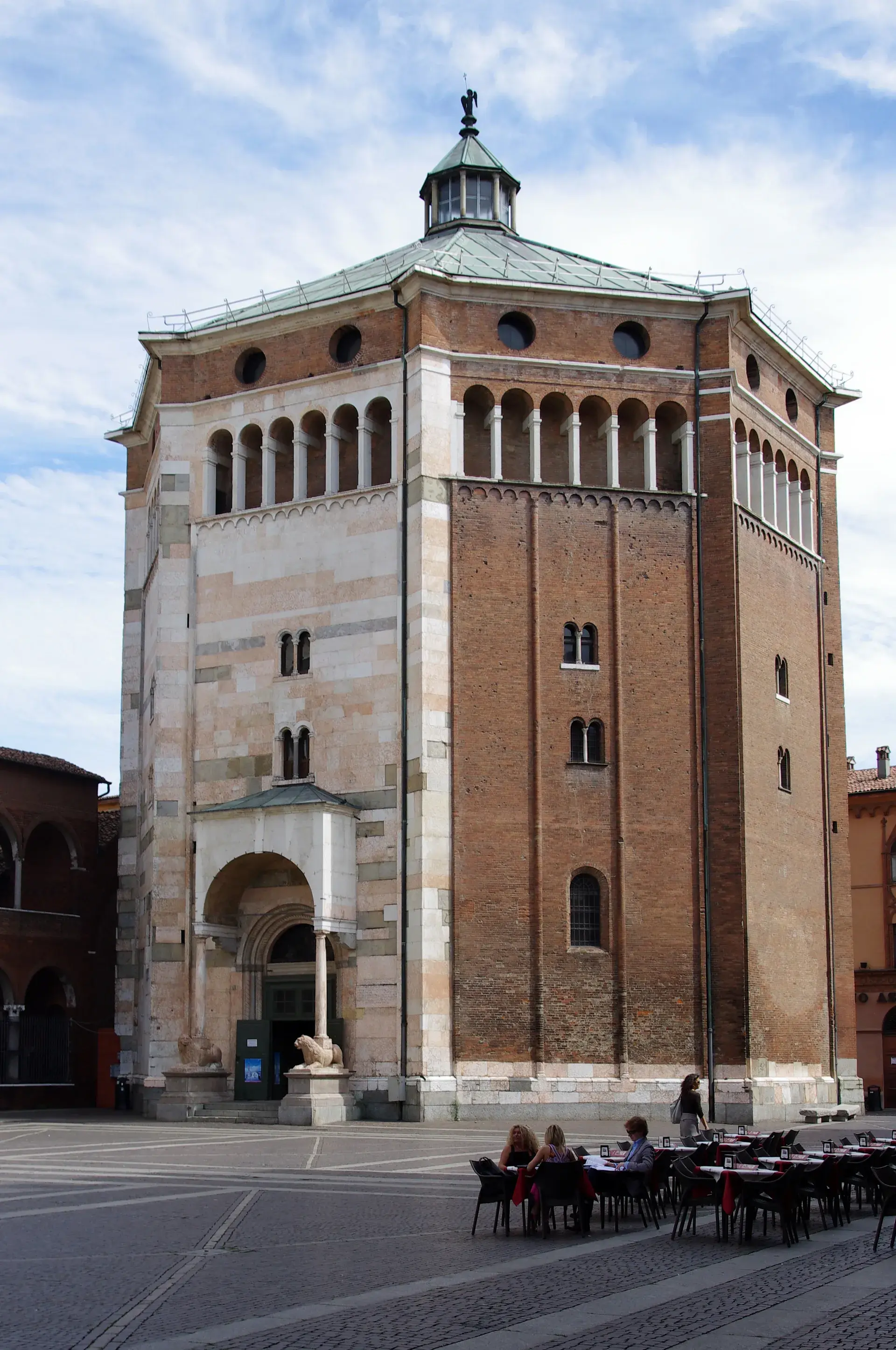
Visitors navigate the 502 steps inside the narrow cavity between the tower walls on foot, as the historic structure has no elevator. The climb offers close encounters with the rhythmic clicking and humming of the clockwork gears behind the mechanism room glass, accompanied by cool breezes entering through thin defensive arrow slits in the brickwork. At the summit, the open-air belvedere delivers 360-degree panoramic views over the rooftops of Cremona, the course of the River Po, and the plains of the Po Valley. Access to the Torrazzo is managed as part of the Diocesan museum circuit, with joint tickets available for the adjacent Baptistery and Diocesan Museum.
FAQ
How tall is the Torrazzo di Cremona?
The Torrazzo di Cremona stands at 112.54 meters tall, making it the tallest medieval brick bell tower in Italy.
How many steps lead to the top of the Torrazzo di Cremona?
There are 502 steps leading to the open-air belvedere. There is no elevator, and the ascent takes place between the tower's two nested brick walls.
How large is the astronomical clock on the Torrazzo?
The astronomical clock dial measures 8.2 meters in diameter, which is significantly wider than the dials of London's Elizabeth Tower (Big Ben).
What is inside the Torrazzo di Cremona?
The tower houses the Museum of Time (Museo Verticale), which features horology exhibits, the original 16th-century mechanical clock movement, a functioning Foucault pendulum, and a summit belvedere.