Piazza del Duomo Lecce: A Theatrical Baroque Jewel
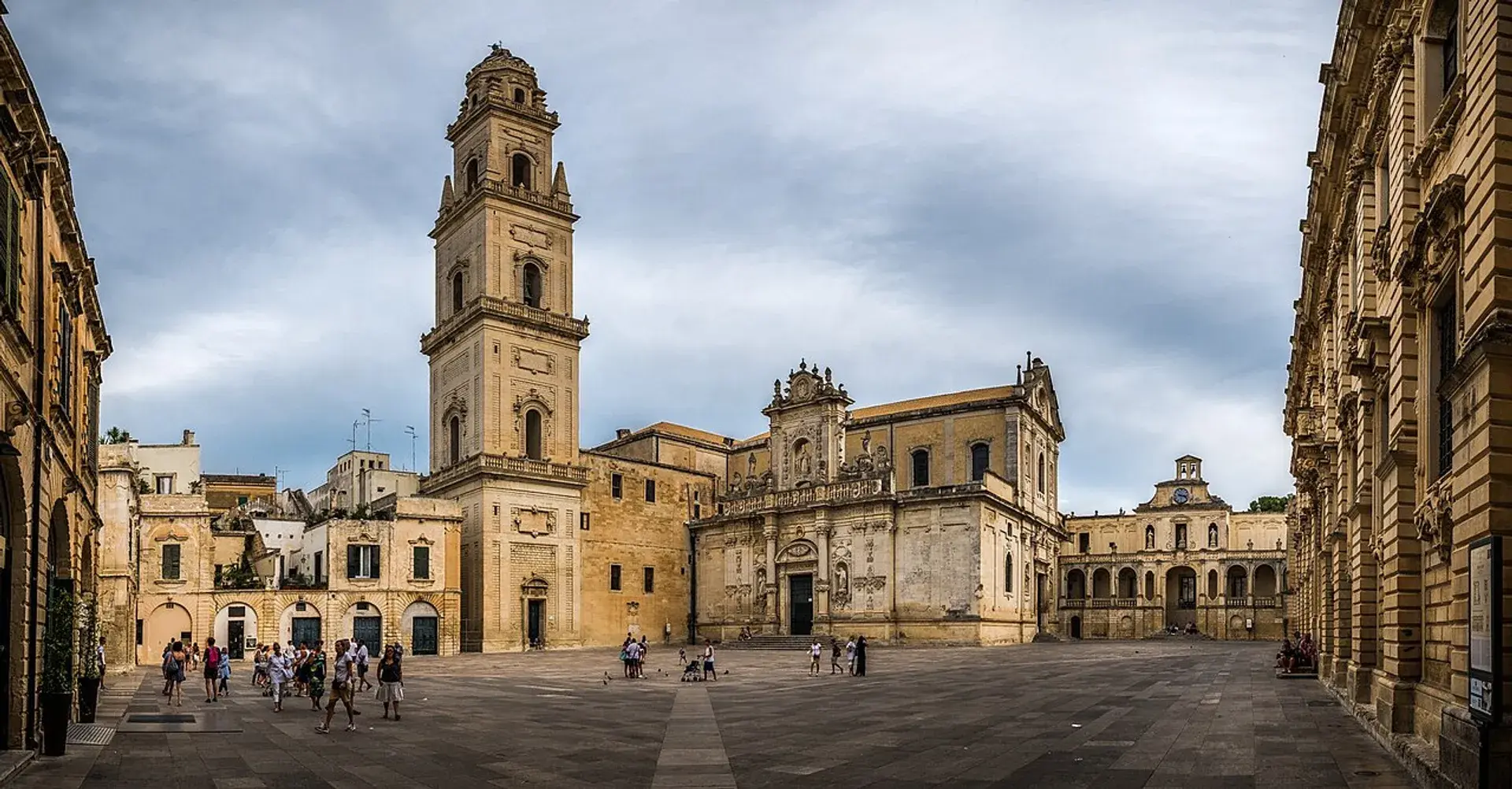
Piazza del Duomo is one of Lecce's most important squares, a magnificent open-air ballroom defined by its unified Lecce Baroque architectural style. The space, which feels like a private world, is particularly magical at night when the golden stone of its buildings is fully illuminated. The square is home to the Duomo (Cathedral), the Campanile (bell tower), the Episcopio (Bishop's Palace), and the Palazzo del Seminario.
A History of Transformation
The site of the piazza may have served as the city's forum during Roman times. By the Middle Ages, it had evolved into a fortified episcopal complex known as the 'Cortile del Vescovado,' an ecclesiastical citadel with its own defensive walls and a gate that was closed at night. This area served not only religious functions but also civic ones, hosting a major fair starting in 1452 where merchants would offer their finest goods to the bishop.
A pivotal transformation occurred between 1659 and 1670. Commissioned by Bishop Luigi Pappacoda, the architect Giuseppe Zimbalo, known as 'lo Zingarello,' rebuilt the cathedral and surrounding buildings in the grand Baroque style. This project aimed to reflect Lecce's status as a provincial capital. Later, around 1761, architect Emanuele Manieri removed the old entrance walls, creating the monumental propilei (gateways) that opened the once-private courtyard into a more public, theatrical space.
Architectural Marvels and Illusions
The architectural ensemble of Piazza del Duomo is a masterpiece of design. A surprising feature of the Lecce Duomo is its 'false facade.' The richly decorated face that greets visitors upon entering the square is not the main entrance but a lateral one. This was a deliberate choice to create a striking visual impression and avoid presenting a bare wall, enhancing the square's theatricality. The actual, plainer main facade is located on a different side and is not immediately visible.
The Campanile, also designed by Zimbalo and built between 1661 and 1681, stands over 70 meters tall. Historically, it served as both a bell tower and a watchtower for the city. Its summit is crowned with a weather vane depicting Sant'Oronzo, Lecce's patron saint. Another significant building is the Palazzo del Seminario, constructed between 1694 and 1709 by Giuseppe Cino, which now houses the Diocesan Museum.
The Square Today
Today, Piazza del Duomo functions as a central 'living room' for the city—a quiet, majestic space that welcomes visitors. It is a major tourist attraction and a hub for the city's religious life, notably hosting the solemn procession for Saint Oronzo every August 24th. The Campanile offers panoramic views of Lecce, accessible to visitors via an internal elevator. The square remains the property of the Diocese of Lecce, a remnant of its history as an autonomous ecclesiastical center.
FAQ
Why does the Lecce Cathedral have a 'false facade'?
The ornate facade facing the square is a lateral entrance, not the main one. This was a deliberate design choice to create a stunning theatrical effect for visitors entering the enclosed piazza, avoiding the sight of a plain cathedral wall.
Who owns Piazza del Duomo in Lecce?
For centuries, Piazza del Duomo has belonged to the Diocese of Lecce, not the municipality. This is a legacy of its history as an autonomous, walled ecclesiastical center known as the 'Cortile del Vescovado'.
Can you go up the bell tower in Piazza del Duomo?
Yes, the Campanile (bell tower) is accessible to visitors. An internal elevator takes guests to the top for panoramic views of Lecce.
What is inside the Palazzo del Seminario?
The Palazzo del Seminario, built between 1694 and 1709, is now home to the Diocesan Museum of Lecce.