Porta Napoli: Lecce's Triumphal Gateway
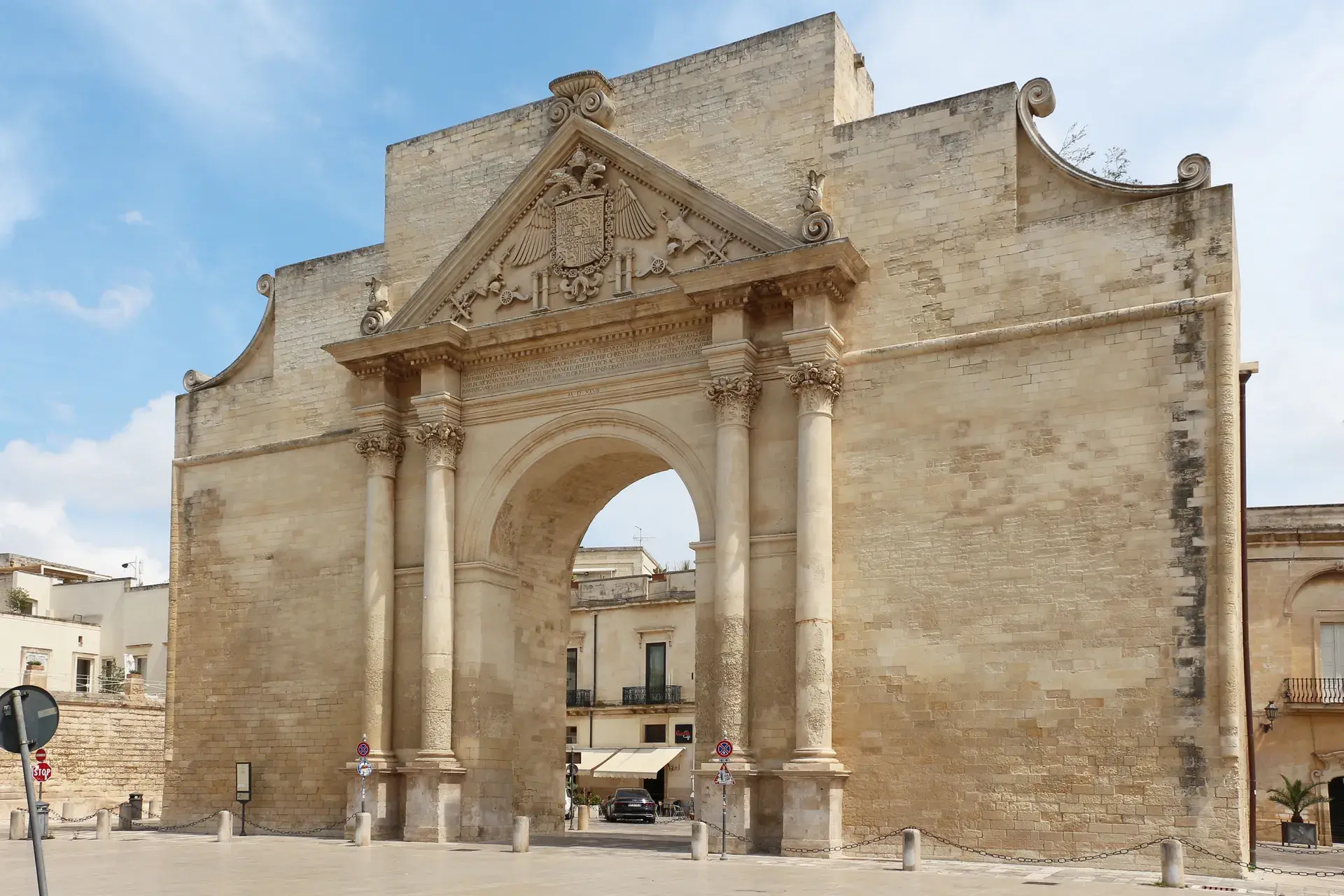
Porta Napoli, also known as the Arco di Trionfo, stands as the most prestigious and imposing gateway to the historic heart of Lecce. Constructed in 1548, this monumental arch serves as a symbolic threshold, separating the modern city from its ancient core and offering an ideal starting point for exploring Lecce's famed architectural wonders.
An Imperial Commission
The construction of Porta Napoli was a direct result of Emperor Charles V's strategic efforts to fortify Lecce in the 16th century. Viewing the city as a crucial defensive bulwark against threats from the East, particularly from the Ottoman Turks, the emperor initiated an extensive fortification program. The gate was commissioned by the local governor, Ferrante Loffredo, and built on the site of the ancient Roman-era Porta San Giusto.
Dedicated to Charles V, the gate was intended to celebrate his military victories and his role as the city's protector. A lengthy Latin inscription on the arch praises the emperor as a "subduer of rebellious Christians" and a "terror and exterminator of the Turks." Originally known as "Porta Reale," the gate has witnessed centuries of history, seeing the passage of armies, merchants, and pilgrims.
Renaissance Architecture and Symbolism
The design of Porta Napoli is attributed to court architect Gian Giacomo dell'Acaya. Its style is one of sober, elegant Renaissance classicism, drawing inspiration from ancient Roman triumphal arches. This makes it a notable contrast to the exuberant Lecce Baroque style that dominates the rest of the historic center.
The structure features a large round arch flanked by two pairs of Corinthian-style columns. These columns support a triangular pediment that prominently displays the imperial Habsburg emblem of Emperor Charles V. The pediment itself features three distinct steps, which are believed to symbolize Charles V's military victories across three continents: America, Gaul, and Africa.
A Tale of Triumphal Entries
Despite being built as a grand tribute to Emperor Charles V, complete with his coat of arms and a laudatory inscription, a surprising irony defines its history: the emperor himself never made a triumphal entry through the arch. The first recorded triumphal procession through Porta Napoli was not until 1639, when Luigi Pappacoda, the Bishop of Lecce, entered the city to begin his influential 31-year episcopate.
Porta Napoli Today
Today, Porta Napoli remains a vital part of Lecce's urban fabric. It serves as an access point for both pedestrian and vehicular traffic into the old town. The gate dominates the Piazzetta Arco di Trionfo, a redeveloped square that has become a major gathering point for the city's social life and nightlife, partly due to its proximity to several university campuses. For visitors, it stands as a significant cultural symbol and the primary entrance to Lecce's historic itinerary.
FAQ
Why was Porta Napoli in Lecce built?
Porta Napoli was constructed in 1548 to honor Emperor Charles V and as a key part of his project to fortify Lecce against potential invasions from the East, especially from the Ottoman Turks.
What is the architectural style of Porta Napoli?
Porta Napoli is built in the Renaissance classical style, inspired by Roman triumphal arches. Its sober and elegant appearance contrasts with the more ornate Lecce Baroque architecture found throughout the city.
Did Emperor Charles V ever pass through Porta Napoli?
No, despite the gate being built specifically in his honor, Emperor Charles V never made a triumphal entry through Porta Napoli. The first recorded triumphal procession was for Bishop Luigi Pappacoda in 1639.
Who designed Porta Napoli?
The design of Porta Napoli is attributed to the court architect Gian Giacomo dell'Acaya, who was commissioned by Ferrante Loffredo, the governor of Terra d'Otranto.