Chiesa di San Michele in Foro: Lucca's Romanesque Gem
The Chiesa di San Michele in Foro is a Roman Catholic basilica in Lucca, Italy, standing on the site of the city's ancient Roman Forum. First documented in 795 AD, the church is a stunning example of Pisan-Luccan Romanesque architecture, dedicated to the Archangel Michael.
A History Etched in Stone
The church's name, "in Foro," directly references its location in what was once the heart of Roman public life. The current building's reconstruction began in 1070 under the commission of Pope Alexander II. For centuries, the site was not only a religious center but also the political hub of Lucca. Until 1370, it served as the seat of the 'Consiglio Maggiore' (Major Council), the most important governing assembly of the commune. Its position on the Via Francigena pilgrimage route also made it a significant spiritual stop for travelers.
Architectural Marvels and Curiosities
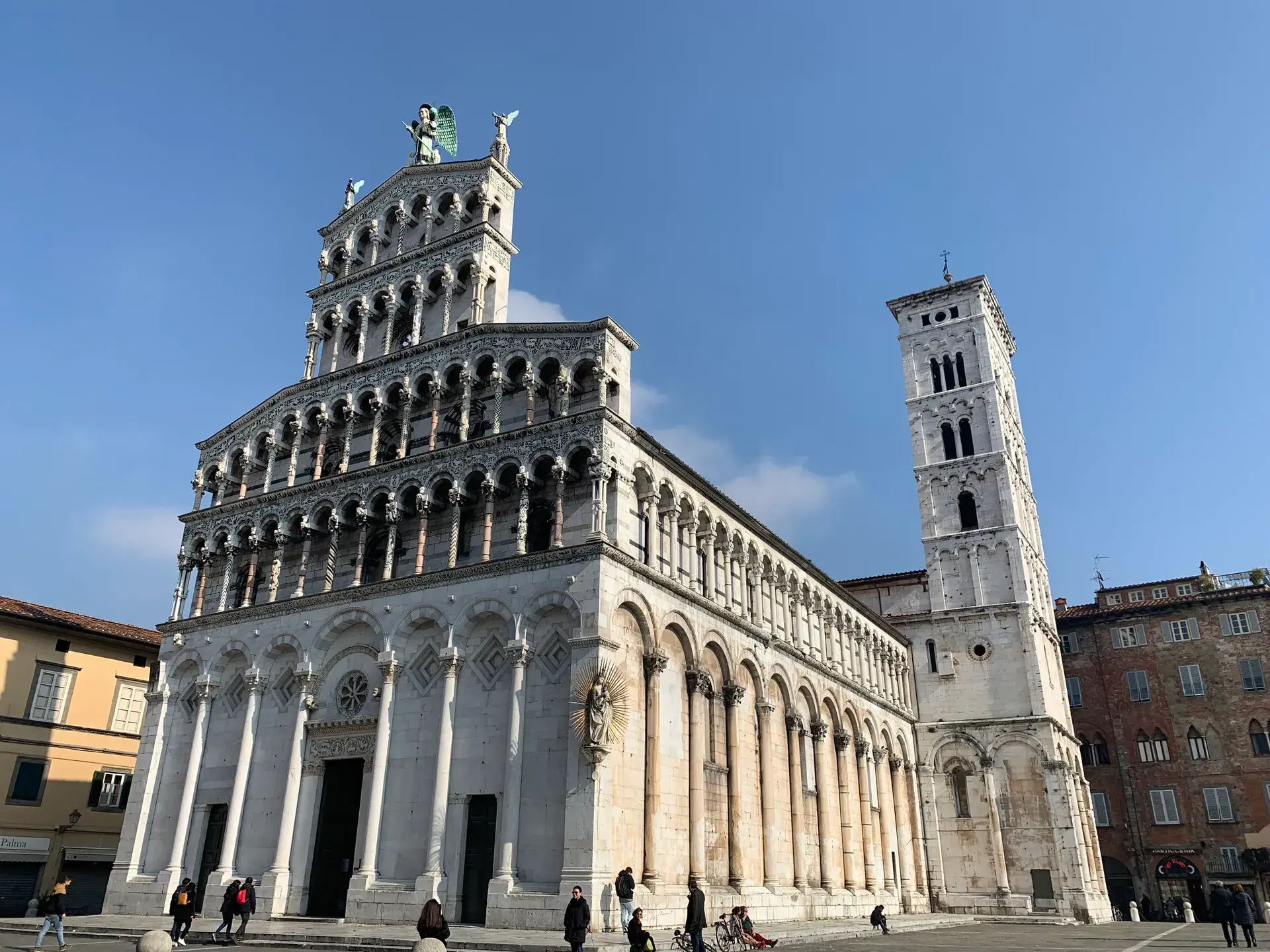
The most striking feature of San Michele is its magnificent 13th-century marble façade. It rises in four tiers of loggias, showcasing a wealth of intricate carvings. Interestingly, the façade is significantly taller than the nave behind it, creating a dramatic "false-front." This is because the original plan for a much higher nave was never completed. Each of the numerous columns on the façade is unique, decorated with distinct patterns, animals, and human heads.
At the very top stands a 4-meter statue of the Archangel Michael, flanked by two angels. The archangel's metal wings are ingeniously hinged to allow them to move with the wind and prevent damage. The bell tower, constructed between the 12th and 14th centuries, rises from the southern transept. According to local chronicles, its top floor was demolished by order of the Doge of Pisa, either because its bells could be heard in Pisa or because its height surpassed a Pisan tower.
Treasures Within
The interior of the church holds significant works of art. Visitors can find Filippino Lippi's 1483 'Pala Magrini,' which depicts the saints Roch, Sebastian, Jerome, and Helena. Other notable pieces include a sculpture of the Madonna by Matteo Civitali from 1480 and an enamelled terracotta 'Madonna and Child' by Andrea della Robbia.
One of the church's most unusual features is the mummified body of San Davino Armeno, displayed under the high altar. San Davino was an Armenian pilgrim who died in Lucca around 1050. His body is one of the oldest known mummified saints in Italy.
A Living Landmark
Today, the Chiesa di San Michele in Foro remains an active basilica. The church has a connection to Lucca's most famous son, composer Giacomo Puccini, who sang in the choir here as a youth. During a 19th-century restoration, the façade was updated with some surprising additions: portraits of Italian Risorgimento heroes like Giuseppe Garibaldi and King Vittorio Emanuele II were carved among the decorations. Every year on September 29th, the church is the center of the 'Festa di San Michele,' a major local festival featuring a mass and an orchestral concert.
FAQ
Why is the church called 'in Foro'?
The name 'in Foro' means 'in the Forum.' The church was built on the site of Lucca's ancient Roman Forum, which was the public and commercial heart of the city.
What is unique about the façade of San Michele in Foro?
The elaborate 13th-century façade is significantly taller than the church's nave, creating a 'false-front' due to an unfulfilled plan for a taller building. Additionally, each of its many columns features unique, intricate carvings.
Are there any famous artworks inside the church?
Yes, the church houses several important artworks, including Filippino Lippi's 'Pala Magrini,' a sculpture of the Madonna by Matteo Civitali, and an enamelled terracotta 'Madonna and Child' by Andrea della Robbia.
Who is the mummified saint in the church?
Under the high altar lies the mummified body of San Davino Armeno, an Armenian pilgrim who died in Lucca around 1050 while on a pilgrimage. It is one of Italy's oldest known mummified saints.