Piazza dell'Anfiteatro in Lucca: A Roman Arena Reborn
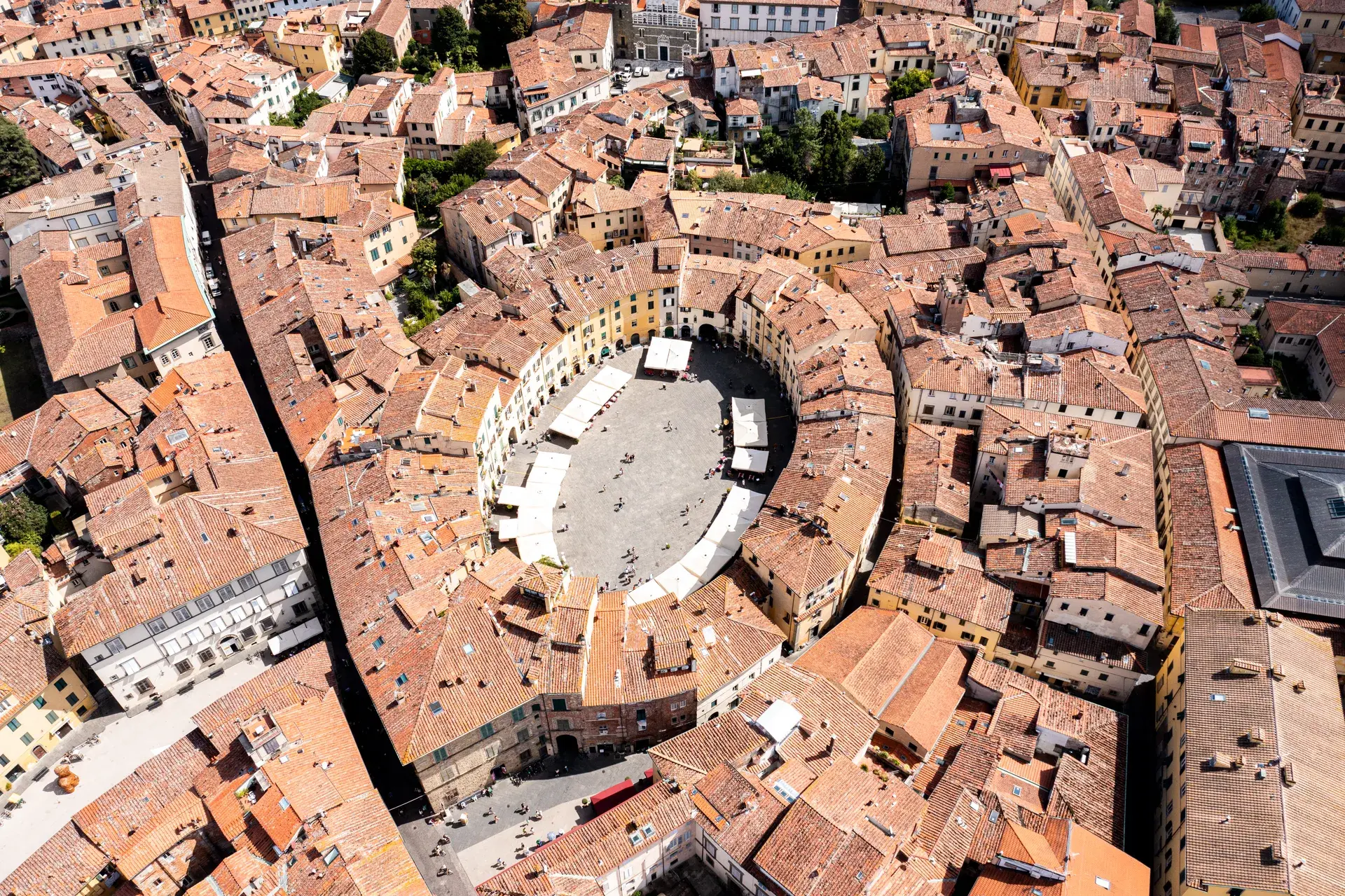
Lucca's Piazza dell'Anfiteatro is a striking public square that owes its unique elliptical shape to the ancient structure buried beneath it. The ring of medieval and later period homes, shops, and cafes precisely follows the footprint of a former Roman amphitheater, creating a vivid example of Lucca's layered urban history.
From Roman Arena to Public Square
The original structure on this site was a grand Roman amphitheater, constructed between the late 1st and early 2nd centuries AD. With 54 arches and 18 rows of seating, it was an imposing venue capable of holding approximately 10,000 spectators. For centuries, it served as a center for social life in ancient Lucca, hosting gladiatorial contests and other public spectacles.
A Millennium of Transformation
After the decline of the Roman Empire, the amphitheater fell into disuse. During the Gothic Wars of the 6th century, it was fortified, and its stones were gradually repurposed for other building projects throughout the city, earning it the nickname 'grotte' (caves). Over the following centuries, a dense collection of structures, including houses, workshops, and even a prison known as 'carceri del Sasso', were built directly onto the ancient ruins. The area became known as the 'Parlascio,' a name possibly derived from a term for public assemblies. By the 19th century, it had also served as a depot, gunpowder store, and abattoir.
The 19th-Century Redesign
The piazza as it appears today is the result of a significant urban renewal project conceived by architect Lorenzo Nottolini. Between 1830 and 1839, Nottolini cleared the accumulated buildings from the center of the old arena. His design created a unified, elliptical public square that preserved the ancient Roman foundation. The space was repurposed as a bustling marketplace, earning it the initial name 'Piazza del Mercato'.
The Piazza Today
Today, Piazza dell'Anfiteatro is a lively, pedestrian-only public space. The ground floors of the surrounding buildings are filled with numerous cafes, restaurants, and shops catering to locals and tourists. The upper floors remain residential, with apartments built into the historic structures. The piazza also hosts community events, most notably the annual flower market for Saint Zita on April 27th, which fills the oval with vibrant blossoms.
Architectural Layers
A fascinating aspect of the piazza is that its current ground level is approximately three meters higher than the original Roman arena floor. The foundations of the ancient amphitheater are buried beneath the paving stones. The buildings that form the piazza's distinctive ring were constructed directly on top of the original Roman walls, incorporating them into their own foundations. Of the four arched gateways providing access to the square, only the lowest one corresponds to an original Roman entrance. A small cross carved into a central tile on the piazza floor marks the precise intersection point of these four gateways.
FAQ
Why is the Piazza dell'Anfiteatro oval?
The piazza's unique elliptical shape comes from being built directly on the foundations of a Roman amphitheater that stood on the site from the 2nd century AD.
Who designed the modern Piazza dell'Anfiteatro?
The current piazza was designed by architect Lorenzo Nottolini between 1830 and 1839. He cleared the cluttered interior to create a unified public square, which was initially used as a marketplace.
Is the original Roman amphitheater still visible?
The original arena floor is buried about three meters below the current piazza level. However, the foundations and walls of the amphitheater were incorporated into the medieval and later buildings that form the oval, so its footprint is perfectly preserved.