Acquedotto Mediceo: Pitigliano's Historic Aqueduct
Monumental Gateway of Pitigliano
The Acquedotto Mediceo stands prominently at the southeastern approach to Pitigliano, marking the boundary between the outer land bridge and the historic center. Set directly adjacent to the Orsini Fortress, the structure provides the primary visual entrance to the town and leads into Piazza della Repubblica.
Constructed from local volcanic tuff (tufo), the aqueduct seamlessly blends with the natural geology and defensive ramparts. The masonry utilizes porous, golden-brown and weathered gray tuff blocks quarried from the surrounding volcanic bedrock. This creates an architectural impression of stone pillars rising directly out of the precipitous cliff edge.
Engineering and Architecture
The most dramatic section of the aqueduct consists of two massive arches supported by a colossal tuff pylon anchored to the sheer cliff. Extending beyond these monumental spans is a continuous run of 13 smaller rounded arches along Via Cavour, leading directly toward the town square.
The layout seen today reflects both 17th-century waterworks and 19th-century urban restructuring. Between 1845 and the mid-19th century, the Lorraine administration removed portions of the outer medieval bastions to build Via Cavour. During this project, workers opened the 13 smaller arches to bridge the gap between the fortified cliff town and expanding outer districts. Today, the elevated arches also function as public viewing belvederes, offering wide vantage points over the Meleta valley and neighboring tufa ravines.
The Quest for Fresh Water
Pitigliano’s location atop an isolated volcanic mesa surrounded by steep river gorges provided natural defense, but it presented severe water supply challenges. The nearby River Lente suffered from pollution, forcing residents to collect drinking water directly from the Meleta stream at the bottom of the ravines.
Initial canalization efforts to supply the Orsini castle began during the 15th and 16th centuries under the Orsini counts, with designs attributed to architect Antonio da Sangallo the Younger. However, major engineering hurdles across the rugged ravines delayed full realization of a public aqueduct for decades.
Following the Medici annexation of Pitigliano in 1604, Grand Duke Cosimo II addressed the municipal water shortage. In 1612, the Grand Duke permitted the local Jewish community to remain in town on the condition that they contribute 4,000 Florentine scudi toward the construction of the aqueduct. Between 1636 and 1639, Florentine architects and master masons from Viterbo directed the final building campaign. Upon its completion in 1639, the aqueduct brought running spring water into Pitigliano centuries before most other settlements in the southern Tuscan Maremma.
Fontana delle Sette Cannelle
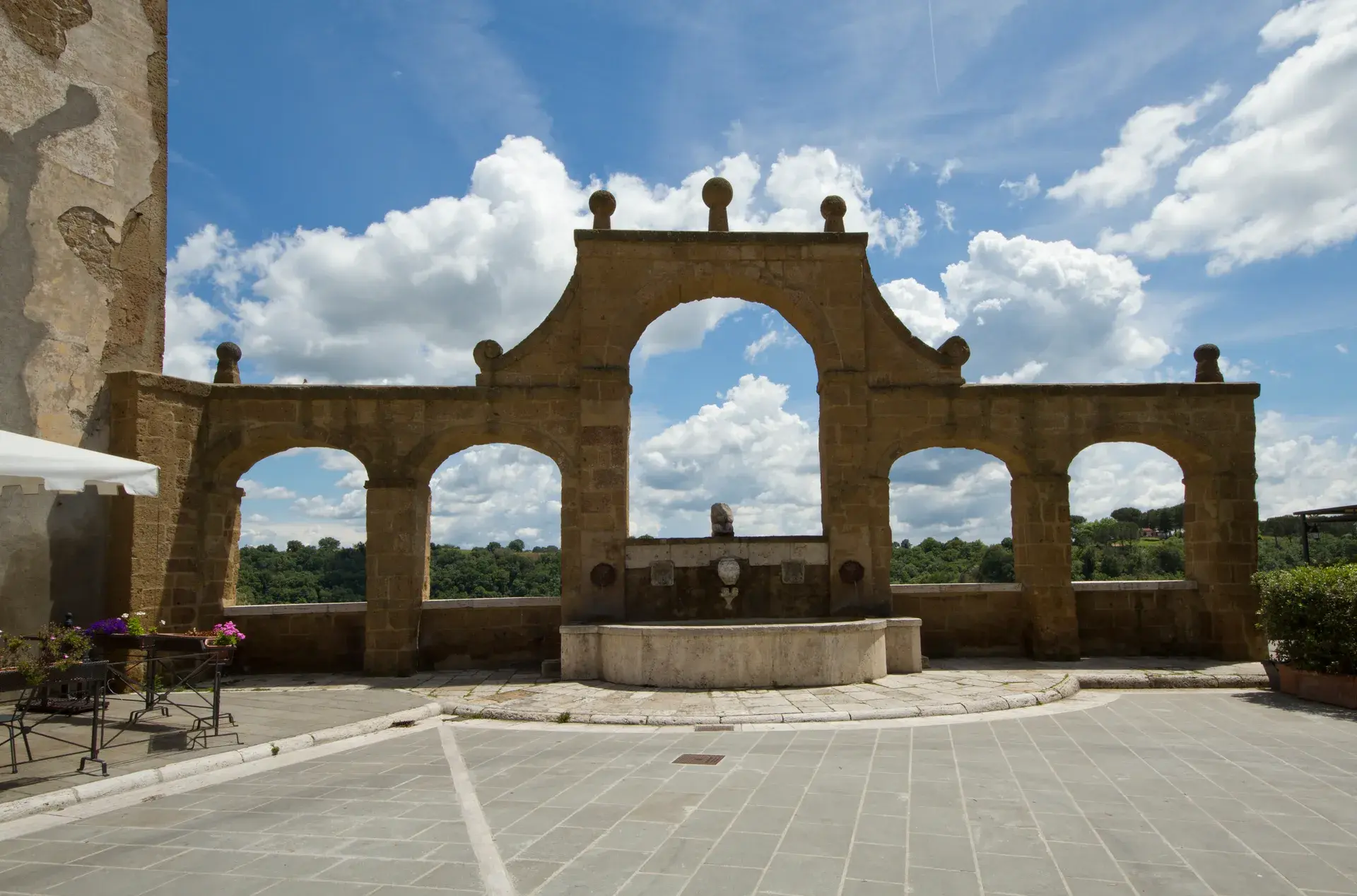
The aqueduct terminates at the southern edge of Piazza della Repubblica at the Fontana delle Sette Cannelle (Fountain of the Seven Spouts). Although the initial fountain structure began in 1545 under Gianfrancesco Orsini, it serves as the ultimate distribution point for the aqueduct's water.
The monument features five arcade niches topped with stone pinnacles. Fresh water flows through decorative spouts sculpted in the shapes of animal heads, a medusa, and a silenus. Surrounding the fountain, the ground paving carries a distinct historical origin: it was reportedly laid using salvaged stone fragments from the funerary monument of Count Niccolò III Orsini, which had been destroyed in the cathedral during an anti-feudal popular revolt in 1547.
FAQ
Why was the Acquedotto Mediceo built?
Pitigliano sits atop a steep volcanic tufa mesa where access to clean water was historically difficult, especially with the River Lente suffering from pollution. The aqueduct was constructed to channel fresh drinking water from the Meleta stream into the town center.
When was the aqueduct constructed?
Early planning began in the 16th century under the Orsini family, but the primary structure was built under Medici supervision between 1636 and 1639. In the mid-19th century, the Lorraine administration opened the 13 smaller arches along Via Cavour during urban road adjustments.
Where does the aqueduct terminate?
The system terminates at the Fontana delle Sette Cannelle on the southern edge of Piazza della Repubblica, which features five arcaded niches and decorative spouts depicting animal heads, a medusa, and a silenus.