Museum of Palazzo Orsini: Pitigliano Fortress
The Fortress at the Gateway of Pitigliano
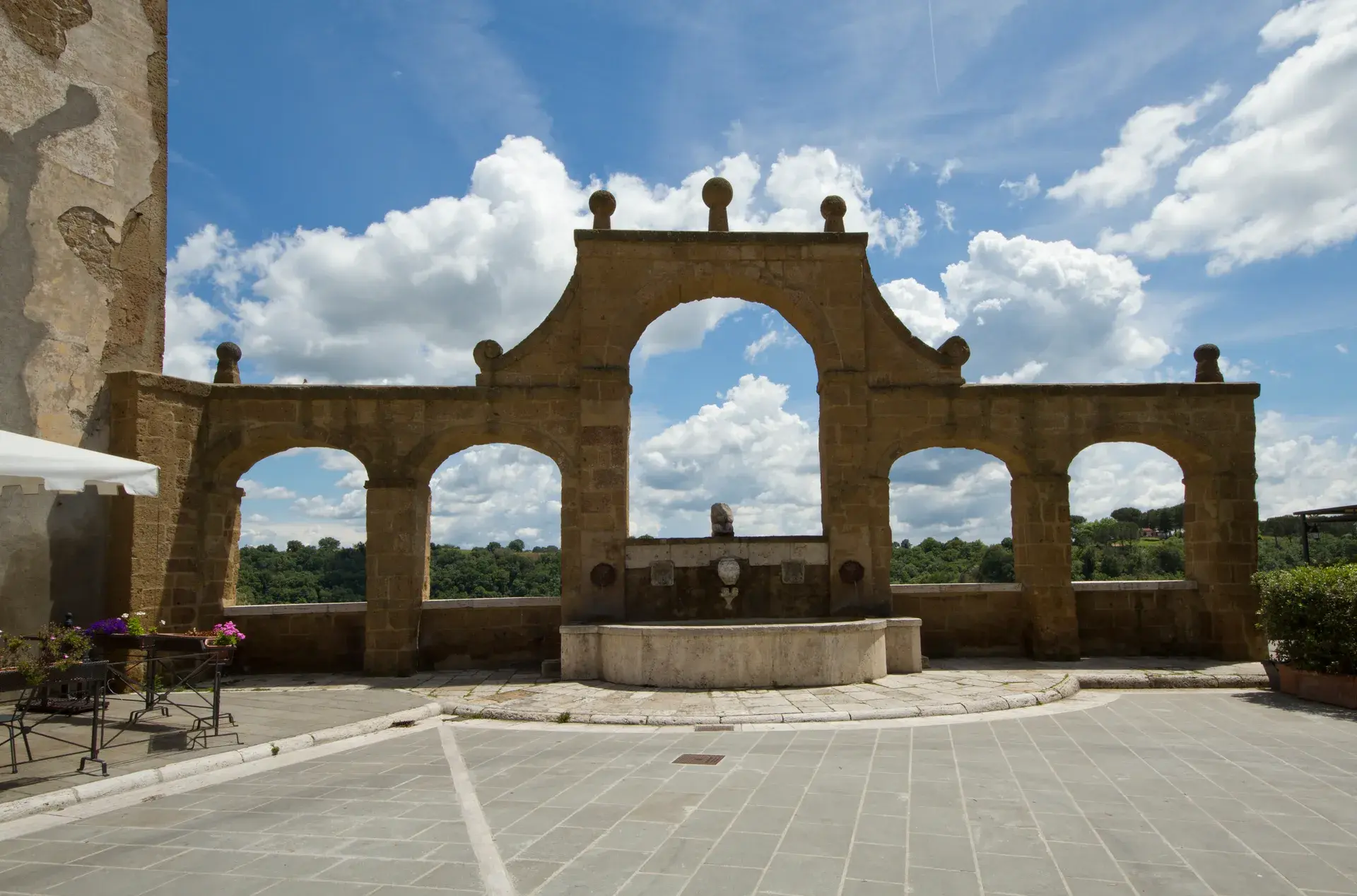
Palazzo Orsini, also known as Fortezza Orsini, stands at the eastern entrance to Pitigliano on Piazza della Repubblica. The historic town sits on an elevated volcanic plateau protected on three sides by sheer ravine gorges. Palazzo Orsini was constructed directly across the narrow eastern neck of land that links the promontory to the neighboring hills, serving as both a protective military barrier and the town's civic gateway.
From the exterior, the fortress presents an imposing defensive block that defines the transition between the modern approaches and Pitigliano's historic center. Past the outer stone rampway and rusticated Renaissance entry portal, the structure opens into an arcaded inner courtyard bordered by classical porticos with Ionic columns. This transition creates an immediate shift in acoustics, moving from the open wind of the piazza into a sheltered, quiet space surrounded by stone.
From Medieval Stronghold to Renaissance Palace
The site originated in the 11th to 12th century, likely as a monastery or religious convent. During the 13th century, the Aldobrandeschi counts of Sovana fortified the location to create a feudal stronghold. The complex passed to the Roman Orsini family in 1293 following the marriage of Romano Orsini to Countess Anastasia Aldobrandeschi, establishing Pitigliano as the seat of the county.
In 1465, Count Niccolò III Orsini, a condottiero captaining forces for the Republic of Venice, carried out extensive expansions and renovations. He adapted the medieval castle into an aristocratic Renaissance palace in celebration of his marriage to Elena Conti di Montelanico. Control of the fortress eventually passed to the Medici of Tuscany in 1604 and the House of Lorraine in 1737. In 1793, Grand Duke Ferdinand III granted the palace to the Bishop of Sovana to serve as an episcopal residence.
Defensive Redesign by Antonio da Sangallo
Around 1520, the Orsini family commissioned the renowned Renaissance military architect Antonio da Sangallo the Younger to modernize the fortress's defenses. To counter contemporary artillery, Sangallo replaced the older rounded towers with thick polygonal bastions.
The overall layout preserves a medieval keep (cassero), perimeter curtain walls, battlements, and two historic towers. The sheer volcanic tuff cliff at the base blends into the masonry ramparts, which contrast with the smooth travertine details of the courtyard. In the center of the arcaded courtyard stands a 16th-century hexagonal travertine cistern-well. Its stone panels are carved with the Orsini five-petaled rose alongside the Aldobrandeschi rearing lion, physically recording the union of the two houses. According to local custom, touching this carved well-head brings good luck.
Inside the Museum of Palazzo Orsini
The complex houses the Museum of Palazzo Orsini, also known as the Diocesan Museum of Sacred Art. Occupying 21 restored, frescoed rooms, the museum presents a comprehensive collection of regional ecclesiastical art. Exhibits include liturgical silver, reliquaries, early printed Cinquecentine books, and fine paintings spanning the 14th to 18th centuries.
Among the significant artworks preserved in the museum is a rare polychrome wooden statue of the Madonna and Child by the prominent Sienese sculptor Jacopo della Quercia. Another rare piece rests in the private study of Count Niccolò III Orsini: beneath mid-15th-century painted coffered ceilings stands a freestanding 16th-century painted poplar-wood statue depicting the condottiero count dressed in full armor.
Civic and Archaeological Collections
In addition to the Diocesan Museum, the fortified palace complex accommodates several other institutions and historical spaces. These include the Museo Civico Archeologico della Civiltà Etrusca, which displays Bronze Age, Etruscan, and Roman artifacts excavated from Pitigliano, Sovana, and Poggio Buco. The complex also houses the bishop's residence, diocesan and municipal historical archives, and a preserved historic castle olive mill (frantoio).
FAQ
What is the historical significance of the courtyard well at Palazzo Orsini?
The 16th-century hexagonal travertine well-head is carved with the Orsini five-petaled rose and the Aldobrandeschi rearing lion, symbolizing the 1293 dynastic marriage that created the County of Pitigliano.
Which notable Renaissance architect worked on Palazzo Orsini?
Antonio da Sangallo the Younger redesigned the complex's fortifications around 1520, replacing rounded towers with polygonal bastions capable of withstanding artillery.
What key exhibits are preserved in the Museum of Palazzo Orsini?
The museum includes a 16th-century painted wooden statue of Count Niccolò III Orsini in full armor, a polychrome wooden Madonna and Child by Jacopo della Quercia, and 21 frescoed rooms filled with sacred art, liturgical silver, and 14th-to-18th-century paintings.