Fontana delle Sette Cannelle: Pitigliano's Landmark
The Aqueduct's Monumental Terminal Head
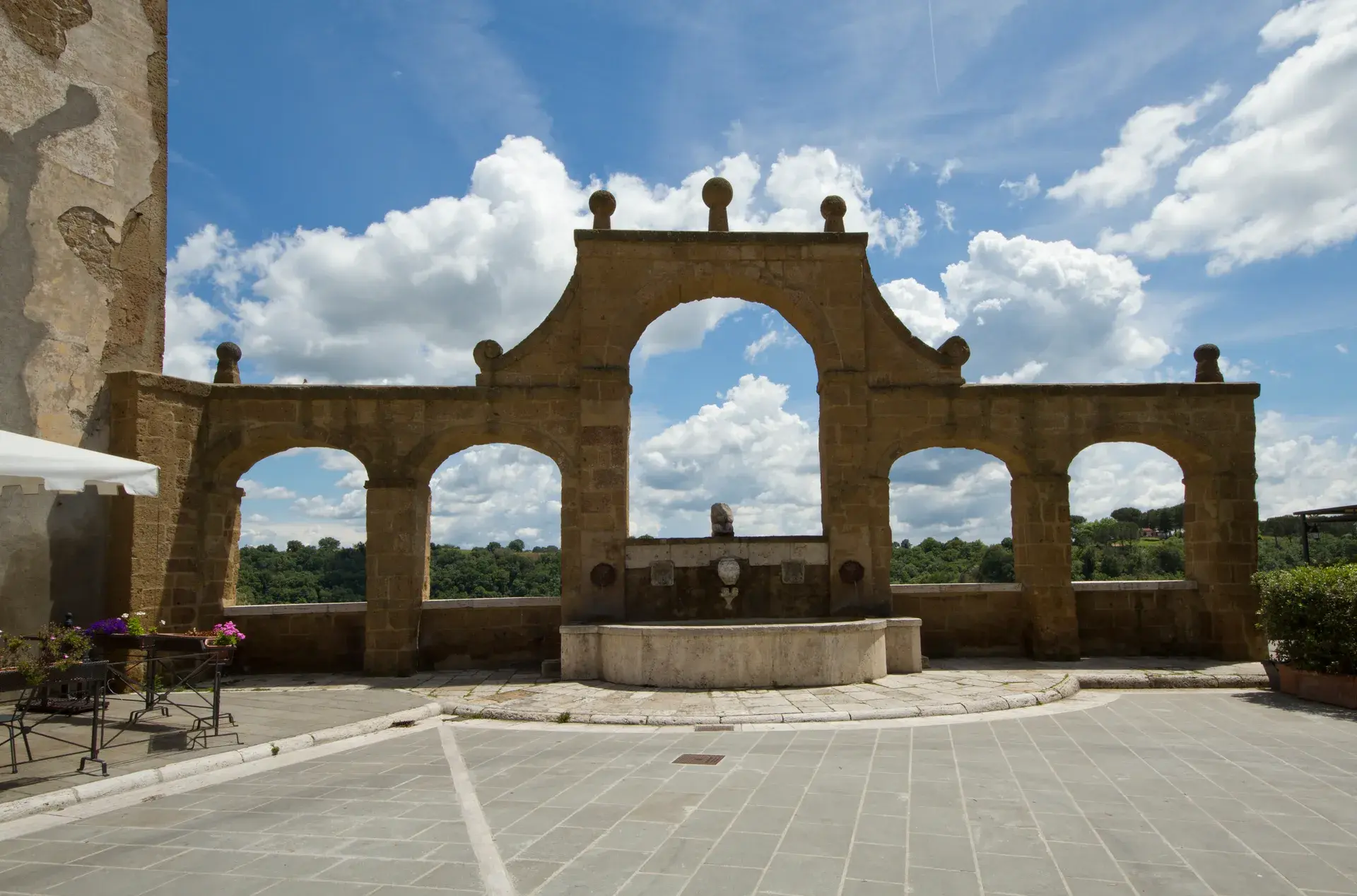
The Fontana delle Sette Cannelle stands along the southern perimeter of Piazza della Repubblica in Pitigliano. Built from porous, golden-brown volcanic tuff ashlar, the fountain marks the terminal head of the historic town aqueduct. It is positioned adjacent to a panoramic terrace that overlooks the deep gorge of the Valle del Meleta, directly where the towering arched aqueduct meets the gateway into the historic center.
Historically, the clifftop settlement of Pitigliano faced significant water security challenges. Perched atop an isolated tufa plateau, the town lacked natural springs on its summit and relied primarily on rainwater cisterns. The fountain served as the critical public domestic water distribution point that transformed urban life once fresh water was piped directly into the center.
A Fountain Built a Century Before the Water
Commissioned by Count Gianfrancesco Orsini, ruler of the County of Pitigliano, the fountain structure was erected in 1545. However, the delivery of running water did not follow immediately. While the elaborate fountain head stood ready in the mid-16th century, the ambitious arched aqueduct required to carry water across the surrounding valley remained unfinished for decades.
The engineering project was finally completed around 1637–1638 under the rule of the Medici Grand Dukes of Tuscany, who had absorbed the county into their territory. By the mid-18th century, the fully operational monument was commonly referred to as the Fontana delle Sette Cannelle or the Fontana Medicea.
Architecture and Mythological Mascarons
The facade of the fountain features five distinct arches: a tall central semicircular arch flanked on each side by two lower segmental arches. Five carved stone pinnacles accentuate the upper roofline, with three ornamenting the central pediment cornice and two positioned at the outer corners. Perched atop the structure sits a weathered stone sculpture of a bear, the heraldic emblem of the Orsini dynasty.
The landmark derives its name from its seven spouts (sette cannelle), which empty into stone basins below. Rather than following a uniform decorative scheme, these spouts form a stylistic patchwork added and modified across different eras. Water discharges through bronze and carved tuff mascarons depicting animal figures and mythological characters, including Medusa, Silenus, and a Herculean male head.
The Civic Setting of Piazza della Repubblica
The Fontana delle Sette Cannelle serves as an orientation landmark at the entrance to Pitigliano's old town. Piazza della Repubblica also contains two other water features: a pair of smaller twin fountains (fontane gemelle) installed at opposite ends of the square during the early 20th century. Together with the neighboring Palazzo Orsini complex, the 16th-century fountain anchors the civic and historical memory of the town's hydraulic development.
FAQ
Why was the fountain built before the aqueduct was finished?
Count Gianfrancesco Orsini constructed the ornamental terminal head in 1545 as part of an infrastructure project to bring water to Pitigliano. However, the arched aqueduct needed to carry the water across the ravine was not completed until around 1637–1638 under the Medici Grand Dukes.
What figures are carved on the spouts of the fountain?
The seven spouts feature stone and bronze mascarons representing a mix of animal and mythological faces from different centuries, including Medusa, Silenus, and a Herculean male head.
What is the meaning of the bear sculpture on top of the fountain?
The weathered stone bear atop the monument represents the heraldic symbol of the Orsini family, whose count, Gianfrancesco Orsini, commissioned the fountain in 1545.