Chiesa di Santa Maria e San Rocco, Pitigliano
History and Medieval Origins
Documented in papal tax rolls (Rationes decimarum) dating to 1276–1277 and 1296, the Chiesa di Santa Maria e San Rocco is recognized as the oldest surviving church in Pitigliano. Established in the 12th or 13th century, it was originally dedicated solely to Santa Maria and functioned as the primary parish church for the early medieval settlement on the tufa plateau.
The church gradually lost its status as the town’s primary parish when the nearby Cathedral of Saints Peter and Paul was expanded and designated as the episcopal seat. In 1907–1908, the church was co-dedicated to San Rocco, the patron saint of Pitigliano and protector against plague epidemics.
Renaissance Reconstruction by Giovanni da Traù
Around 1500, Count Niccolò III Orsini undertook a significant reorganization of Pitigliano's urban plan. As part of this initiative, he commissioned the architect and sculptor Giovanni da Traù (also known as Giovanni Dalmata) to rebuild the medieval structure into a classical Renaissance church.
Giovanni da Traù integrated sections of the older building into the new design, resulting in a combination of medieval masonry and late Renaissance styling that defines the structure today.
Exterior Architecture and the Romanesque Relief
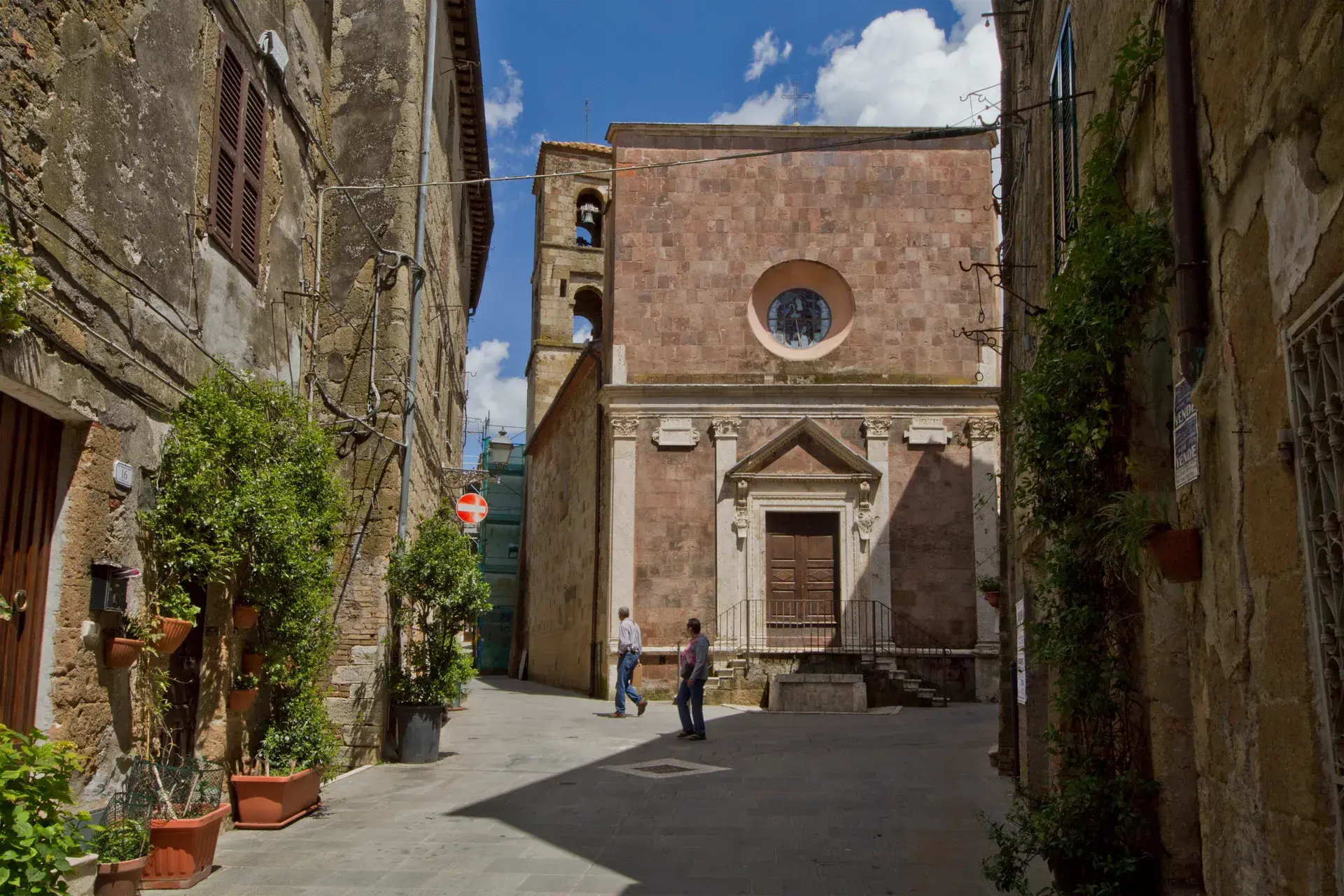
The building features a late Renaissance facade with a lower register defined by four Corinthian pilasters flanking a pedimented portal. This lower level displays smoothly carved stone trim that contrasts against the rough, porous golden-brown tufa masonry visible on the upper wall. The entrance is elevated and reached via twin stone staircases framing an integrated fountain basin at the base. High on the facade, a circular oculus contains a stained-glass window depicting San Rocco, added during the church's early 20th-century co-dedication.
One of the building's oldest architectural components is set into the exterior wall along Via Generale Orsini. Here, a salvaged 11th- or 12th-century volcanic stone (nenfro) architrave from the original medieval structure is embedded directly into the masonry. The Romanesque bas-relief depicts a human figure grasped by two winged dragons or griffins, representing an allegory of the human soul assaulted by evil forces.
Interior Art and Asymmetric Design
The church's interior features an unusual trapezoidal layout where the aisles widen as they extend from the entrance toward the presbytery. The space is divided into three naves by two rows of travertine columns topped with Ionic capitals.
Above the arch of the presbytery rests a painted chronological band displaying nine coats of arms. This sequence documents the successive governing authorities of Pitigliano, including the Orsini, the Medici, the Grand Dukes of Lorraine, the local civic community, Pope Pius IX, and the House of Savoy, with a notation dated 1891.
Among the church's interior artwork is a fresco of the Madonna del Buon Viaggio ("Our Lady of the Safe Journey"), originally executed to bless travelers passing through the ancient Porta di Sovana gate. The church also houses paintings of Saint Peter and Saint Paul, which local tradition maintains were rescued from the nearby rival city of Castro following its destruction in 1649.
Setting at the Gate of Capisotto
Standing at the intersection of Via Generale Orsini and Via F. Zuccarelli, the church serves as the structural entrance to Capisotto, Pitigliano's oldest residential quarter. Its location marks the junction where the central route through the historic center divides toward the Jewish Ghetto in one direction and the descent to Porta di Sovana in the other. Today, the church remains an active Roman Catholic place of worship within the Diocese of Pitigliano-Sovana-Orbetello.
FAQ
What is the oldest church in Pitigliano?
The Chiesa di Santa Maria e San Rocco is the oldest surviving church in Pitigliano, with records tracing back to papal tax rolls from 1276–1277.
Why does the church have two dedications?
Originally founded in the Middle Ages under the sole dedication to Santa Maria, it was co-dedicated to San Rocco in 1907–1908 in honor of Pitigliano's patron saint and protector against plague.
What is the carving embedded on the church's exterior wall?
The left exterior wall along Via Generale Orsini features a reused 11th- or 12th-century volcanic stone (nenfro) architrave showing a Romanesque relief of a human figure gripped by two winged dragons or griffins.
Who designed the Renaissance renovation of the church?
Around 1500, Count Niccolò III Orsini commissioned the architect and sculptor Giovanni da Traù (Giovanni Dalmata) to rebuild the church.