Duomo di San Gimignano: Art, Frescoes & History
The Collegiate Church That Is Not a Cathedral
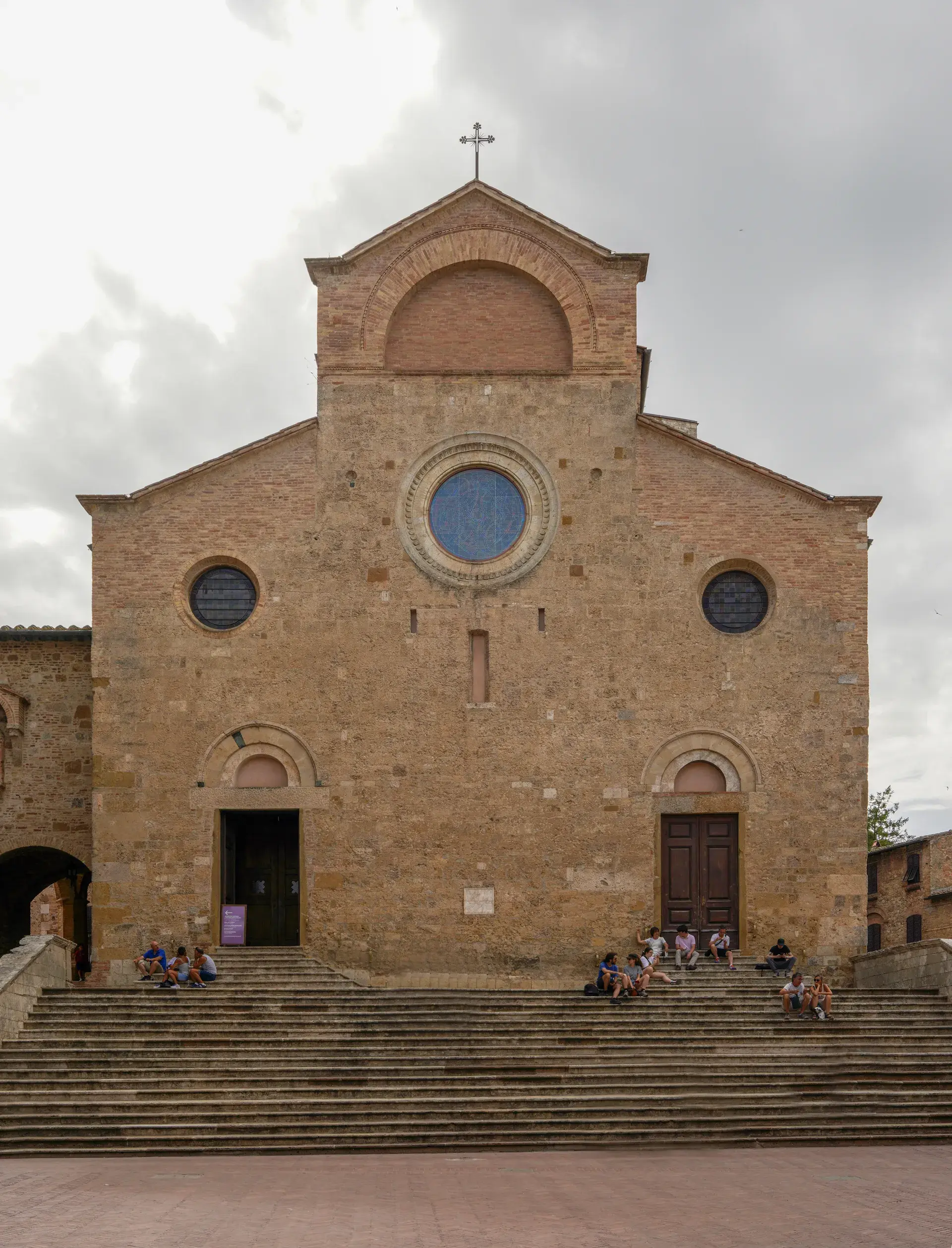
Despite defining the western perimeter of Piazza del Duomo, the primary church of San Gimignano is not technically a cathedral. Because San Gimignano was never an episcopal see, the building never housed a bishop's throne (cathedra). Officially designated the Basilica Collegiata di Santa Maria Assunta, it historically operated as a collegiate church governed by a chapter of canons and a provost (preposto). Ecclesiastically, it falls under the Archdiocese of Siena-Colle di Val d'Elsa-Montalcino and was elevated to a minor basilica by Pope Pius XI in 1932.
The building's cathedral-like scale and monumental travertine staircase were financed by prosperous local merchants and trade guilds. Rather than answering to a resident bishop, the oversized structure functioned as an assertive civic symbol designed to proclaim municipal and religious independence from the neighboring dioceses of Volterra and Siena.
Medieval Roots Along the Via Francigena
The site dates back to an earlier 10th-century church, which grew rapidly in prestige and wealth between the 10th and 12th centuries as San Gimignano developed into an essential staging post along the Via Francigena pilgrimage route to Rome. On November 21, 1148, Pope Eugenius III consecrated the Romanesque church alongside fourteen prelates, a milestone commemorated on its exterior facade. Subsequent episcopal and papal decrees granted the canons wide-ranging autonomy from regional feudal authorities.
During the late 1460s, the commune hired the Florentine architect Giuliano da Maiano to renovate and expand the church. Da Maiano lengthened the choir and transept while adding two Renaissance spaces: the Chapel of the Conception and the Chapel of Santa Fina.
Fourteenth-Century Frescoes and Interior Splendor
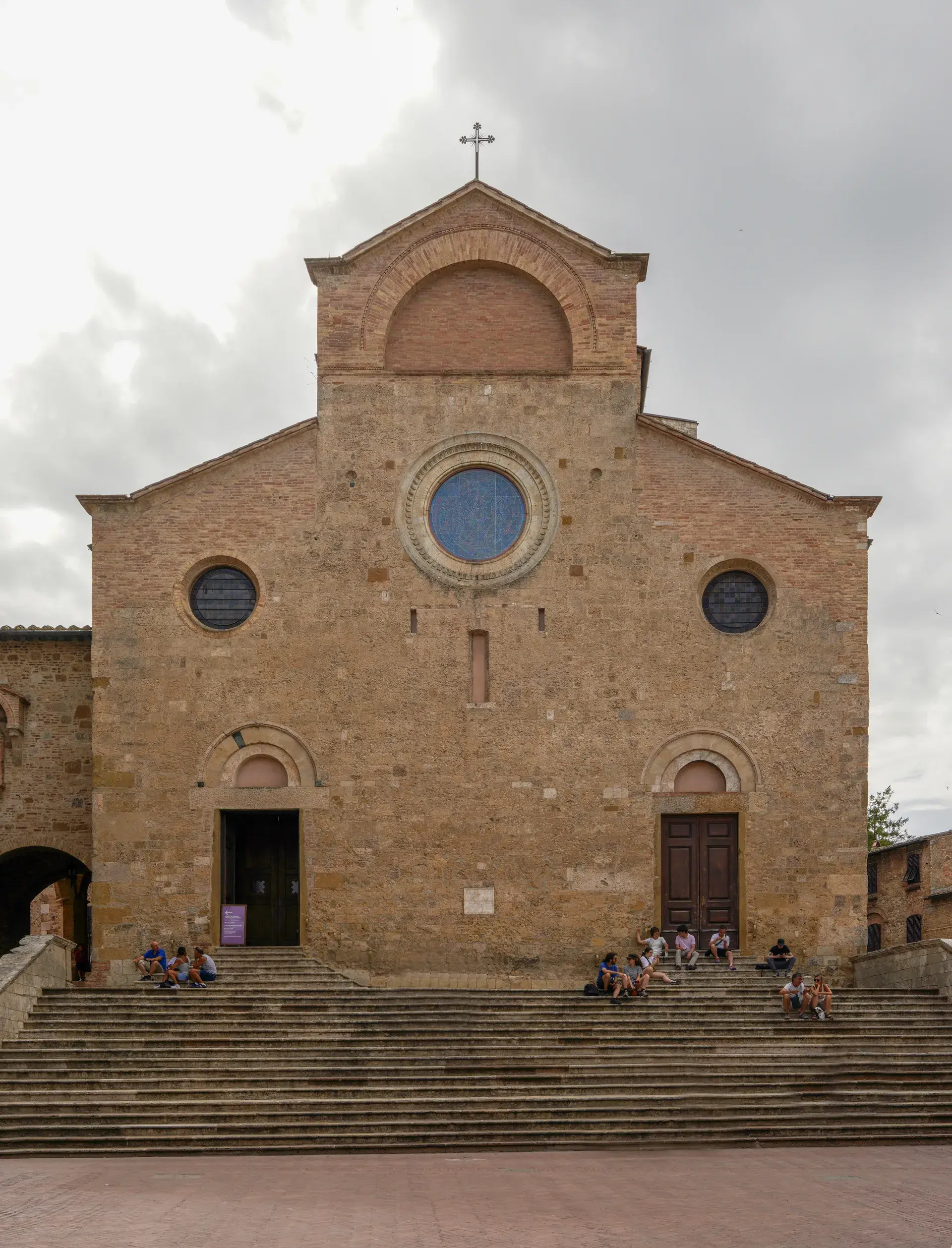
From the piazza, the basilica presents an austere, flat travertine facade pierced by three simple round-headed oculi. Stepping past this understated stone exterior reveals a dramatic interior defined by high visual saturation. Dim nave air gives way to zebra-banded black-and-white stone arches, deep lapis lazuli vaults sprinkled with painted gold stars, and walls covered in medieval pigment.
The nave features some of Tuscany's best-preserved 14th-century fresco cycles. On one wall, Sienese master Bartolo di Fredi created an extensive narrative of Old Testament scenes, completed in 1367. The opposing nave wall contains a New Testament cycle that modern art historians attribute to the workshop of Lippo Memmi. Renaissance biographer Giorgio Vasari popularized a dramatic legend claiming that these New Testament frescoes were painted by an artist named Barna da Siena, who purportedly died after falling from the scaffolding inside the church.
The Chapel of Santa Fina and Cultural Legacy
The Renaissance Chapel of Santa Fina, designed by Giuliano da Maiano and his brother Benedetto, contains frescoes painted by Domenico Ghirlandaio. The chapel honors the town’s patron saint, Fina dei Ciardi, who died in the 13th century. According to local religious tradition, after spending five years paralyzed on an oak board, bright yellow violets miraculously blossomed from the wood upon her death. To this day, the yellow wallflowers that bloom from the stone cracks of San Gimignano's medieval towers each spring are known as viole di Santa Fina.
The evocative interior of the basilica and the Chapel of Santa Fina achieved cinematic recognition in 1999, serving as primary filming locations for Franco Zeffirelli's semi-autobiographical period film Tea with Mussolini.
Civic Harmony, Wartime Damage, and Present-Day Use
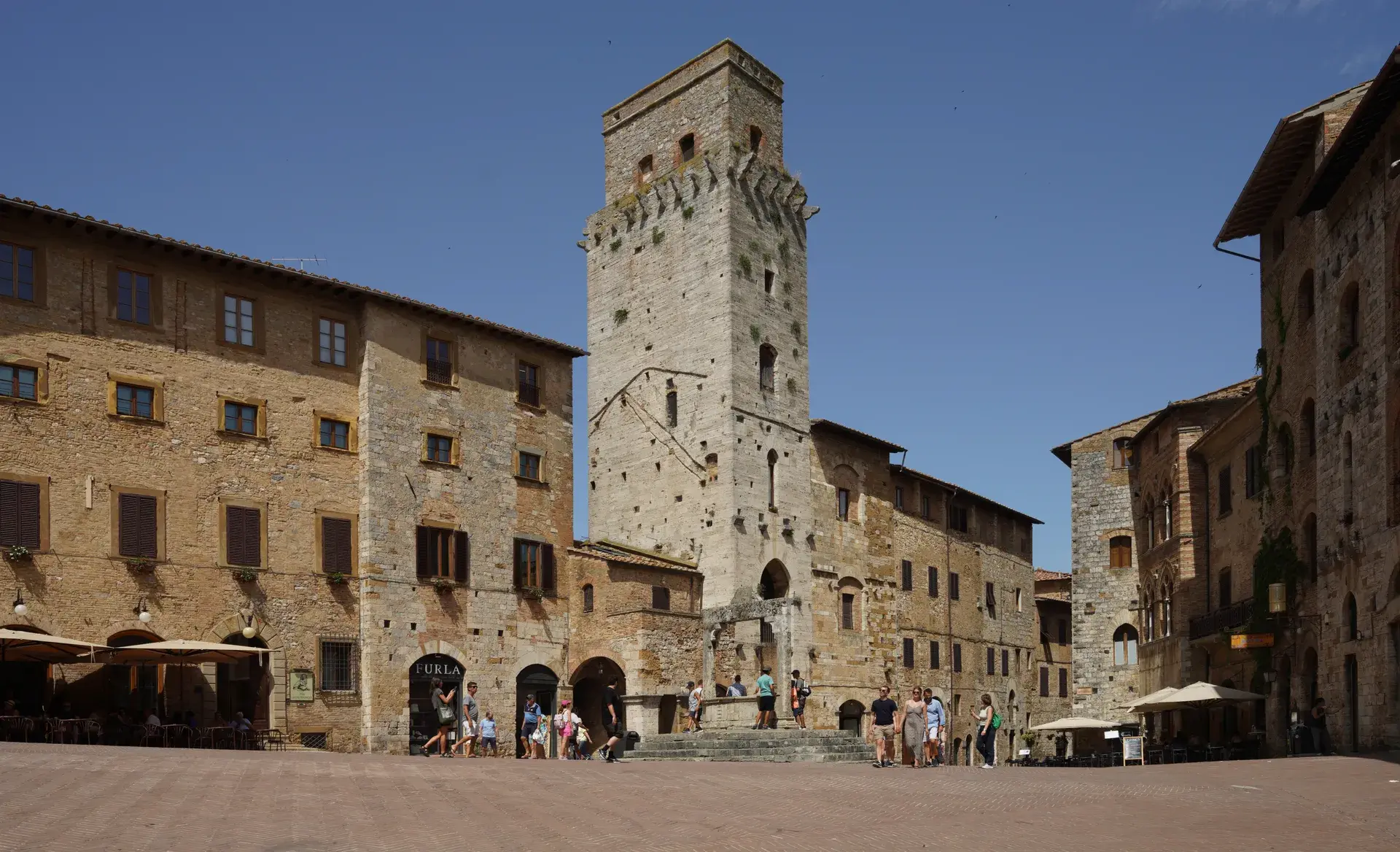
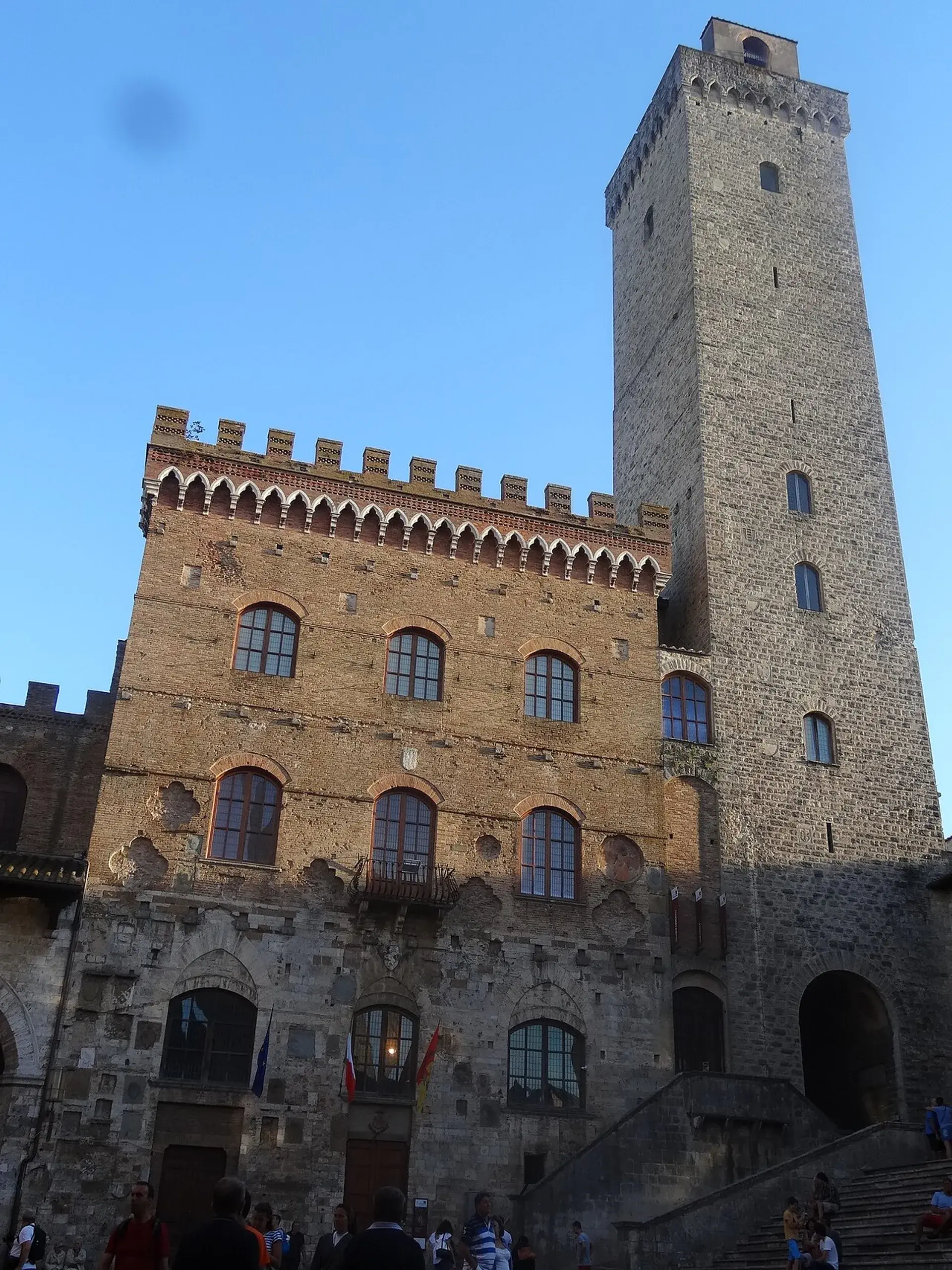
Positioned opposite the Palazzo Vecchio del Podestà and Torre Rognosa, and adjacent to the Palazzo Comunale and Torre Grossa, the basilica forms the sacred counterpart in San Gimignano's dual-power medieval plan. It stands across the sloped brick square as the religious balance to the secular government buildings.
The site has also witnessed major historical encounters. Dante Alighieri arrived at the civic center as an ambassador in 1300, and the Dominican friar Girolamo Savonarola delivered Lenten sermons from the church pulpit in 1497. In 1944, Allied shellfire and aerial bombardment during World War II inflicted damage on the building and its artwork, prompting an extensive postwar restoration effort.
Today, the Collegiata remains the primary active Roman Catholic parish church in San Gimignano, hosting regular Masses and liturgical ceremonies. It is also open daily to the public as an admission-ticketed monumental church and museum, with entry often coordinated via a combined pass with the neighboring Museo d'Arte Sacra.
FAQ
Why is the church called the Duomo if it is not a cathedral?
Although popularly known as the Duomo, the church never served as the seat of a bishop and contains no cathedra (bishop's throne). It was historically a collegiate church, officially named the Basilica Collegiata di Santa Maria Assunta, built to cathedral proportions by local merchants seeking ecclesiastical independence from nearby dioceses.
Who painted the frescoes inside the church?
The nave walls contain Old Testament fresco cycles painted by Bartolo di Fredi in 1367 and New Testament scenes attributed to Lippo Memmi and his workshop. In addition, the Renaissance Chapel of Santa Fina features frescoes by Domenico Ghirlandaio.
What is the legend behind the 'viole di Santa Fina'?
Local tradition states that after the town's patron saint, Santa Fina, spent five years paralyzed upon an oak plank, yellow violets sprouted from the wood at her death. The yellow wallflowers that continue to bloom each spring on the town's medieval towers are named in her honor.
Is the Duomo di San Gimignano open to visitors?
Yes. It operates daily as both an active Roman Catholic parish church holding religious services and an admission-ticketed monumental fresco museum, with tickets frequently bundled with the adjacent Museo d'Arte Sacra.
Gallery