Torri dei Salvucci: San Gimignano’s Twin Towers
The Architectural Rivalry of Piazza delle Erbe
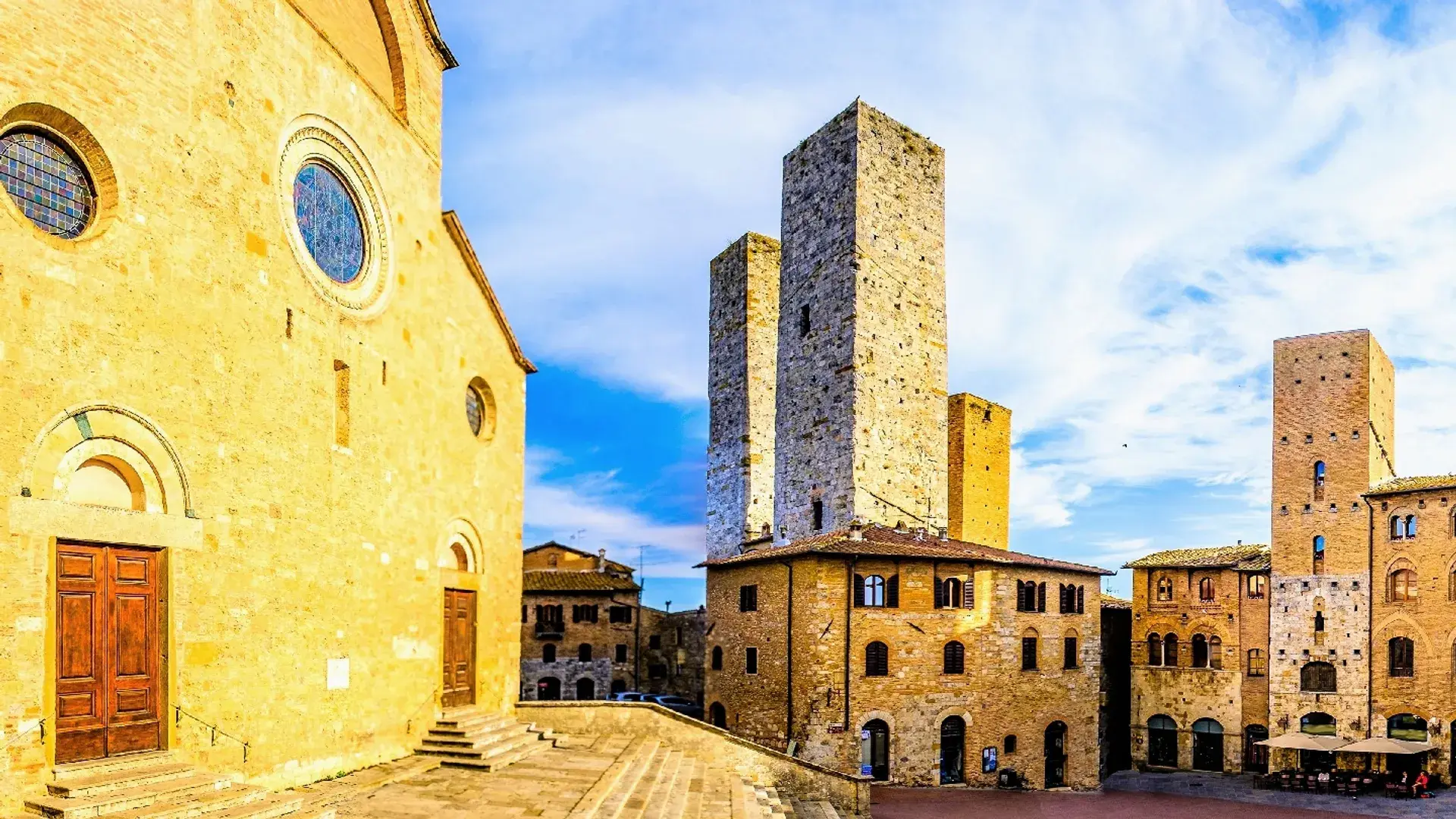
Framing the northern perimeter of Piazza delle Erbe in San Gimignano, the Torri dei Salvucci stand as prominent relics of medieval civic competition. Erected between approximately 1248 and 1257, these two tower-houses—designated Torre Salvucci Maggiore and Torre Salvucci Minore—were commissioned by the Salvucci family, one of the town's most prosperous merchant and moneylending dynasties. Situated directly beside Piazza del Duomo, Piazza delle Erbe historically served as the everyday market square for produce and herbs.
During the 12th and 13th centuries, an economic boom driven by trade and pilgrimage traffic along the Via Francigena prompted patrician families to build over 70 towers across the town, transforming San Gimignano into what is often called the "Manhattan of the Middle Ages." The Torri dei Salvucci were built with square bases, thick defensive stone masonry, and narrow slit openings intended for military protection and security rather than domestic comfort.
Circumventing the 1255 Height Decree
The construction of the Salvucci towers directly challenged municipal authority. The family intended their stone monoliths to rival or surpass the commune's official tower, the roughly 51-meter Torre Rognosa. To reassert civic supremacy, municipal authorities passed a decree in 1255 capping the maximum height of private towers below the level of the town hall.
Because the Salvucci structures violated this regulation, the commune forced their reduction, or scapitozzatura, cutting the towers down to roughly 40 to 42 meters. However, the Salvucci found a way to bypass the intent of the law. Forbidden from building higher, they constructed two massive towers side-by-side, doubling their visual presence and dominating the square through horizontal density.
Factional Warfare and the Fall of the Commune
The towers served as private bastions in an escalating feud between San Gimignano's leading aristocratic factions. The Salvucci clan headed the local Ghibelline faction, which aligned with imperial authority and nearby Siena. Their bitter rivals, the Guelph Ardinghelli family, aligned with Florence and the Papacy. In response to the Salvucci complex, the Ardinghelli erected their own twin towers across the piazza, cementing an architectural standoff in the heart of the settlement.
Decades of violent street clashes, ambushes, and political retribution culminated in the 1352 beheading of Ardinghelli family leaders on the town hall steps. Severely weakened by factional warfare and depleted by the Black Death of 1348, the commune could no longer sustain its autonomy. Between 1353 and 1354, San Gimignano formally surrendered its municipal independence to Florence.
Structural Secrets and the Lost Third Tower
Locally referred to as the Torri Gemelle (Twin Towers), the two surviving structures are not identical. Torre Salvucci Maggiore stands slightly taller than Torre Salvucci Minore, and the two exhibit distinct masonry variations across their stone facades.
The fortified complex originally included an additional third tower. In 1439, this third tower collapsed, completely demolishing the adjacent Salvucci family palace and causing structural damage to the neighboring Torre Useppi. Today, the surviving pair ranks among the 14 complete towers still standing in San Gimignano.
Modern Life Inside Torre Salvucci Maggiore
Both towers remain integral to the historical fabric of Piazza delle Erbe. Torre Salvucci Minore is preserved as part of the private medieval streetscape, while Torre Salvucci Maggiore functions as a private historical rental residence.
Inside Torre Salvucci Maggiore, the accommodation forms a vertical residence arranged over 10 to 11 stacked levels. An enclosed interior climb of approximately 143 to 160 steep stone steps links the individual floors, ultimately leading to an open-air rooftop terrace that offers 360-degree panoramic views over San Gimignano's terracotta roofs and neighboring medieval towers.
FAQ
Why did the Salvucci family build two towers next to each other?
When a 1255 municipal decree barred private towers from surpassing the height of the town hall's Torre Rognosa, the Salvucci bypassed the law's intent by building two towers side-by-side to double their visual prominence on the square.
Were the Torri dei Salvucci lowered after their construction?
Yes. Because the towers originally violated civic height limits, communal authorities ordered their reduction, or scapitozzatura, cutting them down to roughly 40 to 42 meters.
Are the two Salvucci towers identical?
Although known locally as the Twin Towers (Torri Gemelle), they are not structurally identical. Torre Salvucci Maggiore is slightly taller than Torre Salvucci Minore and features distinct masonry details.
What happened to the third tower of the Salvucci complex?
In 1439, a third tower belonging to the Salvucci fortified complex collapsed, destroying the family palace and damaging the neighboring Torre Useppi.
Discover San-gimignano like never before
Dive into San-gimignano hidden stories and secret spots with Ciceru interactive tours.
Explore tour
Audioguide
Quizzes
Maps
Solo
Couples
Groups & families

© Photo by Torre Salvucci Maggiore Medieval Tower Experience via Google Maps · Google Places