Rocca di Montestaffoli Viewpoint in San Gimignano
The Summit Overlook of San Gimignano
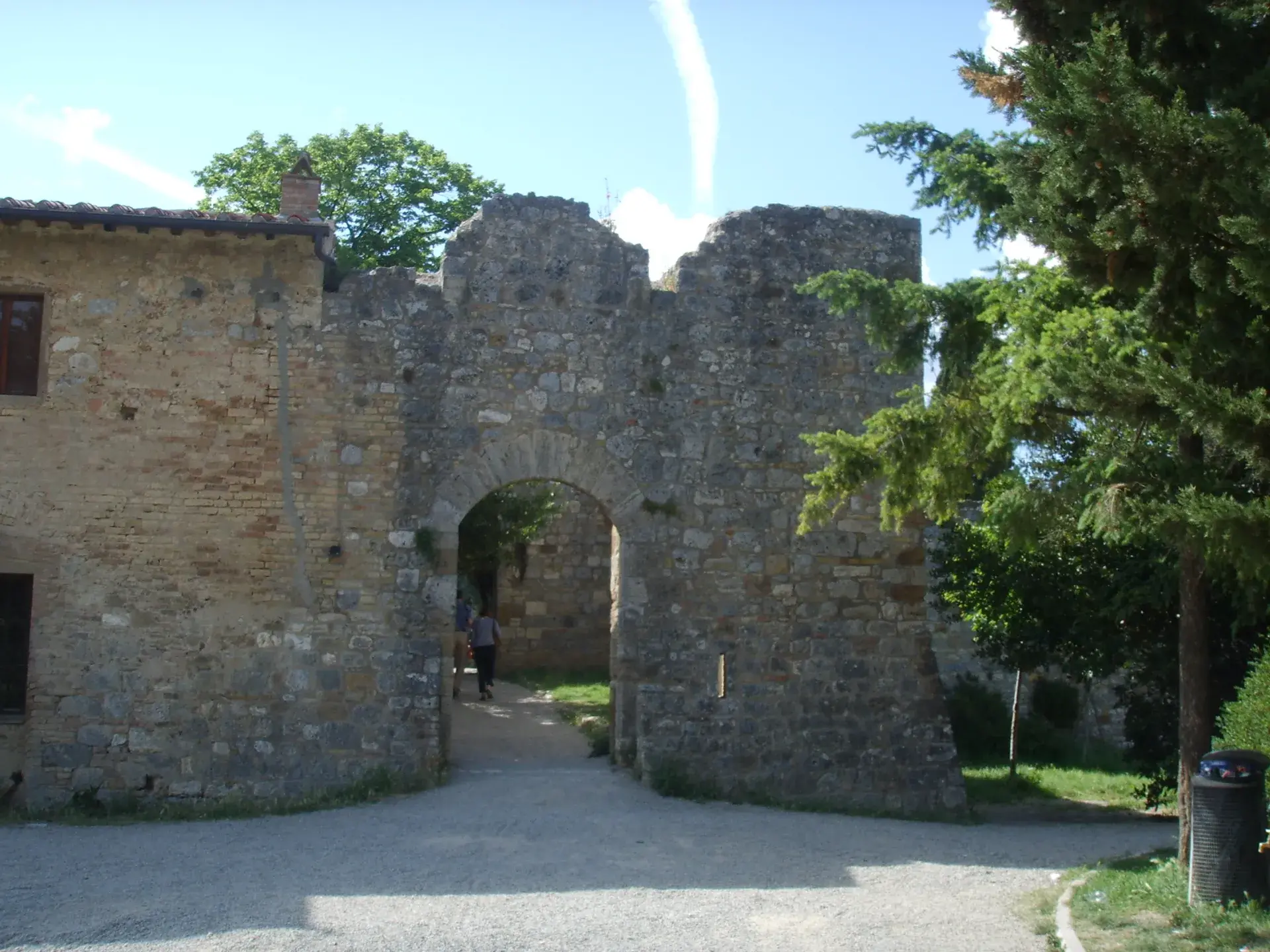
Perched atop the hill of Montestaffoli, the highest geographic elevation in San Gimignano, the viewpoint at Rocca di Montestaffoli provides sweeping panoramas across the Elsa Valley (Val d'Elsa). By climbing the stone stairs of the fortress's single surviving corner watchtower, visitors can observe San Gimignano's famous stone towers nearly at eye level, framed against the undulating Tuscan countryside.
The hilltop was occupied as early as the 10th century under the authority of the Bishops of Volterra, serving as a site for early fortifications and an active market. In 1335, a Dominican convent was established on the grounds, remaining until regional conflict reshaped the hilltop's purpose.
A Stronghold Built for Subjugation
San Gimignano's communal independence came to an end in the mid-14th century. Weakened by famine, the devastating Black Death of 1348, and violent domestic warfare between the Guelph Ardinghelli and Ghibelline Salvucci factions, the commune surrendered its sovereignty to Florence in 1353.
To solidify Florence's control, Florentine authorities evicted the Dominican community and razed their convent church to build a new fortress between 1353 and 1358. Engineered with a trapezoidal layout, defensive bastions, corner towers, and a central keep, the stronghold was integrated directly into the town walls. The garrison served a dual purpose: its outer perimeter watched the Val d'Elsa for hostile forces from Siena, while its inward-facing defenses were configured to quell local rebellions within San Gimignano.
Medici Dismantling and Transformation
Between 1555 and 1558, Duke Cosimo I de' Medici ordered the systematic dismantling of the fortress. This decommissioning occurred not due to defeat, but as a consequence of victory. After Florence successfully conquered Siena in 1555, the regional frontier threat ceased to exist. Because an external enemy was no longer positioned across the valley, retaining a fortified stronghold inside San Gimignano posed an unnecessary security liability that could be seized by municipal insurgents. As a result, the keep and interior battlements were leveled, leaving only the outer perimeter curtain walls and the corner lookout tower intact.
Parco della Rocca Today
Today, the enclosed footprint of the fortress functions as Parco della Rocca, a free-access municipal public park. The interior grounds feature walking paths, a historic stone well, and shaded groves of olive trees that provide a quiet refuge from the bustling civic squares below.
In addition to serving as a lookout point, the park acts as an open-air venue for seasonal cultural events, musical performances, and historical reenactments such as the Giostra dei Bastioni. The complex also contains the restored Villa della Rocca, home to the Vernaccia di San Gimignano Wine Experience, where visitors can engage with educational museum exhibits and regional wine tastings.
FAQ
Is there an admission fee to access the Rocca di Montestaffoli viewpoint?
No, the interior of the fortress ruins operates as a free-access municipal public park known as Parco della Rocca.
Why was the fortress dismantled by Florence?
Duke Cosimo I de' Medici ordered the fortress dismantled between 1555 and 1558 following the defeat of Siena. With the external border threat resolved, the fortress was reduced so that local rebels could not seize it as a stronghold.
What amenities and attractions are located within the fortress grounds?
The park includes walking trails, an olive grove, a historic well, and the restored Villa della Rocca, which hosts the Vernaccia di San Gimignano Wine Experience with museum exhibits and tastings.