Museo Castello del Buonconsiglio: Grand Fortress
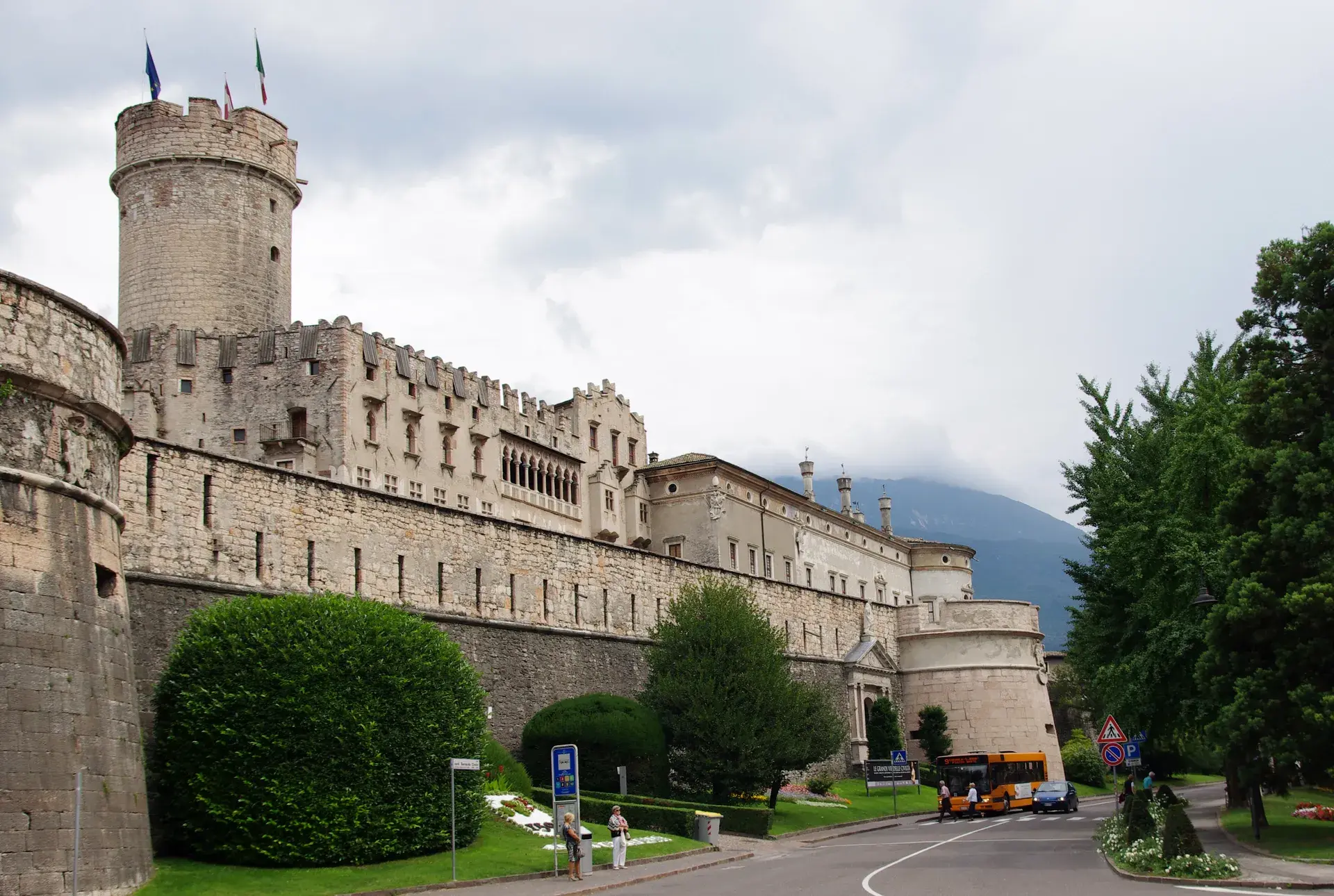
The Castello del Buonconsiglio stands as the largest monumental complex in the Trentino-Alto Adige region. Situated on an elevated rocky rise on the northeastern edge of Trento's historic center, it anchors the northern end of the classic route from Piazza del Duomo. For nearly 800 years, the complex served as the fortified residence of the Prince-Bishops of Trento. The sprawling architecture embodies the city's history as a borderland capital, ruled by ecclesiastical leaders who balanced Italian artistic culture with the political demands of the Holy Roman Empire.
Medieval Origins and Castelvecchio
The fortress originated in the 13th century as the Castelvecchio, built along the city walls to provide a secure residence for the prince-bishops. Its original defensive core includes the circular keep known as the Torre d'Augusto. The heavy, rough stone walls, heavy arches, and defensive battlements create an imposing exterior.
In the late 15th century, Bishop Johannes Hinderbach enhanced the medieval structure by adding decorative stonework and a Gothic loggia. The open Venetian Loggia on the upper tier of the Castelvecchio overlooks the terracotta rooftops of Trento and the surrounding limestone mountains.
The Torre Aquila Frescoes
During the late 14th century, Prince-Bishop George of Liechtenstein incorporated the defensive Torre Aquila, or Eagle's Tower, into his private quarters. This tower contains the internationally renowned "Cycle of the Months," a secular fresco series from the late International Gothic period.
The celebrated cycle contains only eleven visible panels. The depiction of March was destroyed centuries ago when a wooden spiral staircase was cut directly through the wall to connect the upper levels of the tower.
The Renaissance Magno Palazzo
Between 1528 and 1536, Cardinal-Prince-Bishop Bernardo Clesio transformed the fortress into a humanist Renaissance court with the construction of the Magno Palazzo. This expansion was completed ahead of major diplomatic summits and the Council of Trent. The architectural transition is stark, shifting from the rough defensive elements of the Castelvecchio to refined frescoed loggias, symmetrical courtyards, and terracotta roundels.
The Magno Palazzo features extensive 1530s fresco cycles executed by prominent Italian masters, including Girolamo Romanino, Dosso and Battista Dossi, and Marcello Fogolino. One notable ceiling fresco by Dosso Dossi depicts the Roman god Jupiter completely absorbed in painting butterflies while Mercury gestures for silence. This artwork is believed to symbolize the prioritization of the arts and leisure over statecraft.
Baroque Links and Modern Era
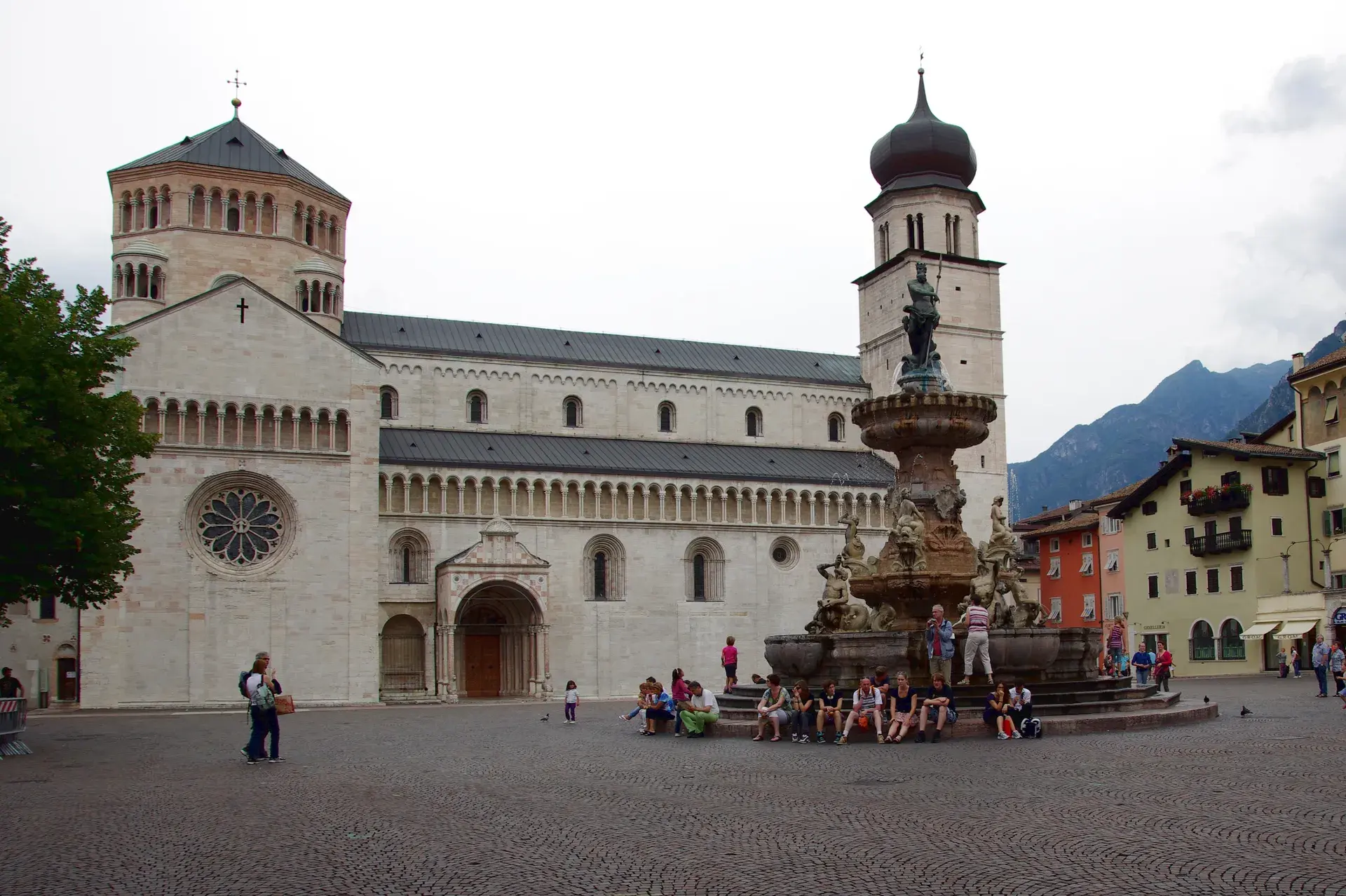
In the 1680s, Bishop Francesco Alberti Poja constructed the Baroque Giunta Albertiana to seamlessly connect the medieval Castelvecchio with the Renaissance Magno Palazzo. Beyond these architectural links, local folklore suggests the prince-bishops also relied on a secret subterranean passage connecting the castle directly to the Cathedral of Saint Vigilius, allowing them to travel beneath the city unseen.
Following the secularization of the episcopal principality under Austrian rule in 1803, the castle was repurposed as a military barracks and prison. During World War I, Austrian authorities used the castle courtroom, the Stua della Famea, to try Italian irredentists. In 1916, Trentino patriots including Cesare Battisti, Fabio Filzi, and Damiano Chiesa were held in makeshift cells and executed in the rear ditch, now known as the Fossa dei Martiri.
Since the 1970s, the castle has been owned and managed by the Autonomous Province of Trento. It operates as the primary site of the provincial museum network, housing extensive collections of archaeology, numismatics, and fine arts ranging from medieval wood carvings to Renaissance paintings.
FAQ
What was the original purpose of the Castello del Buonconsiglio?
From the 13th century until 1803, the complex served as the fortified seat and residence of the Prince-Bishops of Trento.
Why is the month of March missing from the Cycle of the Months fresco?
The fresco panel depicting March in the Torre Aquila was destroyed centuries ago when a wooden spiral staircase was cut directly through the wall to connect the tower's upper levels.
What role did the castle play during World War I?
Under Austrian rule during WWI, the castle was used as a prison and site for military trials. In 1916, Italian irredentists such as Cesare Battisti were tried in the castle courtroom and executed in the rear ditch, known as the Fossa dei Martiri.