Torre Verde: Trento's Historic Green Tower
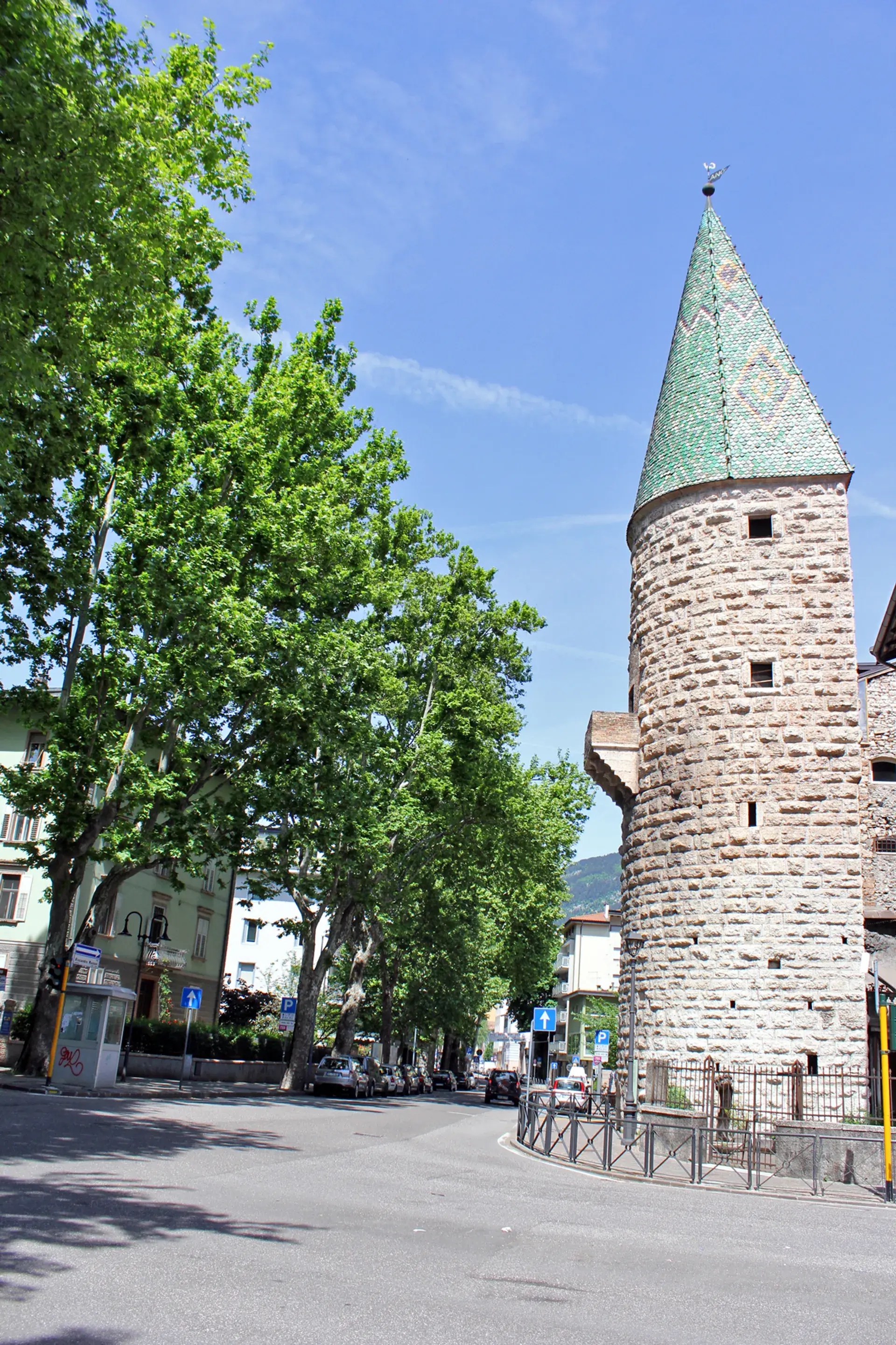
Look up at the imposing stone walls of Torre Verde, a striking historical landmark standing guard near the city's ancient defenses. A bright green roof that once guided boats on a river that is no longer there.
A Medieval River Fortress
Located at the intersection of Via Torre Verde and Via Alessandro Manzoni, Torre Verde originally served as the northeastern corner bastion of Trento's medieval walls. It was connected directly to the Castello del Buonconsiglio by a fortified wall. While early defensive structures at the site date back to the late 12th century, the tower took its prominent late-medieval form during the 15th century.
Until the mid-19th century, the tower stood on the eastern bank of the Adige River. It functioned as a strategic outpost, guarding the Porto di San Martino and collecting customs tolls from commercial boats that moored directly at its base to pay taxes to the Prince-Bishop.
Architectural Contrasts and Royal Renovations
The structure is defined by the sharp visual contrast between the rough medieval stone masonry of its semi-cylindrical base and its glossy, emerald-green ceramic roof tiles. By 1506, the building was explicitly recorded in municipal records as Turrim Viridim due to this distinctive coloring.
A stone coat of arms on the structure attributes significant renovations to Prince-Bishop Georg Hack von Themeswald between 1446 and 1465. Furthermore, the distinctive patterns of the roof tiles are historically associated with Prince-Bishop Domenico Antonio Thun.
The Lost River and Urban Evolution
Together with the western Torre Vanga, Torre Verde marked the historical perimeter where Trento met the Adige River. This waterside setting changed drastically in 1858 when Austrian authorities diverted the river westward to prevent flooding and facilitate the construction of the Brenner railway.
This massive civil engineering project stripped the tower of its river edge. Following the demolition of adjacent city walls, Torre Verde was left isolated amid newly paved streets, a monument to an older version of the city.
Artistic Legacy and Folklore
Before the river shifted, Torre Verde caught the eye of the German Renaissance master Albrecht Dürer, who painted the tower in his panoramic watercolors of Trento during the 1490s. Beyond its artistic fame, local folklore frequently associated the tower's chambers with harsh medieval imprisonment.
Historical records also confirm its use as a sentry watch, a customs outpost, and even a 17th-century municipal gunpowder magazine. Today, Torre Verde serves solely as an exterior visual landmark on the walking route between Trento's historic center and the Castello del Buonconsiglio. The interior remains closed to the public, and the attached structure is utilized for private residential and commercial purposes.
FAQ
Can visitors go inside Torre Verde?
The interior of Torre Verde is closed to the public. It serves purely as an exterior visual landmark, and the attached structure is used for private residential and commercial purposes.
Why is the structure called Torre Verde?
The tower is named for its striking conical roof, which is covered in glossy, emerald-green glazed ceramic tiles. It was recorded in municipal records as Turrim Viridim by 1506.
Did the Adige River originally flow next to Torre Verde?
Yes, until the mid-19th century, Torre Verde stood directly on the eastern bank of the Adige River. In 1858, Austrian authorities diverted the river westward for flood prevention and railway construction, leaving the tower isolated on paved streets.