Galleria Subalpina: Turin's 19th-Century Arcade
The Galleria Subalpina, officially known as the Galleria dell'Industria Subalpina, is an enclosed commercial shopping passage in the historic center of Turin. Serving as an elegant pedestrian bridge, it connects two of the city's most important public spaces: Piazza Castello and Piazza Carlo Alberto. It is one of Turin's three surviving monumental covered galleries, standing alongside the Galleria Umberto I and Galleria San Federico.
Architectural Grandeur
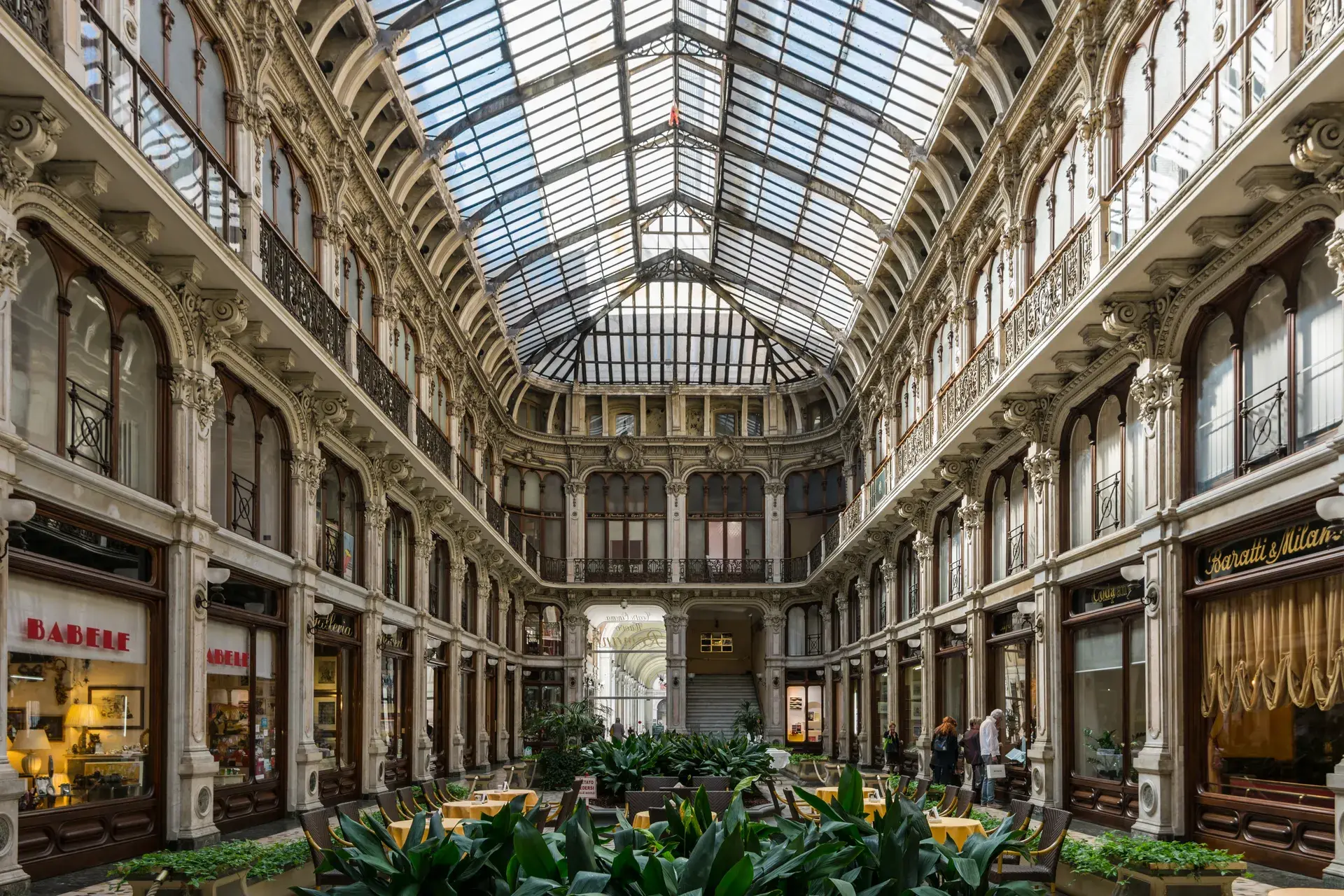
Designed in 1873 by architect Pietro Carrera, the gallery officially opened on December 30, 1874. The Eclectic and Neo-Renaissance structure spans approximately 50 meters in length, 14 meters in width, and 18 meters in height. A striking cast iron and glass barrel-vaulted ceiling channels diffuse daylight into the interior, contrasting beautifully with the polished marble, dark wood, and gilded trim of the shopfronts below.
A decorative continuous balcony runs around the second-floor perimeter, adding to the visual elegance of the space. Recent restorations have maintained these historical details, including bas-reliefs and historic lighting systems, while integrating indoor plant arrangements that create a sheltered "jardin d'hiver" (winter garden) atmosphere within the stone-and-glass corridor.
A History of Leisure and Resilience
The arcade was funded by and named after the Banca dell'Industria Subalpina. It was created to provide a protected, fashionable indoor promenade dedicated to bourgeois leisure and luxury commerce, reflecting the urbanization trends of late 19th-century Europe. During the late 19th and early 20th centuries, the gallery's venues became regular meeting spots for prominent Italian literary figures, including the author Edmondo De Amicis.
The gallery suffered structural damage to adjacent structures during Allied air raids on August 8, 1943. Following the end of World War II, the damaged sections were subsequently rebuilt faithfully to Carrera's original designs.
Historic Cafés and Cinematic Fame
Today, the thoroughfare hosts antique bookstores, art galleries, boutiques, and historic businesses. It is famously home to the flagship Caffè Baratti & Milano, which has operated in the gallery since 1875. Brand history attributes the invention of the "cremino"—a layered hazelnut gianduja and cream praline—to Ferdinando Baratti at this very location.
The gallery also houses the Cinema Romano, a three-screen art-house theater with roots tracing back to the 19th-century Caffè Concerto Romano. Beyond its daily commercial use, the Galleria Subalpina has served as a filming location for classic movies, including Peter Collinson's 1969 heist film The Italian Job, Dario Argento's 1971 thriller Four Flies on Grey Velvet, and Luigi Comencini's 1975 film The Sunday Woman.
FAQ
When was the Galleria Subalpina built?
Construction began in 1873 based on designs by architect Pietro Carrera, and the gallery officially opened on December 30, 1874.
What are the dimensions of the Galleria Subalpina?
The enclosed hall is approximately 50 meters long, 14 meters wide, and 18 meters high, topped with a large cast iron and glass vaulted ceiling.
What famous businesses are located in the Galleria Subalpina?
The gallery is home to boutiques, antique bookstores, the three-screen art-house Cinema Romano, and the flagship Caffè Baratti & Milano, which has been operating there since 1875.
What is the connection between the Galleria Subalpina and the cremino chocolate?
The invention of the cremino, a layered hazelnut gianduja and cream praline, is traditionally attributed to Ferdinando Baratti at the gallery's Caffè Baratti & Milano.