Piazza San Carlo: Turin's Historic Baroque Square
The Living Room of Turin
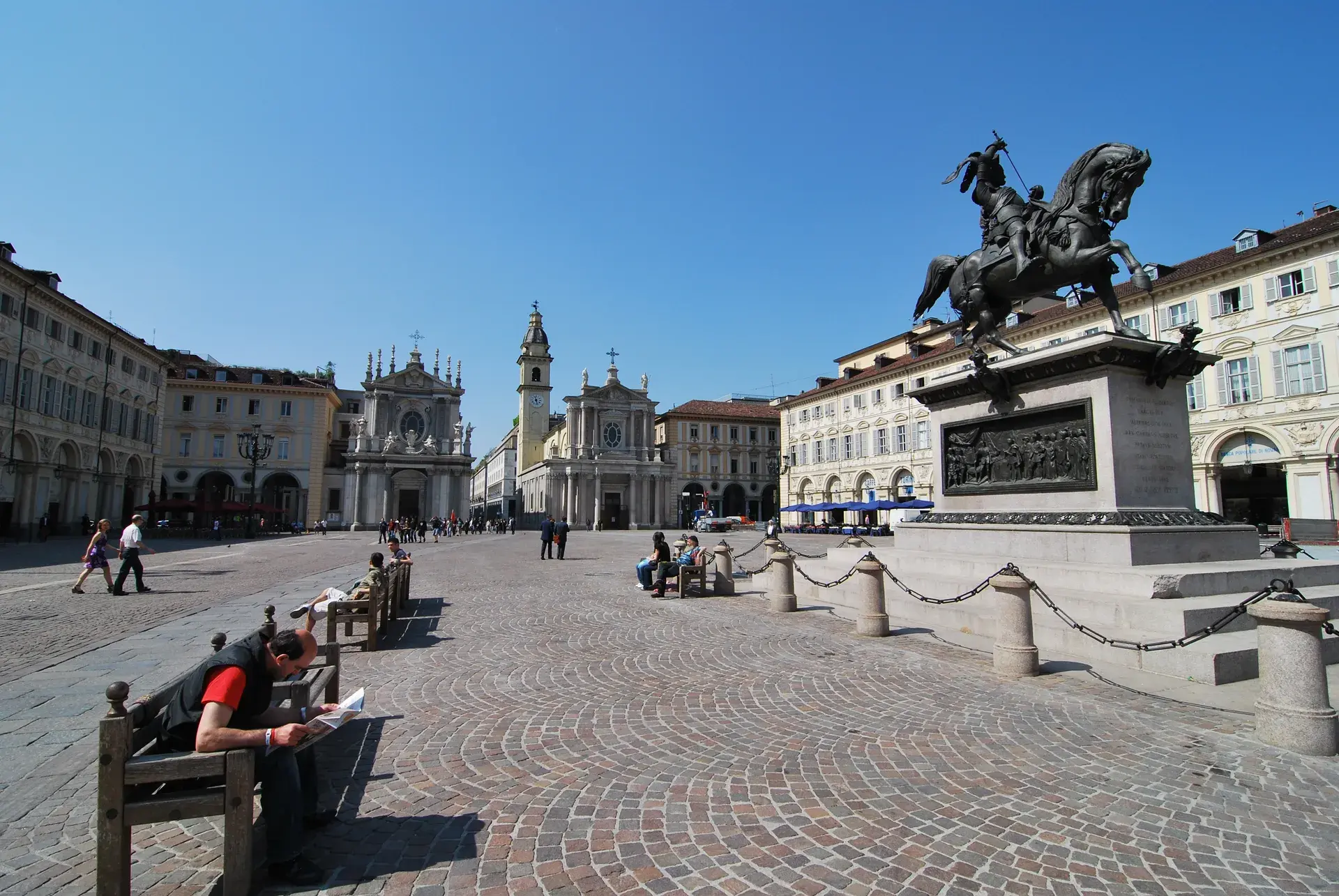
Piazza San Carlo serves as the elegant centerpiece of central Turin. Positioned midway along Via Roma, the rectangular Baroque square functions as an architectural bridge linking the northern royal hub of Piazza Castello to the southern Porta Nuova station district. Locals commonly refer to the pedestrian square as "Il Salotto di Torino," or Turin's living room.
The square is defined by continuous, symmetrical porticoed facades originally designed in the 1630s by architect Carlo di Castellamonte and later modified by Benedetto Alfieri. These deep, vaulted arcade walkways amplify the sounds of foot traffic while sheltering outdoor seating for the surrounding establishments.
The Twin Churches and The Bronze Horse
The southern end of the square is famously framed by two Baroque churches flanking Via Roma. Santa Cristina, begun in 1639, features a facade designed by Filippo Juvarra between 1715 and 1718. Its neighbor, San Carlo Borromeo, was founded slightly earlier in 1619.
At the precise center of the square stands an 1838 bronze equestrian monument sculpted by Carlo Marochetti. Known in the Piedmontese dialect as Caval ’d Brôns (The Bronze Horse), the statue depicts Duke Emanuele Filiberto of Savoy in military armor following the Battle of Saint-Quentin. In a surprising detail, the Duke is depicted sheathing his sword rather than drawing it, serving as a symbol of peace.
Centuries of Urban History
The space originated in the early 17th century during Turin's southward expansion beyond its Roman walls. Commissioned by Duchess Christine of France, it was initially known as Piazza Reale. The square briefly functioned as a military parade ground and was renamed Place Napoléon during French rule before finally becoming Piazza San Carlo.
Its current name honors Saint Charles Borromeo, the Archbishop of Milan, following his 1578 walking pilgrimage to venerate the Holy Shroud. Remnants of the city's turbulent military past remain visible in the upper exterior masonry of surrounding buildings, such as Palazzo Solaro del Borgo, which still bears embedded cannonballs from the 1706 French Siege of Turin.
Historic Cafes and Civic Life
During the 19th and early 20th centuries, Piazza San Carlo became a primary gathering space for political and literary figures. Prominent Italian leaders and writers, including Count Camillo Benso di Cavour, Giovanni Giolitti, and Cesare Pavese, frequently debated inside the square's cafes.
Today, historic establishments like Caffè San Carlo, Caffè Torino (operating since 1903), and Confetteria Stratta (founded in 1836) continue to anchor the square. Visitors seeking local traditions can find a bronze plaque of a rampant bull—the heraldic emblem of Turin—inset into the pavement outside Caffè Torino since 1930. Local lore dictates that discreetly stepping on the bull brings good fortune, though the Milanese tradition of spinning on the emblem is avoided here.
Beyond its cafes, the square remains a vital cultural space. It regularly hosts civic gatherings, public installations, and photography exhibitions at the Gallerie d'Italia located inside Palazzo Turinetti.
FAQ
Why is Piazza San Carlo called the living room of Turin?
It is known as "Il Salotto di Torino" (Turin's living room) because it serves as the city's premier pedestrian gathering space, surrounded by historic cafes, boutiques, and deep porticoes where locals socialize.
What are the two churches in Piazza San Carlo?
The southern side of the square is framed by two Baroque churches: Santa Cristina, featuring a facade designed by Filippo Juvarra, and San Carlo Borromeo. They flank the entrance to Via Roma.
What does the statue in the center of Piazza San Carlo represent?
The central statue is the Caval 'd Brôns, an 1838 bronze monument of Duke Emanuele Filiberto of Savoy. It depicts the Duke sheathing his sword after the Battle of Saint-Quentin, symbolizing the arrival of peace.
Where is the lucky bull in Turin?
A bronze plaque of a rampant bull is embedded in the pavement outside Caffè Torino in Piazza San Carlo. According to local tradition, discreetly stepping on it brings good luck.