Turin Cathedral: History, Architecture & the Shroud
Architectural Contrast in Piazza San Giovanni
Turin Cathedral, formally known as the Cattedrale metropolitana di San Giovanni Battista or Duomo di Torino, stands in Piazza San Giovanni in the historic center of Turin, Italy. Dedicated to Saint John the Baptist, the city's patron saint, the church serves as Turin's primary Catholic place of worship, the seat of the Archdiocese of Turin, and an important pilgrimage destination.
Positioned between the ancient Roman ruins of the Porta Palatina and the Royal Palace complex (Palazzo Reale), the cathedral marks the physical threshold where Turin transitioned from an ancient and medieval town into the Baroque capital of the House of Savoy. From Piazza San Giovanni, the building displays three distinct historical layers stacked together: a pale white Renaissance facade in front, a two-tone bell tower to the left, and the dark, tiered Baroque dome of Guarino Guarini's Chapel of the Holy Shroud rising behind the choir.
Turin: a self-guided walking tour of the Savoy capital, with audio, quizzes & free eSIM
2 hours10 stopsAudio guideStart any day, at your own paceTicket on your phone · 30-day refundAncient Foundations and Renaissance Rebuilding
The site adjacent to the ancient Roman theatre of Julia Augusta Taurinorum has held Christian buildings since the early Christian era. Prior to the current structure, three adjoining basilicas—dedicated to San Salvatore, Santa Maria di Domno, and San Giovanni Battista—occupied the ground. Historical accounts record that the Lombards established the site's dedication to Saint John the Baptist, and in 662 AD, Duke Garibaldo of Turin was assassinated inside the earlier church during an Easter service.
Between 1490 and 1492, the three medieval basilicas were demolished to clear space for a unified cathedral. On July 22, 1491, Bianca of Monferrato, regent of Savoy, laid the first stone of the new church. Commissioned by Cardinal Domenico della Rovere and designed by Tuscan architect and sculptor Amedeo di Francesco da Settignano, known as Meo del Caprino, the cathedral was built between 1491 and 1498 and consecrated on September 21, 1505.
Renaissance Facade and the Campanile di Sant'Andrea
Turin Cathedral is the city's only surviving example of Renaissance religious architecture. Its pale, geometric facade combines white marble and Bussoleno stone divided across three portals, opening onto a Latin cross interior. One local tour source also notes that the cathedral's back wall depicts the 12 signs of the zodiac.
Standing free to the left of the cathedral is the Campanile di Sant'Andrea, a bell tower reaching roughly 60 to 62.5 meters in height. Its dark exposed red brick base dates to c. 1469–1470, built for Bishop Giovanni di Compey, while its contrasting light-toned Baroque upper belfry was added by Filippo Juvarra between 1720 and 1723. Juvarra originally intended to crown the tower with a cupola, but interrupted work left the belfry with its distinctive flat top.
Guarini's Chapel and the Shroud of Turin
In 1578, the House of Savoy transferred the Shroud of Turin from Chambéry to their new capital. To house the relic, Duke Carlo Emanuele II commissioned an elevated chapel behind the cathedral's choir linking the church directly to the Royal Palace. Priest-architect and mathematician Guarino Guarini took over the project in 1667–1668 and completed the Chapel of the Holy Shroud in 1694.
From the exterior, Guarini's charcoal-toned dome reveals an intricate structural skeleton of twelve vertical divisions, six large drum windows beneath an undulating cornice, zigzagging segmental ribs, and diminishing rings crowned by a pagoda-like lantern—a silhouette that has no corresponding feature on the interior. On the night of April 11–12, 1997, a severe fire swept through the chapel, prompting firefighters led by Mario Trematore to smash the protective case and carry the Shroud to safety. Following a 21-year restoration, the chapel reopened in 2018. In 1988, radiocarbon testing by laboratories in Arizona, Oxford, and Zurich dated samples of the Shroud to between AD 1260 and 1390, though some researchers continue to dispute those findings.
Visiting the Cathedral and Nearby Landmarks
Entry to Turin Cathedral is free, and the church opens daily with a midday closure. According to the official Shroud commission (sindone.org), visiting hours run Monday through Friday from 10:00 AM to 12:30 PM and 4:00 PM to 7:00 PM, Saturday from 9:00 AM to 1:00 PM and 3:00 PM to 7:00 PM, and Sunday from 8:00 AM to 1:00 PM and 3:00 PM to 7:00 PM, though another source lists daily hours of 9:00 AM to 12:30 PM and 3:00 PM to 7:00 PM.
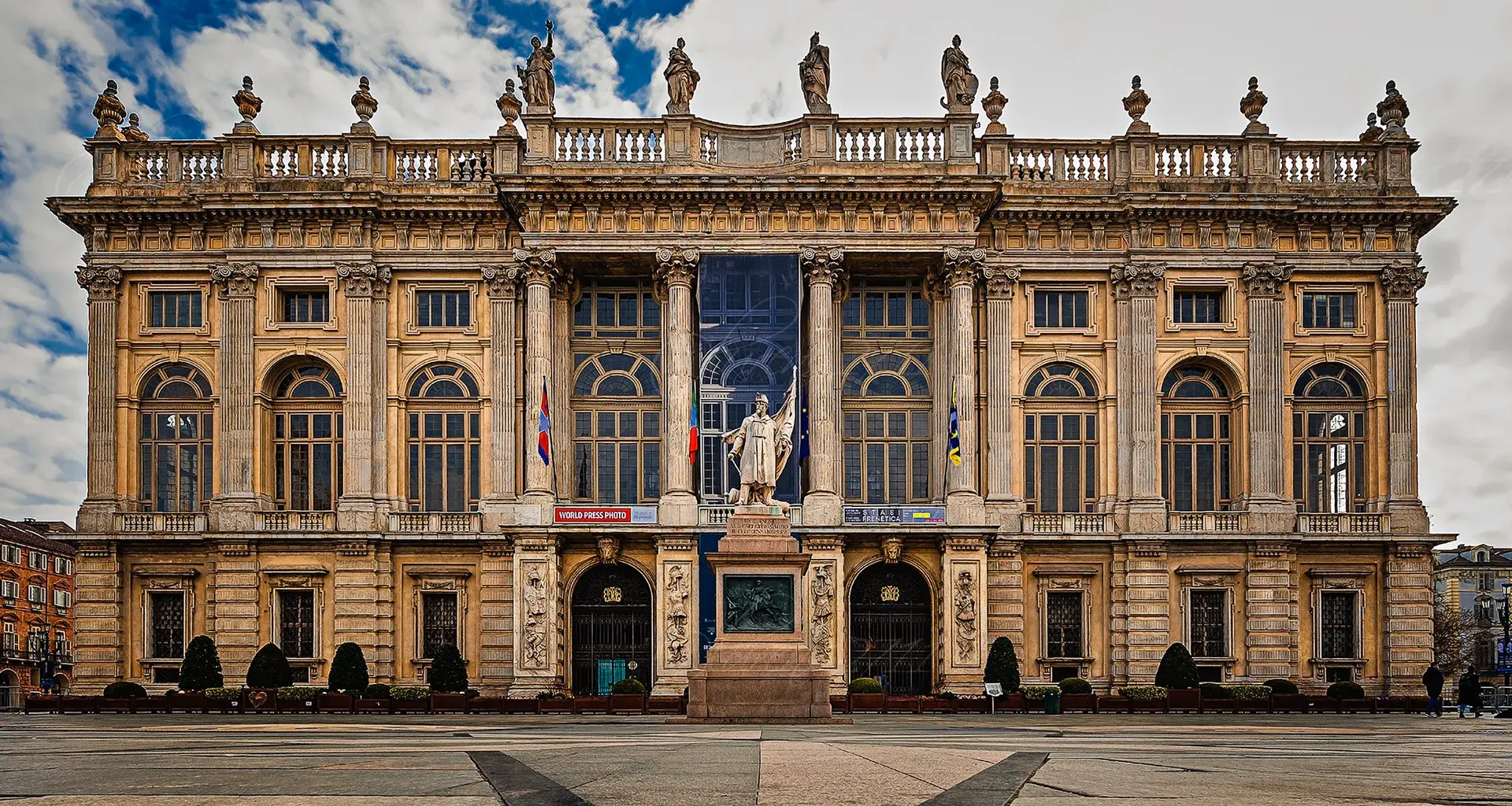
Under normal circumstances, the Shroud itself is not directly visible; it remains inside a conservation case enclosed in a large metal box in the last chapel of the left aisle, beneath the Royal Tribune, where visitors may pause and pray without a reservation. No public exhibitions are currently scheduled. Access to Guarini's restored Chapel of the Holy Shroud is separate from the cathedral nave and forms part of the Musei Reali route entered through the Royal Palace. The cathedral also sits within walking distance of Palazzo Madama, the Egyptian Museum, and the Museo della Sindone in the crypt of the church of the Santo Sudario on Via San Domenico.
FAQ
Can visitors see the Shroud of Turin inside Turin Cathedral?
Under normal circumstances, the Shroud cannot be seen directly. It is kept in a conservation case inside a large metal box in the last chapel of the left aisle, beneath the Royal Tribune, where visitors can pray without a reservation. No public exhibitions are currently scheduled.
Is Turin Cathedral free to enter, and how is the Chapel of the Holy Shroud accessed?
Entry to Turin Cathedral is free, and it is open daily with a midday closure. Guarino Guarini's restored Chapel of the Holy Shroud is visited separately as part of the Musei Reali, with entry through the Royal Palace.
Why do the cathedral facade, bell tower, and dome look so different from one another?
The complex reflects multiple architectural eras. The main church was built in the Renaissance style between 1491 and 1498, while the free-standing Campanile di Sant'Andrea pairs a c. 1469–1470 brick base with a 1720–1723 Baroque belfry by Filippo Juvarra, and Guarino Guarini completed the dark Baroque dome of the Chapel of the Holy Shroud behind the choir in 1694.