Fontana Grande in Viterbo: History & Architecture
An Architectural Prototype in the City of Fountains
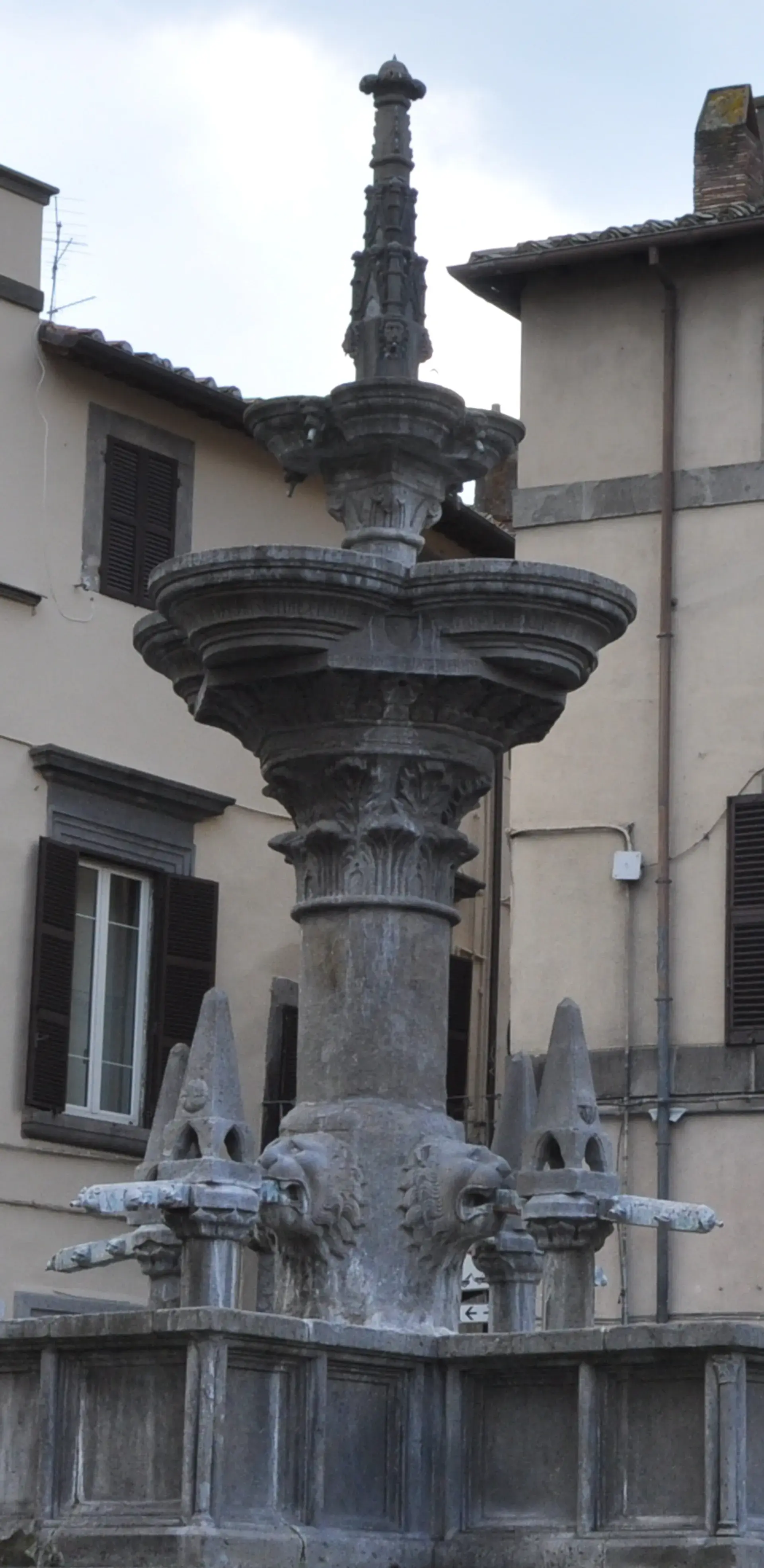
Situated in Piazza Fontana Grande near Porta Romana, at the junction of Via Garibaldi and Via Cavour, Fontana Grande stands as the oldest and largest public fountain in Viterbo. Known throughout Italy as the "City of Fountains" (Città delle fontane), Viterbo established much of its civic architectural language through this 13th-century monument. The fountain served as the prototype for the signature Viterbese spindle-fountain (fontana a fuso) style, a design later constructed across public squares such as Piazza del Gesù, Piazza San Faustino, and Pianoscarano.
Carved from local ash-grey volcanic peperino stone, the fountain merges Romanesque structural elements with ascending Gothic spires and vertical details. The monument features a lower basin in the shape of a Greek cross resting on concentric stone steps. At its center, a column supports two stacked, tiered bowls (tazze) that taper into an upper pinnacle. As water cascades continuously from the upper bowls into the main basin, the porous peperino darkens and glistens, producing a distinct acoustic presence that echoes across the stone-walled square.
Signed in Peperino: The 1212 Origins
Commissioned in 1212 by the medieval commune of Viterbo, Fontana Grande replaced an earlier communal water source recorded as Fontem Sepalis in the 1192 papal Liber Censuum, which had undergone municipal repairs in 1206.
The fountain holds a unique place in medieval art history because of its makers. While public civic artisans typically remained anonymous during the early 13th century, local master stonecutters (scalpellini) Pietro and Bertoldo di Giovanni chiseled their personal names directly into an epigraph on the lower basin in 1212, preserving their identities alongside the monument.
Centuries of Alterations and Restorations
Fontana Grande was altered and restored several times over subsequent centuries:
- 1279: Significant modifications were carried out under the municipal authority of podestà Orso Orsini.
- 1424: Restorations funded in part by Pope Martin V reworked the central pillar and added four sculpted lion heads. These spouts feature the civic heraldic lion (Faul), an emblem displayed on medieval palaces and city gates throughout Viterbo.
- 1827: Municipal architect Domenico Lucchi restored the upper shaft and added the pyramidal crowning elements visible today.
The name Fontana Grande first appeared in archival records in a notarial act dated May 11, 1483, recorded by Tommaso d’Andrea. By 1565, it had become the monument's official civic designation.
Aqueduct Traditions and Modern Civic Use
A longstanding local tradition attributes the aqueduct feeding Fontana Grande to the 1st-century Roman consul Mummius Niger Valerius Vegetus, who reportedly built a conduit near the church of San Sisto to supply his suburban villa (Villa Calvisiana). However, archaeological verification for this Roman origin is lacking.
Today, Fontana Grande remains a free, 24-hour public monument and a central orientation landmark within Viterbo's historic center. Pedestrians frequently sit along its perimeter steps, fill bottles from its spouts, and gather at adjacent outdoor cafes surrounding the square.
FAQ
When was Fontana Grande constructed?
Fontana Grande was commissioned in 1212 by the medieval commune of Viterbo, replacing an earlier water source documented in 1192 as Fontem Sepalis.
Who designed and carved Fontana Grande?
The monument was carved by local master stonemasons Pietro and Bertoldo di Giovanni, who inscribed their names on the fountain's lower basin.
What stone was used to build Fontana Grande?
Fontana Grande is built from grey volcanic peperino stone, a porous material characteristic of historic architecture in Viterbo.
Why are there lion heads on the fountain?
The four lion-head spouts, added during a 1424 restoration funded in part by Pope Martin V, depict the heraldic lion (Faul), the civic emblem of Viterbo.