Piazza San Pellegrino: Viterbo's Medieval Heart
Piazza San Pellegrino serves as the architectural core of the San Pellegrino quarter in Viterbo. Celebrated as one of the largest and best-preserved intact 13th-century residential districts in Europe, the square reflects the defensive, domestic, and mercantile life of medieval Italy. While the nearby Piazza San Lorenzo and Palazzo dei Papi showcased ecclesiastical and political authority, San Pellegrino captures the everyday world of medieval townspeople and patrician dynasties.
Peperino Stone and Medieval Architecture
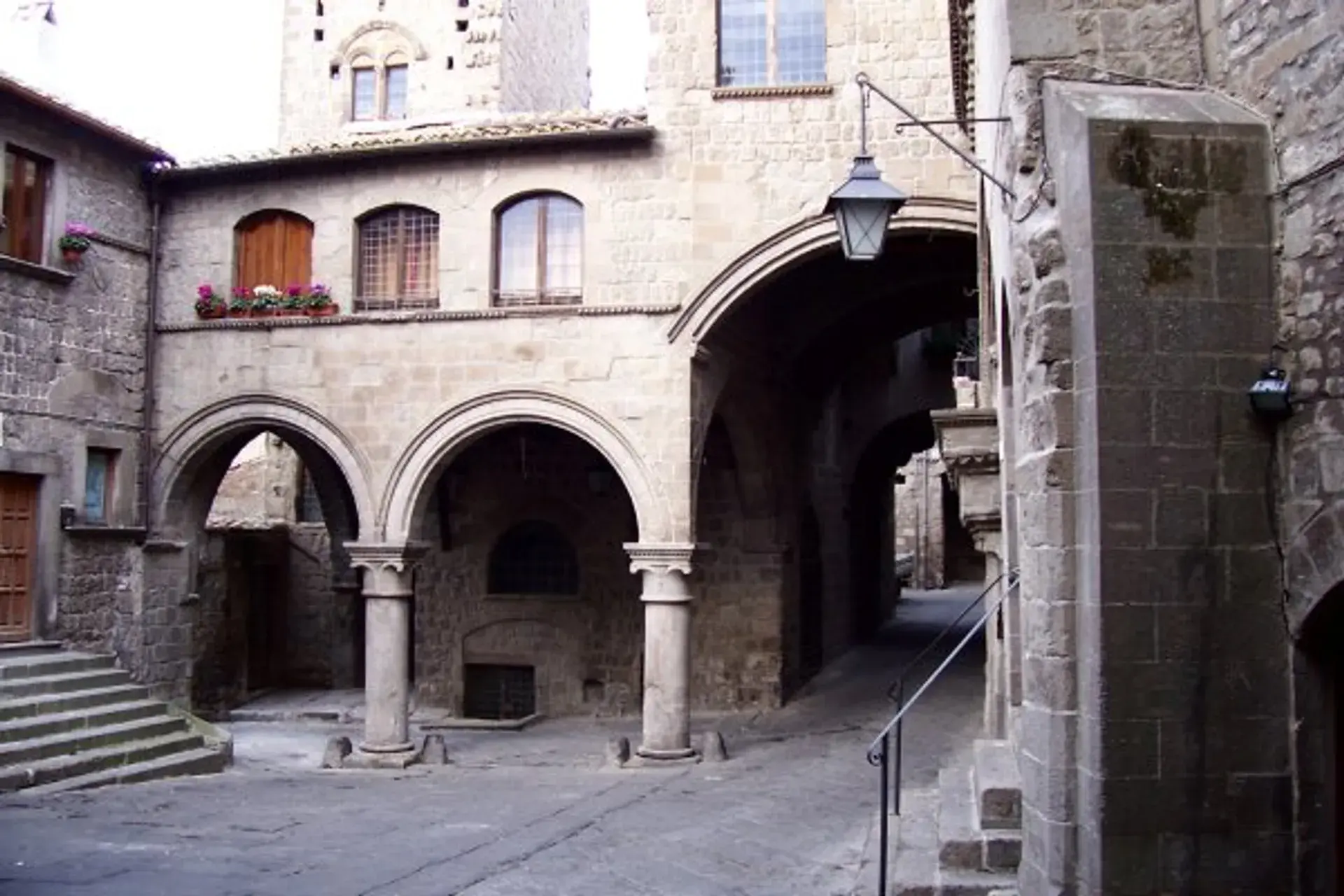
The buildings enclosing Piazza San Pellegrino are constructed almost entirely from peperino, a dark-grey volcanic tuff stone quarried locally. This material defines the quarter's somber aesthetic, absorbing daytime sunlight and casting sharp, deep shadows that cool the narrow streets in warmer months. Entering the pedestrian square creates a pronounced acoustic shift: modern traffic sounds vanish, replaced by footsteps echoing over basalt flagstones and water running from neighborhood fountains.
The square's dominant structure is the 13th-century Palazzo degli Alessandri, a multi-story patrician residence defined by a ground-floor portico with massive columns, broad arches, and carved family crests displaying the cross of Saint Andrew. Rising behind and around the palace complex are fortified structures such as Torre Scacciaricci and Torre Alessandri. These towers are remnants of a heavily fortified skyline; medieval chronicles indicate that Viterbo once held nearly 200 private family towers, of which approximately 40 remain standing across the city today.
Piazza San Pellegrino also preserves the classic vernacular features of Viterbo's medieval domestic architecture:
- Profferli: Exterior stone staircases leading directly from the street to the first-floor living quarters, allowing the ground floor to serve as workshops, storage rooms, or stables.
- Richiastri: Enclosed interior courtyards or lightwells that functioned as private domestic gardens for noble families.
- Case-ponte: Covered overhead bridges that span narrow alleyways to connect upper stories of facing buildings.
Palazzo degli Alessandri features a notable architectural variant of the local profferlo. While most Viterbo staircases project directly into the open street with an exposed stone parapet, the Alessandri staircase is set within a deep, recessed archway, creating a sheltered hybrid balcony.
The 1252 Papal Decree and Preservation
The San Pellegrino quarter expanded rapidly during the 12th and 13th centuries, a period when Viterbo operated as an independent commune and hosted the Papal Curia. Piazza San Pellegrino served as the fortified base of the Alessandri, an influential Guelph family loyal to the papacy. When opposing Ghibelline factions temporarily gained control of Viterbo and forced the Alessandri into exile, customary political warfare required the complete demolition of the family's urban palace.
In 1252, Pope Innocent IV intervened from Perugia, issuing an official decree that explicitly banned the destruction of Palazzo degli Alessandri and its fortified towers. This papal intervention represents one of the earliest documented preservation orders in medieval European history enacted to protect domestic architecture from political ruin.
Following the later departure of the papal court and the realignment of regional trade corridors, Viterbo experienced prolonged economic stagnation. As a result, the San Pellegrino quarter did not undergo the sweeping Renaissance or Baroque redesigns common in other Italian centers, locking its 13th-century urban layout in place. In 1927, a municipal restoration lowered the square's ground level, unearthing the original column bases of the Alessandri portico that had been buried beneath centuries of accumulated street pavement.
Chiesa di San Pellegrino and Urban Context
Facing the square is the Chiesa di San Pellegrino, a small church documented as early as 1045 under the authority of the Benedictine Abbey of Farfa. The building underwent modifications over the centuries, receiving a Neo-Gothic facade in 1889 before requiring structural reconstruction following bomb damage sustained during World War II.
Piazza San Pellegrino anchors the southern terminus of the historic walking axis that crosses central Viterbo, linking Piazza del Plebiscito and Piazza del Gesù toward the bridge leading to the medieval working-class neighborhood of Pianoscarano.
Contemporary Role
Piazza San Pellegrino remains a living, inhabited neighborhood rather than an open-air museum. Residents continue to climb medieval profferli to reach their private residences. Palazzo degli Alessandri is maintained under the ownership of the Provincial Administration of Viterbo, functioning as a venue for temporary art exhibitions, conferences, and cultural events.
The square serves as an essential waypoint for travelers and pilgrims journeying along the Via Francigena route. It also forms the central stage for the annual spring festival San Pellegrino in Fiore, during which the dark peperino staircases, archways, and basalt streets are covered in vibrant floral installations.
FAQ
Why did Piazza San Pellegrino retain its 13th-century appearance?
A 1252 decree by Pope Innocent IV prevented political rivals from demolishing Palazzo degli Alessandri. Subsequent economic stagnation and the departure of the papacy in the late Middle Ages halted large-scale Renaissance and Baroque redevelopment, leaving the medieval fabric intact.
What is a profferlo?
A profferlo is an external stone staircase unique to medieval domestic architecture in Viterbo. It leads directly from the street to the first-floor living space, preserving the ground floor for workshops, storage, or stables.
What is peperino stone?
Peperino is a dark-grey volcanic tuff stone quarried in the region around Viterbo. It forms the primary building material for the buildings, arches, towers, and staircases of Piazza San Pellegrino.
What is Palazzo degli Alessandri used for today?
Owned by the Provincial Administration of Viterbo, Palazzo degli Alessandri hosts temporary art exhibitions, conferences, and municipal cultural events.