Porta Romana: Historic Gateway to Viterbo
The Southern Threshold to the City of the Popes
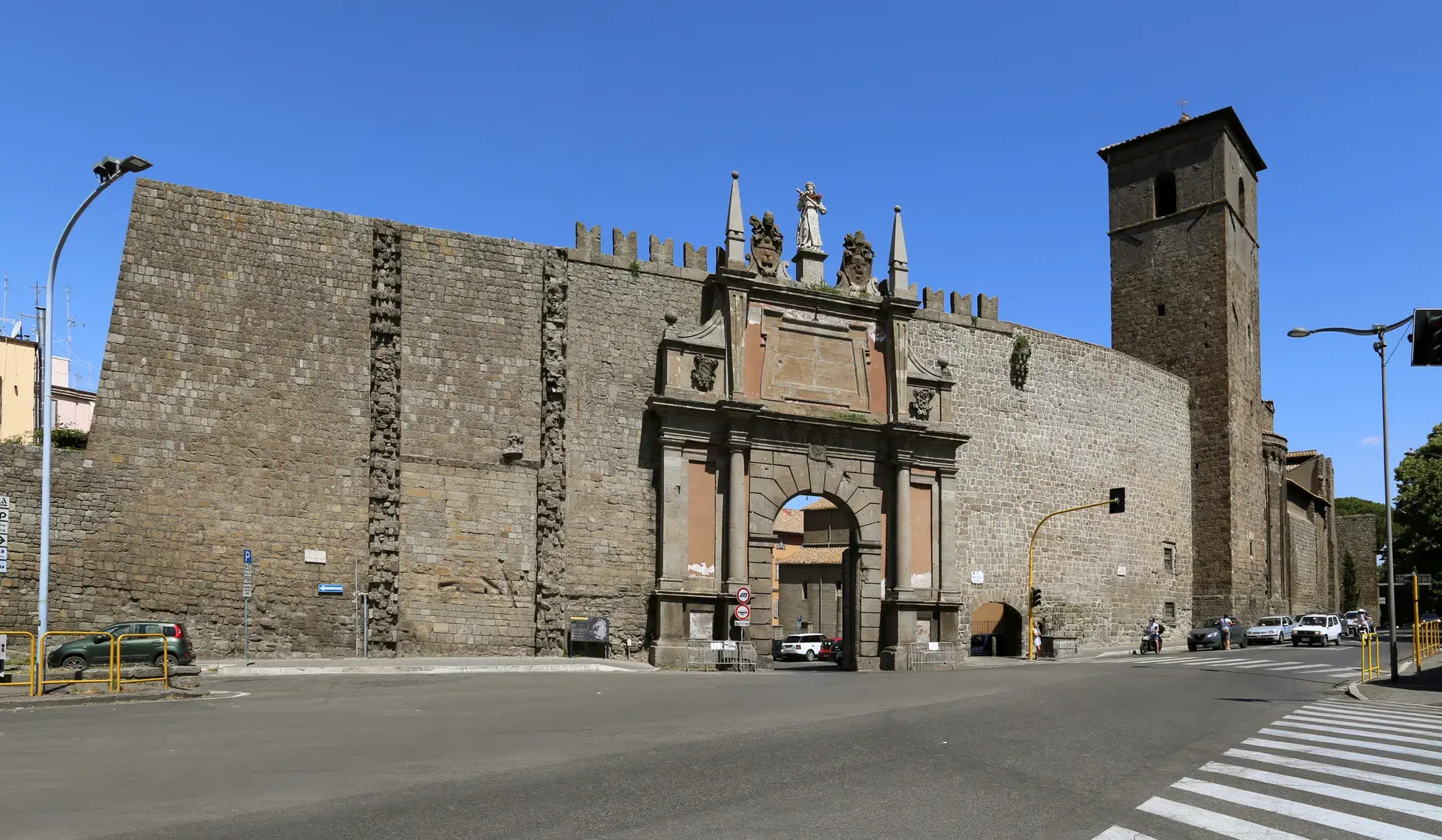
Porta Romana stands as the monumental southern gateway into Viterbo, marking the historical arrival point for travelers, pilgrims, and cardinals traveling from Rome along the Via Cassia and the Via Francigena. Built from a combination of local stone and volcanic tuff (tufo), the single-arch portal is integrated directly into the city's medieval defensive walls, which remain crowned with swallow-tail Ghibelline merlons.
The pale Baroque facade creates a dramatic visual contrast against the dark volcanic stone of the surrounding medieval masonry. Above the portal, the upper structure is accented by decorative scrolls, pinnacles, and heraldic emblems, providing an imposing visual entrance that marks the classic starting point for traversing Viterbo's sequence of historic quarters northward along Via Garibaldi.
Papal Ambition and Civic Pragmatism
The current monument replaced an earlier medieval gateway known as Porta di San Sisto, which originally passed directly under an adjacent defensive tower. That medieval tower still stands today, repurposed as the Romanesque bell tower of the neighboring Church of San Sisto.
Construction on the new gateway began between 1621 and 1649, designed by architect Francesco Maiolino with stonework executed by Paolo Pieruzzi and Bernardino Parenti. The heavy wooden doors were crafted by carpenter Francesco Minestrone of Vetralla. The gateway was officially inaugurated in October 1653 to honor the arrival of Pope Innocent X Pamphilj, who was visiting Viterbo and the nearby estate of his sister-in-law, Donna Olimpia Maidalchini.
To honor the visit, the city designated the portal Porta Innocenziana (as well as Porta Pamphilia), emblazoning the facade with the Pamphilj and Maidalchini arms alongside the civic crest of Viterbo. Later, during the papacy of Clement XI in 1705, provincial governor Marcellino Albergotti added Clement's coat of arms and commissioned the crowning stone statue of Saint Rose (Santa Rosa), the city's patron saint. Despite these papal and civic honors, local residents steadfastly ignored the official names, continuing to refer to the portal simply as Porta Romana due to its practical role as the road heading toward Rome.
Artillery Scars and Revolutionary Conflict
Beyond its heraldic and religious symbols, the stonework of Porta Romana bears physical records of military conflict. In December 1798, French revolutionary troops under the command of General François-Étienne Kellermann bombarded Viterbo's southern fortifications.
During the assault, artillery rounds and exploding shrapnel struck the gateway. Deep gouges and chipped edges remain visible across the pale Baroque moldings, pediment, and decorative stone reliefs, preserving a direct physical record of the late 18th-century bombardment.
Modern Civic Life and Traditions
Porta Romana remains an active vehicular and pedestrian artery, connecting the interior of the historic walled center with outer transit routes and the nearby Porta Romana railway station.
Directly inside the archway lies Piazza San Sisto, a public square that anchors one of the city's major cultural traditions. Every year on September 3, the square serves as the assembly and departure site for the procession of the Macchina di Santa Rosa. In this space, more than 100 porters (facchini) hoist an illuminated, 30-meter-tall tower to begin its transport through the darkened medieval streets of Viterbo.
FAQ
Why was the gate named Porta Romana despite official papal dedications?
Although formally inaugurated as Porta Innocenziana to honor Pope Innocent X Pamphilj, local residents persistently called it Porta Romana because it opened directly onto the road leading toward Rome along the ancient Via Cassia.
What caused the damage visible on the facade of Porta Romana?
The gouges and chipped stone across the Baroque moldings and pediment were caused by artillery fire and shrapnel during a December 1798 assault by French revolutionary forces commanded by General François-Étienne Kellermann.
What existed at the site before the Baroque gate was built?
The site was previously occupied by the medieval Porta di San Sisto, which routed travelers beneath a defensive tower. That medieval fortification now serves as the Romanesque bell tower for the Church of San Sisto.
What major annual event begins inside Porta Romana?
Piazza San Sisto, located immediately inside the gate, serves as the assembly and starting point for the annual September 3 procession of the Macchina di Santa Rosa, where a 30-meter illuminated tower is carried through the city by over 100 facchini.