Santa Maria Nuova, Viterbo: Romanesque Church Guide
The Civic Heart of Medieval Viterbo
Before the construction of the Palazzo dei Priori, Santa Maria Nuova operated as the civic and administrative center of medieval Viterbo. Documented as early as 1080 in a parchment recording a donation by a priest named Biterbo to the town and the Bishop of Tuscania, the church regularly accommodated popular assemblies (arenghi) and General Councils.
Beyond hosting public gatherings, the church presbytery was trusted to safeguard the commune's vital assets. Medieval authorities stored the city's iron cash chests, official archives, and the 1251 City Statutes within the building until 1574. Situated along the urban corridor of the Via Francigena, the complex was also established alongside a dedicated hospice to house traveling pilgrims on their way to Rome.
Romanesque Peperino Architecture
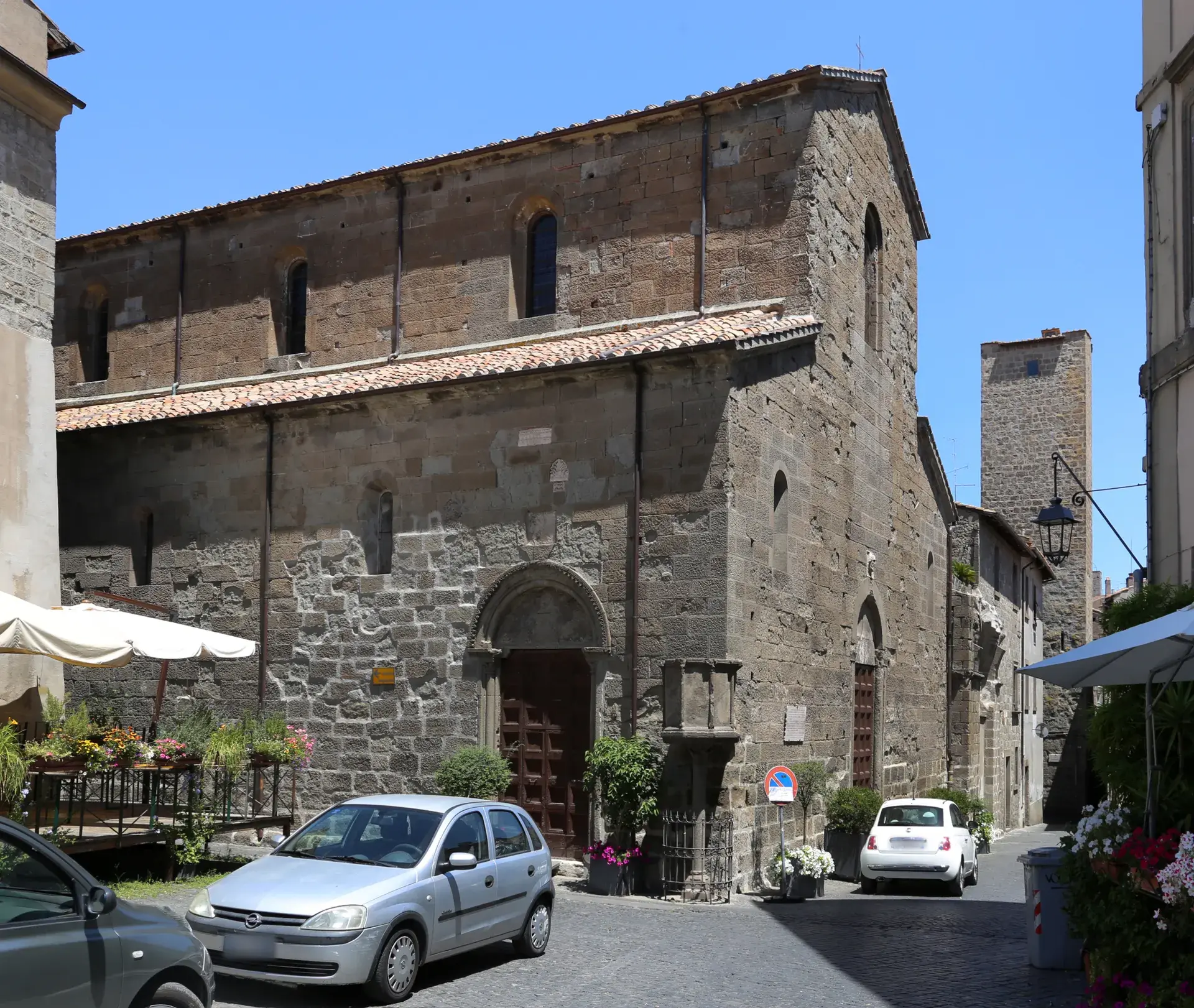
Santa Maria Nuova is constructed from grey volcanic peperino stone, standing as one of the oldest surviving Romanesque structures in Viterbo. The building follows a traditional three-aisled basilica layout concluding in three semicircular apses. Inside, the central nave is separated from the side aisles by two rows of stone columns, each crowned with distinctive medieval carved capitals.
Thick, unadorned peperino walls preserve a dim, cool interior lit by slender slit windows. Overhead, the ceiling displays timber framework lined with hundreds of 15th-century terracotta tiles (pianelle), painted in tempera with geometric motifs, floral patterns, and medieval guild heraldry. Extensive restorations between 1907 and 1914, followed by post-World War II bomb damage repairs, removed later Baroque additions to reveal the Romanesque stonework and patches of 13th- to 15th-century wall frescoes.
The Rediscovered Medieval Cloister
Directly behind the church's apse lies an archaic medieval cloister known as the Chiostro Longobardo. Characterized by early medieval column forms, the rectangular courtyard was slowly enveloped by residential housing over centuries of urban growth, vanishing from local awareness. It remained forgotten until 1954, when it was accidentally rediscovered and subsequently excavated over several decades to reveal its preserved colonnades.
Exterior Details and Guild Traditions
The exterior facade facing Piazza Santa Maria Nuova incorporates notable decorative fragments, including three narrow lancet windows and an ancient Roman marble bust mounted above the portal. Renaissance chronicler Annio da Viterbo alleged that this sculpted head represented Jupiter, promoting a local theory that the church had replaced a pagan temple.
Projecting from the front corner of the church is a small external stone pulpit. Local tradition identifies this platform as the site where theologian Saint Thomas Aquinas preached in 1266 or 1267 to arbitrate peace between Viterbo and the neighboring city of Orvieto. Inside, the church preserves a 13th-century triptych painted on leather-covered wood. According to civic legend, the chest containing this artwork was unearthed in 1283 after plow oxen knelt before the buried object, leading Viterbo’s Plowmen’s Guild (Arte dei Bifolchi) to establish their headquarters in the church.
Modern Status and Access
In 1567, a papal bull issued by Pope Pius V subordinated Santa Maria Nuova to Viterbo Cathedral. Today, the complex remains an active parish church within the Diocese of Viterbo, serving the joined parish of Santa Maria Nuova, San Pellegrino, and San Lorenzo. Positioned along the pedestrian route between Piazza del Plebiscito and the Colle del Duomo, the church welcomes visitors and pilgrims daily, with scheduled access provided for the adjacent cloister.
FAQ
What role did Santa Maria Nuova play in Viterbo's local government?
Before the Palazzo dei Priori was built, the church served as Viterbo's civic hall, hosting General Councils and public assemblies. It also housed the municipal archive, the 1251 City Statutes, and the city's financial treasury chests until 1574.
What is the Chiostro Longobardo?
The Chiostro Longobardo is an archaic medieval cloister located behind the apse of the church. It was completely surrounded and hidden by domestic residential buildings for centuries until its accidental rediscovery in 1954.
Did Saint Thomas Aquinas preach at Santa Maria Nuova?
Local tradition holds that Saint Thomas Aquinas preached from the small stone pulpit on the exterior corner of the church in 1266 or 1267 to mediate peace between Viterbo and Orvieto, though this event is rooted in traditional lore rather than contemporary civic records.