Palazzo Falson: Mdina's Medieval Townhouse Museum
A Medieval Survivor in Mdina
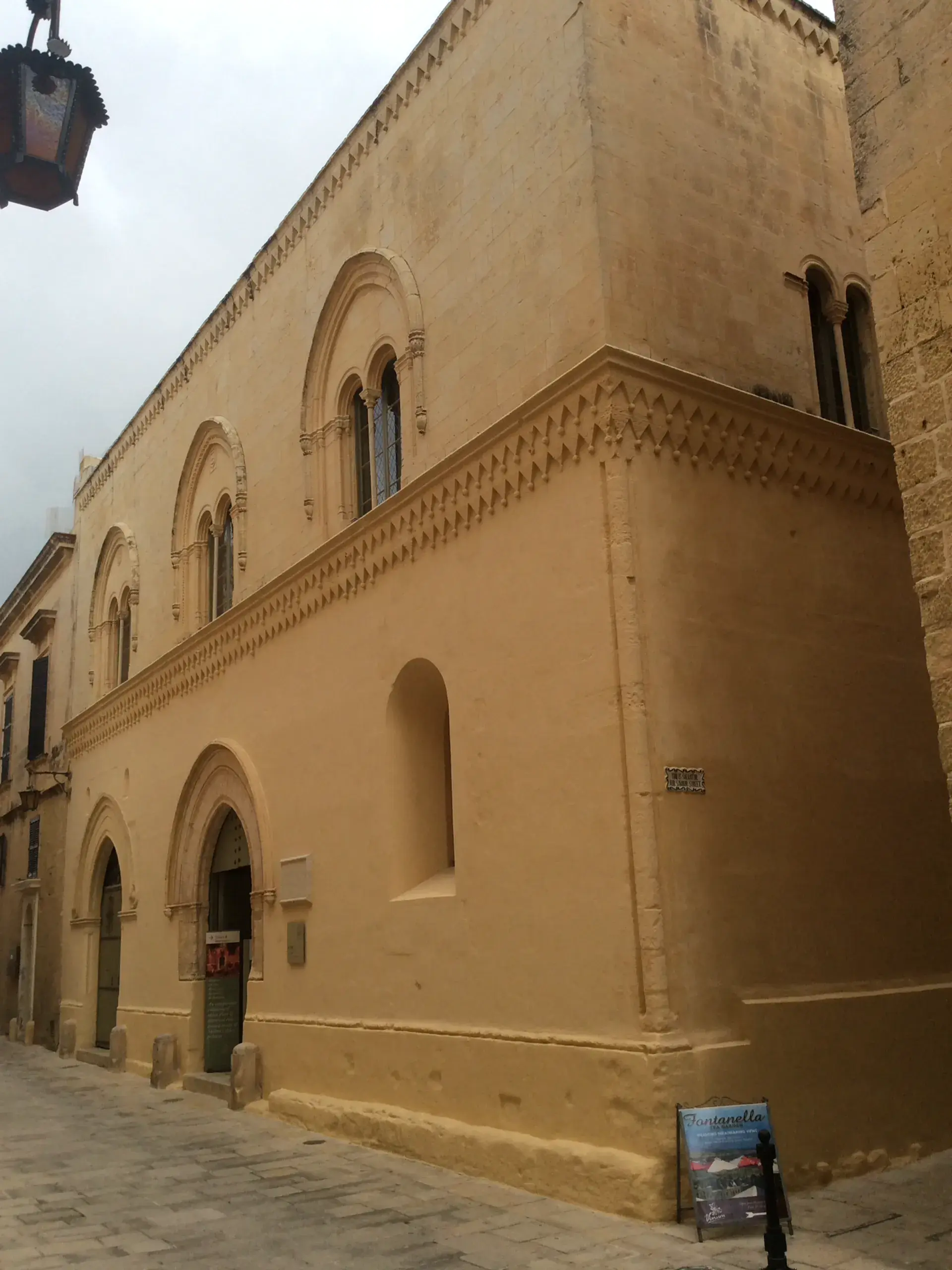
Standing along Villegaignon Street near Bastion Square, Palazzo Falson represents a rare secular domestic survivor from Malta's medieval era. While much of Mdina was rebuilt in the grand Baroque style following the catastrophic 1693 Sicily earthquake, Palazzo Falson survived largely intact. It remains the second-oldest standing building in the ancient walled city, with its earliest ground-floor construction dating to roughly 1240.
The structure exhibits the Siculo-Norman and Siculo-Renaissance vernacular styles that defined medieval aristocratic residences in Malta. The limestone facade features double-light mullioned Arabesque windows (bifora) on the upper level and a distinctive double-serrated string course. Past the entrance, the street noise and heat transition into a cool, shaded interior courtyard centered around a carved stone fountain.
Centuries of Noble History
Palazzo Falson rests on the site of "La Rocca," an Arab-period defensive bastion dating between 870 and 1091. Throughout the medieval and early modern periods, the property evolved through several expansions, including major structural modifications around 1495 and the addition of a second floor in the 16th century by the noble Falsone family, whose members included Ambrosio and Vice-Admiral Michele de Falsone.
In 1574, the home was thrust into religious turmoil when its owner, Matteo Falson, fled to Sicily to evade charges of Lutheranism brought by the Roman Inquisition. The property was subsequently confiscated and divided among the Grand Master, the Bishop, and the Inquisitor. Over the centuries, it became known under various names, including Palazzo Cumbo-Navarra and Casa dei Castelletti.
The Gollcher Legacy and Collections
The building took on its modern character in the 20th century through Captain Olof Frederick Gollcher OBE (1889–1962), a Maltese-Swedish artist, British Army officer, and antiquarian. Gollcher purchased the property in stages in 1927 and 1938, dubbing it "The Norman House." He transformed the residence into a personal repository of culture, amassing more than 40 distinct collections.
Gollcher also introduced his own historicist architectural alterations, incorporating retro-medieval and Renaissance-style details. These additions include an external stone staircase in the courtyard, a faux Siculo-Norman fountain, and an interior fireplace carved with the date "1531."
Rare Horology and Hidden Galleons
Among the museum's decorative arts, two curiosities stand out for their historical rarity. The first is a 10-hour pocket watch crafted around 1797 by Robert Robin, royal watchmaker to King Louis XVI. Designed during the French Revolution's short-lived experiment with decimal time—which divided the day into 10 hours of 100 minutes—the timepiece is one of only three known surviving decimal watches made by Robin.
The second curiosity came to light during an extensive five-year conservation project carried out between 2001 and 2007. As conservators stripped away damaged interior wall plaster, they uncovered 15th-century maritime graffiti scratched directly into the limestone blocks, preserving delicate drawings of contemporary galleons made by early inhabitants.
Visiting the Palazzo Falson Historic House Museum
Following Gollcher's death in 1962, his will established The Captain O.F. Gollcher OBE Art & Archaeological Foundation. Today, the property operates as the Palazzo Falson Historic House Museum, managed by Fondazzjoni Patrimonju Malti.
The museum spans 17 fully furnished exhibition rooms displaying Gollcher's collections of arms, armour, silver, rare manuscripts, oriental rugs, ceramics, and fine art. Alongside the permanent exhibition spaces, Palazzo Falson hosts archival research facilities, educational workshops, and temporary exhibitions, with a rooftop venue, Gustav Café, overlooking the rooftops of Mdina.
FAQ
How old is Palazzo Falson?
Palazzo Falson is the second-oldest standing building in Mdina. Its earliest ground-floor structure dates to around 1240, with major updates occurring around 1495 and a second storey added in the 16th century.
Who was Captain Olof Frederick Gollcher?
Captain Olof Frederick Gollcher OBE was a Maltese-Swedish artist, collector, and British Army officer who bought the palace in the early 20th century and assembled more than 40 collections of art, weapons, and antiques.
What makes the Robert Robin watch in the museum unique?
Crafted around 1797 by the French royal watchmaker Robert Robin, it was built for the French Revolutionary decimal time system that divided days into 10 hours of 100 minutes. It is one of only three known surviving decimal watches produced by Robin.
When is Palazzo Falson open to visitors?
Palazzo Falson operates as a historic house museum and is open to the public Tuesday through Sunday.