Collegiate Church of Saint Mary: Kotor's Ancient Shrine
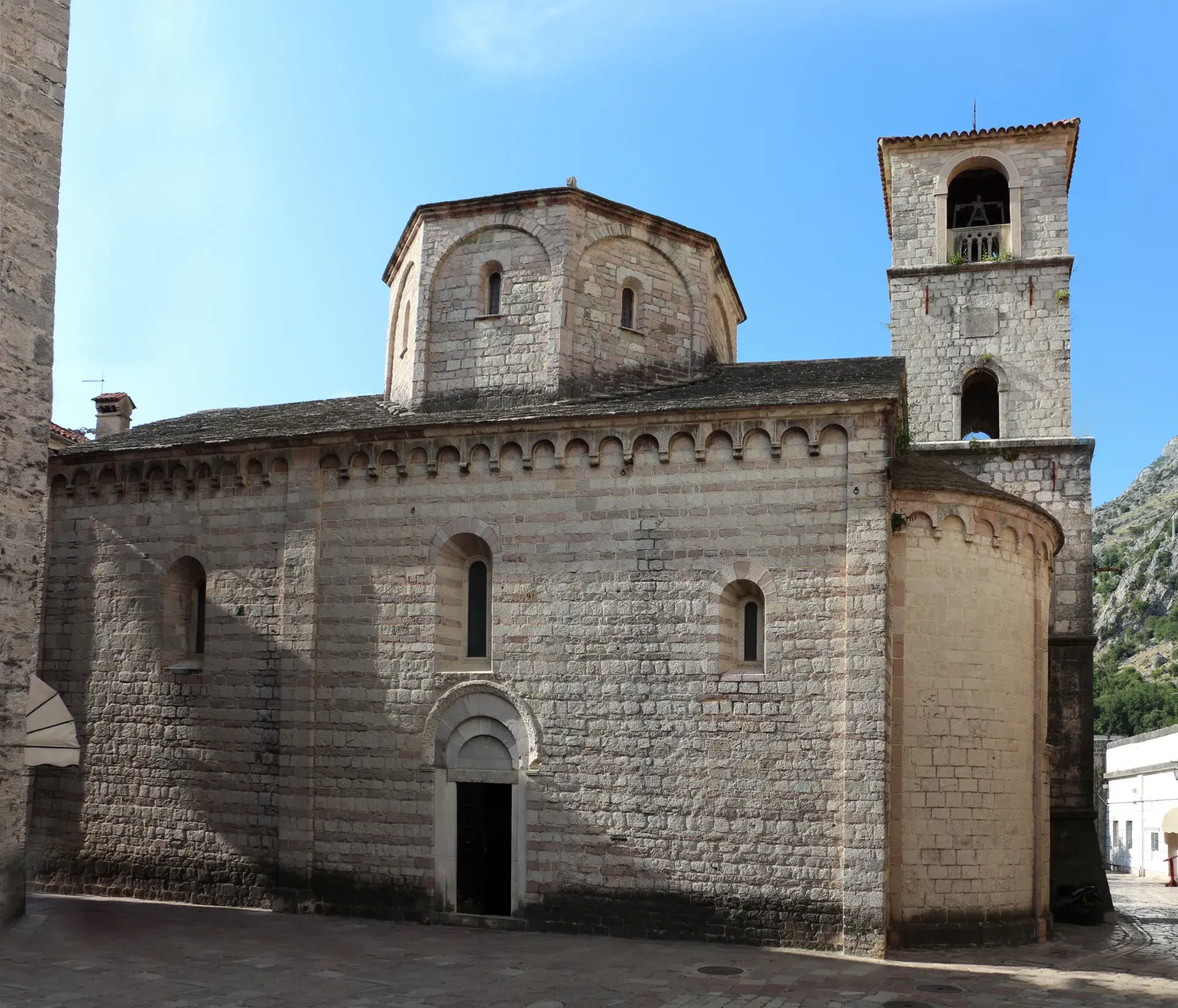
Located on Trg od Drva square near the River Gate in Kotor's Old Town, the Collegiate Church of Saint Mary is a significant Roman Catholic monument. Also known as St. Mary of the River, the current Romanesque structure was consecrated in 1221, but its history stretches back much further, standing on the foundations of a 6th-century basilica.
Architectural History
The church showcases a blend of architectural styles accumulated over centuries. The main building is a Romanesque structure, distinguished by its facade of alternating pink and grey stone rows. Its design, featuring a segmental dome on pendentives, reflects Byzantine-Romanesque-Serbian influences.
Over time, several additions were made. A chapel dedicated to Saint John the Baptist was added in the 15th century, and the current bell tower is a later Baroque addition from the 18th century. The church also underwent significant structural changes following the devastating 1667 earthquake, which included connecting the north nave to the main church body.
Ancient Christian Origins
Archaeological research beneath the current building has revealed the remains of an Early Christian basilica from the 6th century. The discovery of a baptistery within these ancient foundations suggests that this site may have served as Kotor's very first cathedral, predating the more famous Cathedral of Saint Tryphon. This places the Church of Saint Mary on a site of continuous Christian worship for over a millennium.
The Sanctuary of Blessed Ozana
The church is a major pilgrimage site due to its connection with Blessed Ozana of Kotor (1493–1565). Born into an Orthodox family, she converted to Catholicism and became a Dominican anchoress, living a life of prayer and seclusion in a cell attached to the church. Revered as a protector of the city, her counsel was sought by the people of Kotor during times of conflict. Her incorrupt body, originally kept in the Church of Saint Paul, was transferred to Saint Mary's in 1807 and is now preserved in a glass sarcophagus for veneration.
Art and Artifacts
Inside, the church holds several artistic treasures. Fragments of 14th-century medieval frescoes, some attributed to Greek artists, are still visible. These frescoes bear inscriptions in Latin, Cyrillic, and Greek, showing Byzantine Paleologian influences. A more modern, yet striking, feature is the set of bronze entrance doors. Added in the 20th century, these doors feature detailed bas-reliefs depicting scenes from the life of Blessed Ozana. The church also operates a museum displaying a collection of medieval and Renaissance religious artifacts, accessible for a fee.
FAQ
What is the Collegiate Church of Saint Mary in Kotor best known for?
The church is most famous for housing the incorrupt body of Blessed Ozana of Kotor (1493–1565) in a glass sarcophagus. It is also known for its 1221 Romanesque architecture and for being built on the foundations of a 6th-century basilica.
Who was Blessed Ozana of Kotor?
Blessed Ozana was a Dominican anchoress who lived a life of seclusion and prayer in a cell attached to the church. Born Orthodox, she converted to Catholicism and became revered as a protector of the city. Her body was moved to the church in 1807.
How old is the Church of Saint Mary?
The current Romanesque church was consecrated in 1221. However, it is built upon the foundations of an Early Christian basilica that dates to the 6th century, making the site a place of worship for over 1,500 years.
Was this church Kotor's first cathedral?
Archaeological evidence, including the discovery of an ancient baptistery beneath the current structure, suggests that the site of the Collegiate Church of Saint Mary may have been the location of Kotor's original cathedral.