Beurs Rotterdam: History & Architecture of the WTC
Used for a single day before war erupted, the resilient Beurs trade hall stood firm through the devastation of the Rotterdam Blitz. Today, it serves as the literal foundation for Rotterdam's modern skyline and an anchor of the city's commercial core on Coolsingel.
A Modernist Foundation and a Single Day of Trade
The Beurs was born from an early 20th-century plan by Mayor Zimmerman to transform the Coolsingel canal into a grand civic boulevard. Designed by architect Jan Frederik Staal in the Nieuwe Bouwen modernist style, the structure was built between 1936 and 1940. Its interior elements were crafted by Margaret Staal-Kropholler.
The original Beurs complex held its very first trading session on May 9, 1940. This operational debut lasted exactly one day before the German invasion of the Netherlands halted operations. Five days later, on May 14, the newly completed structure took seven direct bomb hits during the devastating Rotterdam Blitz. Despite the destruction that leveled the surrounding historic city, the Beurs remained largely intact. It was swiftly repaired and formally reopened for trade in 1941.
Striking Architectural Evolution
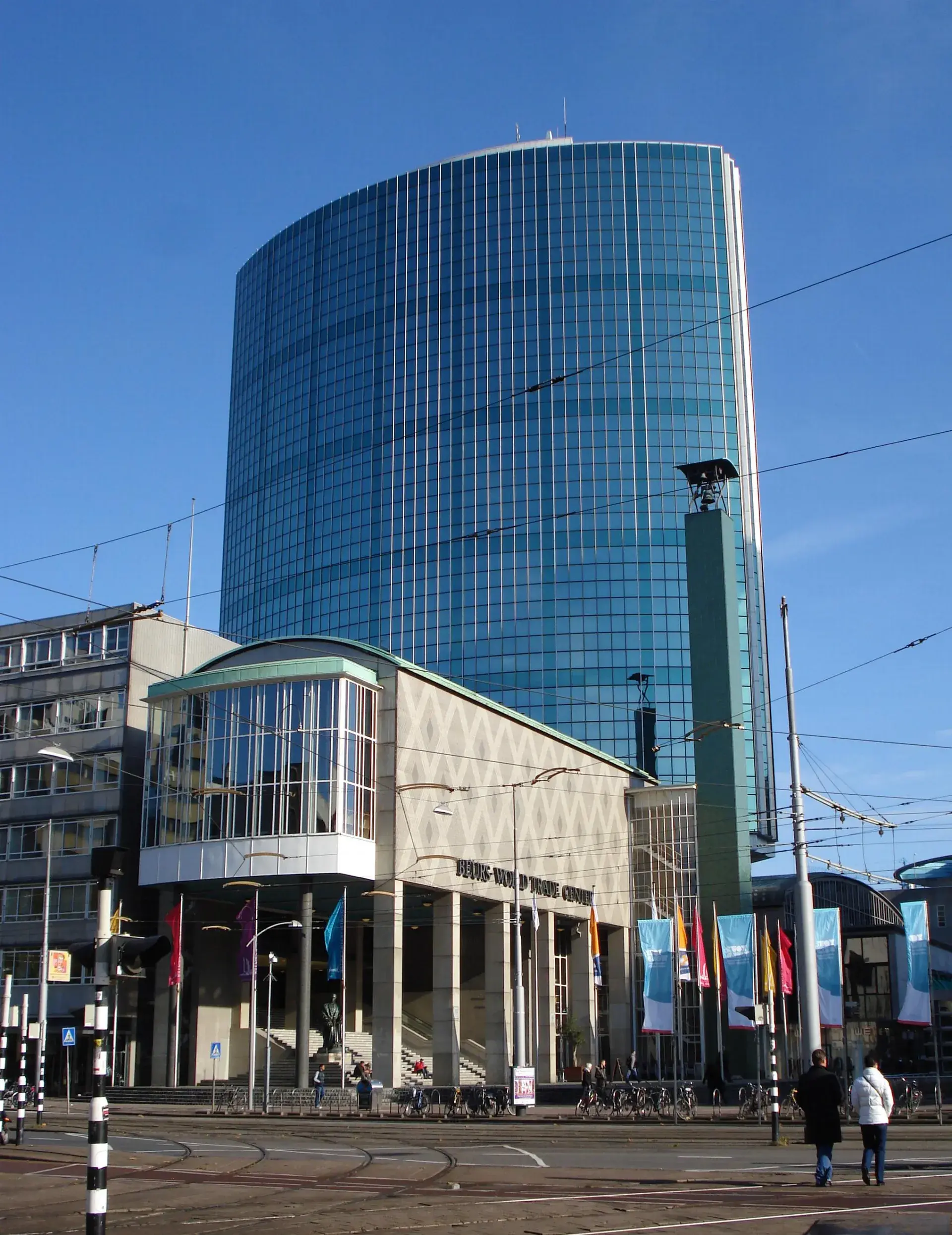
The building features a stark visual and textural contrast that chronicles Rotterdam's post-war commercial growth. The original 1940 structure serves as a low, planar brick-and-concrete base. As commercial demand grew, Arthur Staal, son of the original architect, added an additional floor to this low-rise base in 1973.
Between 1984 and 1987, the complex underwent a dramatic transformation. A 93-meter-tall, sea-green elliptical glass tower designed by architect Rob van Erk was engineered to rise directly above the original exchange hall. Queen Beatrix officially inaugurated the expanded complex as the Beurs-World Trade Center in 1987.
Art and Monuments at the Beurs
The building is approached via a monumental outdoor granite staircase supported by six reinforced concrete columns leading up from Coolsingel. A bronze monument depicting Rotterdam statesman Gijsbert Karel van Hogendorp stands prominently on these stairs.
Inside the central hall, visitors can find a bronze statue of Mercury, the Roman god of commerce. This statue was salvaged from the ruins of Rotterdam's 19th-century exchange, which was destroyed during the 1940 bombardment.
The Modern World Trade Center Rotterdam
Today, the Beurs operates as the World Trade Center Rotterdam (WTC). It is a bustling commercial hub containing approximately 200 offices, retail spaces, and conference facilities. The upper floors of the low-rise complex house the Postillion Hotel, while the building also accommodates the WTC Rotterdam Art Gallery.
Standing as a rare survivor of the 1940 bombing, the building anchors Rotterdam's post-war rebuilding philosophy of innovating rather than replicating the past. It sits adjacent to the busy Beurs metro station along Coolsingel, a ceremonial spine that serves as a gathering place for major civic events, including the Rotterdam Marathon finish line and Feyenoord championship celebrations.
FAQ
What is the Beurs in Rotterdam used for today?
Today, the Beurs operates as the World Trade Center Rotterdam (WTC). It houses approximately 200 offices, retail spaces, conference facilities, the Postillion Hotel, and the WTC Rotterdam Art Gallery.
Did the Beurs survive the Rotterdam Blitz?
Yes. The Beurs took seven direct bomb hits during the Rotterdam Blitz on May 14, 1940. However, the structure remained largely intact, was swiftly repaired, and reopened for trade in 1941.
Who designed the Beurs in Rotterdam?
The original low-rise building was designed by Jan Frederik Staal in the Nieuwe Bouwen modernist style, with interiors by Margaret Staal-Kropholler. The 93-meter glass tower added in the 1980s was designed by Rob van Erk.