Rotterdam Memorial to the Fallen 1940-1945
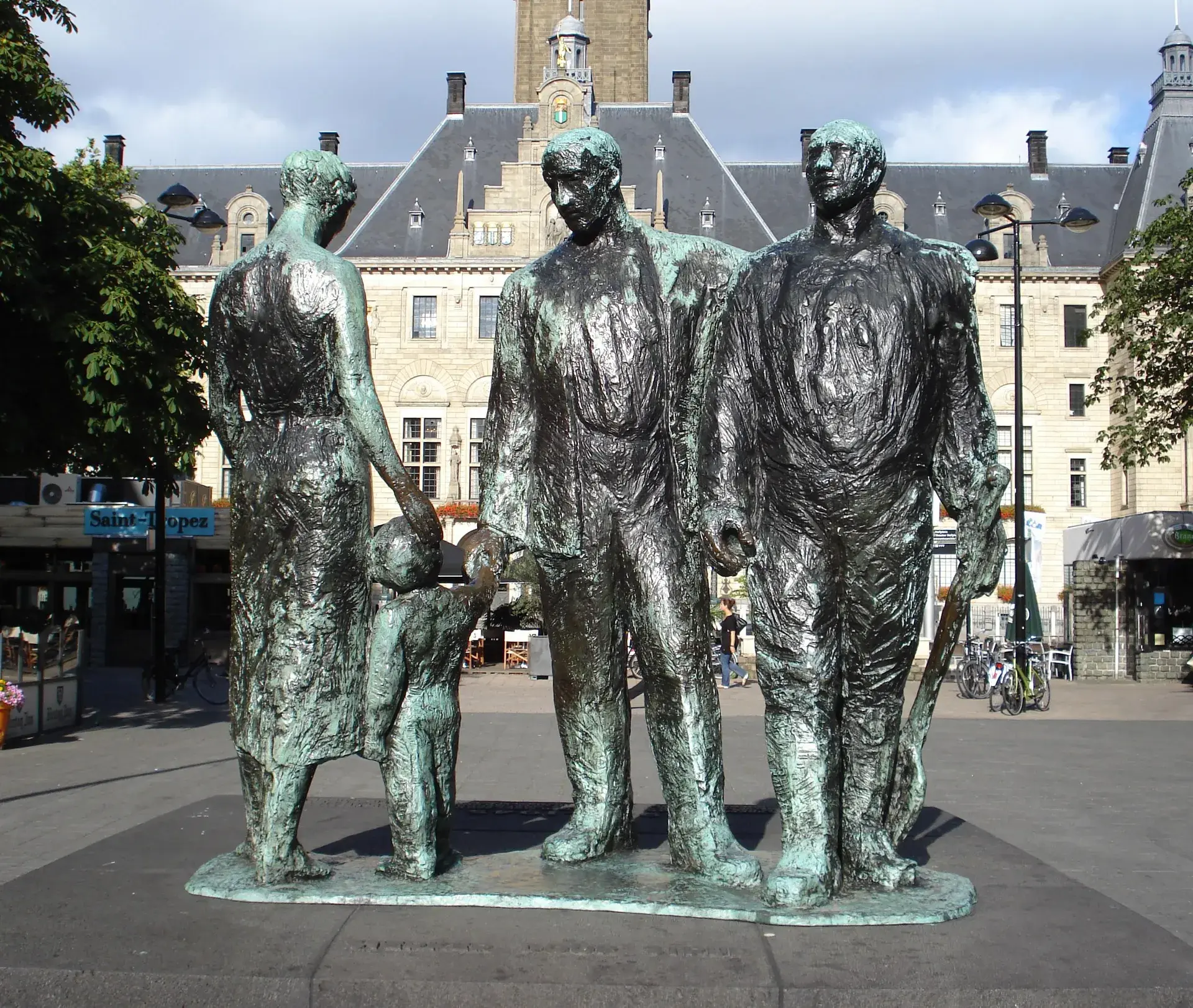
Reflect before this solemn memorial on Stadhuisplein honoring the lives lost during the turbulent war years of 1940 to 1945. Standing between one of the few surviving historic buildings and a postwar promenade, four bronze figures capture the exact moment a city turned its grief into a new future.
A City Transformed by War
The Memorial to the Fallen 1940-1945 (Monument voor alle gevallenen 1940–1945) marks a defining tragedy in Rotterdam's history. On May 14, 1940, at approximately 1:30 PM, German Luftwaffe bombers struck the city. In just fifteen minutes, high-explosive and incendiary bombs decimated the medieval core, claiming an estimated 850 to 900 lives and leaving roughly 80,000 residents homeless.
This catastrophic event completely altered Rotterdam's architectural destiny, steering the city away from historic reconstruction and toward experimental modernism. Today, the geographic boundary of that afternoon's fire zone is permanently mapped into the modern city pavement across central Rotterdam via illuminated markers known as the Brandgrens.
Creation and Symbolism
Immediately following liberation in May 1945, a municipal committee sought to establish a central civic monument. After an initial design competition yielded no winner, the commission was awarded to Dutch sculptor Mari Andriessen in 1953. Princess Wilhelmina officially unveiled the completed work on May 4, 1957.
The monument consists of a 3.2-meter-tall bronze figurative group on a light-colored granite base. Andriessen designed four life-sized figures to embody the past, present, and future. A grieving woman represents the tragedy of the past, while a child signifies emergent life and rebirth. A central man connects the figures by consoling the woman, and a standing man holding a spade symbolizes civic resilience and postwar reconstruction. Interestingly, Andriessen originally designed the memorial with only three figures, adding the child late in the modeling process to introduce the theme of the next generation.
Civic Context and Remembrance
The memorial sits on Stadhuisplein, an active pedestrian plaza lined with outdoor cafes. Its location provides a stark visual contrast between the heavy limestone facade of the 1920 City Hall—one of the few central buildings to survive the bombardment—and the modern concrete-and-glass grid of the 1950s Lijnbaan.
The monument bears two significant inscriptions. The front displays Rotterdam's motto, 'Sterker door strijd' (Stronger through struggle), granted by Queen Wilhelmina in 1948. The rear features a poem written specifically for the memorial by Dutch poet Clara Eggink.
Within Rotterdam's civic art collection, this monument forms a thematic trilogy on war and resistance alongside Ossip Zadkine's 'De Verwoeste Stad' and Hubert van Lith's 'Ongebroken Verzet.' Today, the Memorial to the Fallen serves as the official focal point for Rotterdam's annual National Remembrance Day ceremony every May 4.
FAQ
Who created the Memorial to the Fallen 1940-1945 in Rotterdam?
The memorial was created by Dutch sculptor Mari Andriessen. It was commissioned in 1953 and officially unveiled by Princess Wilhelmina on May 4, 1957.
What do the four figures on the monument symbolize?
The four bronze figures represent different stages of the city's journey. A grieving woman represents the past, a child signifies rebirth, a central man offers connection, and a standing man with a spade embodies postwar reconstruction.
Where is the Memorial to the Fallen 1940-1945 located?
The memorial is located on Stadhuisplein in central Rotterdam, positioned directly between the historic 1920 City Hall and the modern Lijnbaan pedestrian promenade.